
The Crucible of Self: Dreams of Conformity and Individuality
The Somatic Echo
Before the dream forms, the body knows. It is a pressure in the chest, a subtle constriction of the ribs as if bound by invisible filaments. The breath feels shallow, borrowed, as if you are breathing air that belongs to someone else’s atmosphere. There is a low-grade hum in the jaw, a readiness to smile a smile you do not feel, or to swallow words that taste of metal and truth. In the hands, a phantom sensation—the weight of a mask, cool and smooth against the skin, or the ghostly imprint of a uniform you have never willingly worn. This is the somatic ground from which the dream of conformity versus individuality grows: a deep, cellular memory of compression, and a subterranean tremor of something straining to break its own shell.
The Dreamer's Log
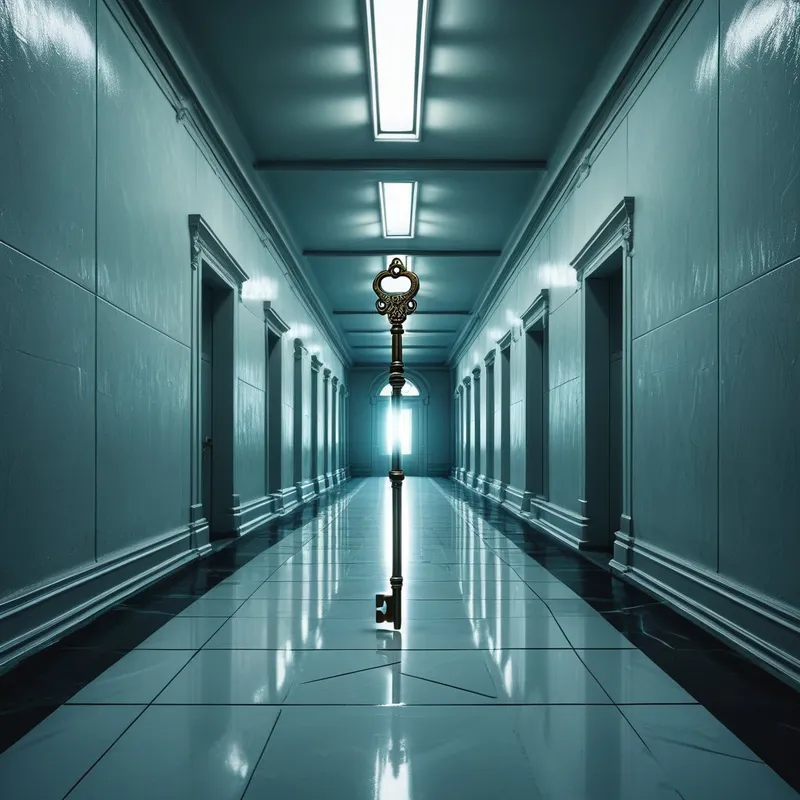
I am walking down an endless, sterile white hallway. The walls are seamless, the floor polished to a mirror sheen. Everyone walks in perfect, silent unison, their faces smooth and placid. I look down and see I am holding a heavy, ornate brass key. I know, with absolute certainty, that it opens a door that is mine alone. But if I stop to use it, I will break the rhythm of the march and be seen.
Alchemical Interpretation: The key is the nascent, authentic self, and the hallway is the internalized pressure of the collective; the dream stages the terrifying moment of choice between carrying your truth and using it.
The False Lead
This theme is not about mere social awkwardness or the simple desire to be different. It is not a call to blind rebellion or a glorification of eccentricity for its own sake. The tension here is far more profound than choosing a unique fashion or an unconventional hobby. It is the soul’s confrontation with the foundational architecture of its own being—the parts built by others for belonging, and the parts that are your irreducible essence. Misinterpreting this as a call to merely "stand out" is to remain in the shadow of the conflict, performing individuality rather than embodying it. The true shift is structural, not cosmetic.
Psychological Architecture
Beneath the dream’s narrative lies the deep work of Individuation—the Jungian process of becoming the undivided, unique being you are meant to be. This is not an act of creation, but of excavation. We are born whole, but we learn to fragment. The "conformist" in the dream is often an internal family of exiles: the Pleaser, the Good Child, the Loyal Soldier. These are psychic parts that formed under the heat of early needs—for love, safety, acceptance. They built a citadel of manners and masks, a fortress of "should" and "must." The dream of individuality is the Self, the core consciousness, beginning to send emissaries into this fortress. It is the slow, often painful, reclamation of disowned territories: your anger, your weirdness, your quiet passions, your unpopular truths. The hallway must be left, the rhythm broken, not to destroy the citadel, but to discover it was never a home—only a waiting room.
Mythic Resonance
We see this eternal drama in the story of The Ugly Duckling. The cygnet, surrounded by ducks, internalizes their verdict—you are ugly, you are wrong, you do not belong. Its suffering is not in being different, but in believing its essence is a flaw. The long migration of misery is the soul’s journey through the false self. The transformation is not the swan becoming beautiful; it is the moment it sees its own reflection in the water and recognizes, for the first time, what it has always been. The myth is not about becoming superior, but about coming home to your own nature. Similarly, in Prometheus, we see the ultimate archetype of individuation against divine conformity: stealing the fire of creative consciousness (self-knowledge, innovation) from the gods of established order, knowing the price will be eternal torment. The dreamer holding the key is Prometheus in the hallway, weighing the cost of the divine theft of one’s own soul.
Symbolic Nodes
- Uniforms, Masks, Identical Crowds: The psyche’s representation of the collective persona.
- Lost or Forgotten Objects (Keys, Names, Maps): The authentic self, misplaced or dormant.
- Malfunctioning or Unique Tools in Standard Settings: Your innate gifts feeling useless or disruptive within internalized systems.
- Doors/Walls that Only You Can See: The threshold of personal potential invisible to the conforming mind.
- Being Muted, Silenced, or Speaking an Unknown Language: The struggle to articulate the self’s truth.
- Altered or Transforming in a Static Environment: The nascent feeling of metamorphosis.
Archetypal Resonance
The core energy of this theme resonates most powerfully with The Rebel Archetype. Not its shadow of wanton destruction, but its pure form: the sacred destroyer of outworn structures, the revolutionary of the soul.
This archetype’s energy is the very somatic echo of the theme—the tension in the chest is its pressure, the tremor in the hands its readiness to dismantle the internal prison. The Rebel does not rebel for chaos, but for authenticity; its target is never the other, but the inner tyrant, the ghost of "the way things are done." In the alchemical vessel of the dream, the Rebel provides the necessary heat and friction to dissolve the calcified layers of the false self. It is the force that finally turns the key, breaks the rhythm, and accepts the terrifying, liberating gaze of the swan upon its own reflection. Its gift is not rebellion, but sovereignty.
The Alchemical Process
The transmutation here is from Lead—the heavy, inert weight of the adapted self—into Gold—the luminous, authentic essence. The required heat is the conscious endurance of existential exposure. This is the Nigredo, the blackening: the feeling of being naked, absurd, or perilously alone as old masks crack. The pressure is the sustained tension between the longing to belong and the imperative to be. You must hold both truths in the same psychic space without fleeing into either pole. The Albedo, the whitening, is the moment of clarity, the "I am that" recognition (like the swan at the water). The final Rubedo, the reddening, is not a one-time achievement but the ongoing practice of embodying your truth in a world that may not have a template for it. The gold is not a static state of "individuality," but the dynamic, flowing integrity of a self that is both unique and connected, having passed through the fire of its own alienation.
The Integration Protocol
Question 1: Where in my waking life do I feel the most palpable sense of that "sterile hallway"—the pressure to smooth my edges, silence my thoughts, or match a rhythm that is not my own?
Question 2: What is the "ornate key" I am carrying? What unique knowledge, perspective, or deep desire do I possess that feels meant for me, yet I hesitate to "use" for fear of breaking step?
Question 3: If the conformist crowd in my dream is an internal family, what are they afraid would happen if I stopped marching? What catastrophe are they trying to prevent by enforcing this uniformity?
Action 1 (Somatic Reclamation): For one minute, stand or sit and deliberately breathe in a rhythm that feels authentically yours—not too deep, not too shallow, just yours. Feel where that natural rhythm wants to move your body—a slight sway, a tilt of the head. Do not perform. Simply inhabit your own breath's pattern.
Action 2 (Creative Excavation): Without planning, draw two abstract shapes on one page. Let one represent the feeling of "the hallway" (conformity pressure). Let the other represent the feeling of "the key" (authentic impulse). Use only color, line, and form. Then, in unstructured writing, have the "key" shape speak to the "hallway" shape. Do not censor.
Action 3 (Ritual of Declaration): Choose one small, authentic preference you normally override for the sake of ease or invisibility (e.g., your true opinion on a trivial matter, your genuine food craving, your desire for silence over noise). Today, honor it outwardly with full, quiet consciousness. Note the internal echoes before, during, and after.
Final Validation
This tension is one of the most profound and disorienting the soul can navigate. To feel the ache of the herd and the call of the horizon simultaneously is not a sign of failure, but of depth. The loneliness is real. The fear of exile is primal. Honor the part of you that built the masks—it was trying to keep you safe. And now, listen, with equal reverence, to the deeper part that knows the mask is beginning to suffocate. The integration is not about destroying the old group, but about founding a new, inner council where every part of you—the conformist and the rebel, the swan and the duckling—finally gets a seat and a voice. The sovereignty you seek is not over a kingdom, but over the wholeness of your own being.