
The Alchemy of Inner War: When Dreams Demand Negotiation
The Somatic Echo
It begins not with a thought, but a tremor. A clenched jaw upon waking, the ghost of a snarl. A stomach knotted into a sailor’s fist. A heart that hammers not with passion, but with the after-echo of a standoff. This is the somatic signature of the conflict dream—a civil war written in the language of muscle and nerve. The body remembers the tension long before the mind can narrate the battle. It is the felt sense of a system divided against itself, a kingdom where the governors are in revolt. You are left not with a story, but with the raw, physiological residue of a negotiation that failed to conclude, a treaty left unsigned in the chambers of your sleep.
The Dreamer's Log
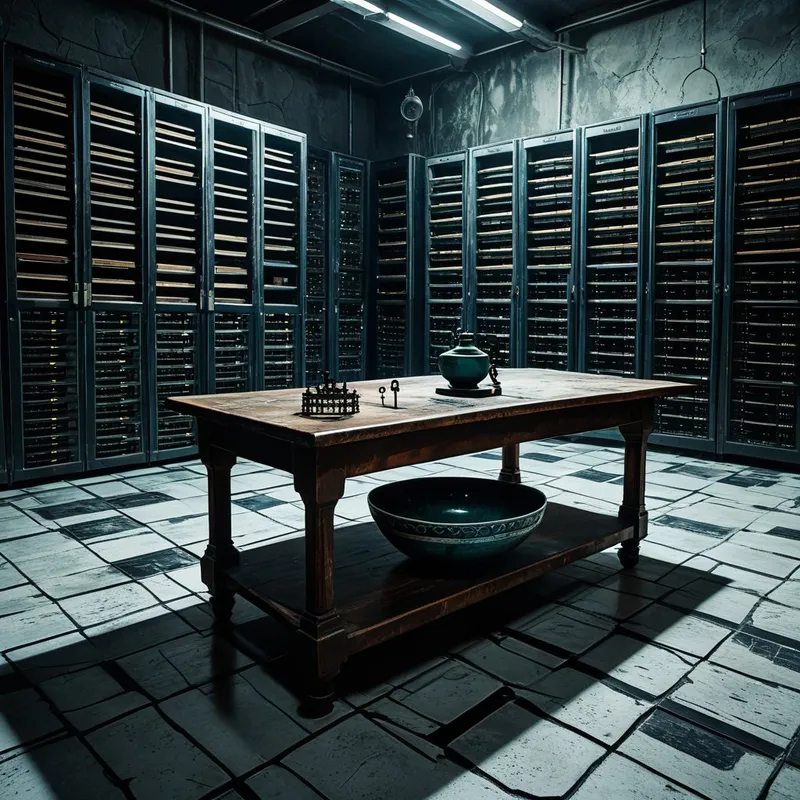
The dreamer finds themselves in a vast, derelict data center. They stand before a fractured console, its screen glitching between two irreconcilable sets of commands. From the shadowed server racks, a cold, logical voice demands absolute efficiency, the purging of "corrupted files." From a small, warm hearth inexplicably glowing in the corner, a softer voice pleads for preservation, for the old, sentimental data. The dreamer’s task is to broker a peace, but their hands hover, unable to input a single keystroke.
This is the alchemical moment: the conscious self, paralyzed at the interface, witnessing the fundamental schism between the ruthless modernizer and the nostalgic archivist within.
The False Lead
This theme is not a simple prophecy of external fights or bad luck arriving at your door. To interpret a dream of conflict as merely a warning of an upcoming argument is to mistake the map for the territory. The dream is not forecasting a storm in the outer world; it is reporting a weather system already active within your inner atmosphere. The tension you feel is not a premonition, but a present fact. The negotiation required is not with a spouse, a boss, or a foe, but with the exiled factions of your own psyche that have declared sovereignty over your choices, your emotions, your very life energy.
Psychological Architecture
Here lies the deep shadow work. Conflict in dreams exposes the fault lines in your personal mythology. It reveals where a once-useful survival strategy—the inner Critic that pushed you to succeed, the inner Protector that taught you to withdraw—has hardened into a tyrannical regime. These are not flaws, but frozen intelligences. The warrior has become a mercenary, the caregiver a martyr. Individuation here is not about defeating these parts, but about hearing their depositions. It is the slow, often painful process of calling a constitutional convention of the self. You must sit in the chamber with the exiled orphan who believes the world is unsafe, the shadow ruler who demands total control to prevent chaos, and the rebel who wants to burn the entire system down. Your wholeness depends not on their silence, but on their integration. You are learning to be the sovereign who can hold the court.
Mythic Resonance
We see this eternal process in the myth of the Homeric Odysseus, but not in his battles with monsters. The resonance is in his return to Ithaca. He does not simply storm his own palace. He arrives disguised, a stranger in his own land. He must first navigate the chaos of the suitors—the parasitic, chaotic forces that have taken up residence in his absence. His final victory is not just an act of violence, but a reclamation of order, a re-negotiation of his kingdom from the inside out. The palace is the psyche; the suitors are the conflicting, untamed impulses; Odysseus is the conscious self, learning to rule again through cunning and integration, not brute force.
Symbolic Nodes
- Standoffs at Thresholds: Doorways, bridges, borders, any liminal space where movement is contested.
- Broken Tools & Weapons: Shattered swords, jammed guns, malfunctioning devices—the failure of old methods of conflict.
- Two Opposing Systems: A lush forest bordering a sterile city; a warm cottage inside a cold fortress.
- The Unsigned Document or Broken Treaty: Scrolls, contracts, or maps that are torn, blank, or impossible to sign.
- The Paralyzed Arbiter: Finding yourself as a judge, mediator, or technician unable to make a ruling or repair.
Archetypal Resonance
The Shadow Ruler Archetype is the dominant force in dreams of unresolved conflict. This is not the benevolent sovereign, but the internal control-freak, the tyrant who believes order can only be maintained through domination, suppression, or the exile of dissenting voices. Its somatic echo is that rigid jaw, that tight chest—the body itself under martial law. The alchemical potential here is immense: to transmute the Shadow Ruler’s fear of chaos into the true Ruler’s capacity for wise governance. This occurs when the conscious ego stops identifying as the tyrant and begins to act as the legitimate sovereign, one who can listen to all subjects—the rebel, the orphan, the jester—and synthesize their needs into a cohesive, adaptable self-governance. The conflict dream is the Shadow Ruler’s failed policy manifesting, and thus, the invitation to develop true sovereignty.
The Alchemical Process
The transmutation of inner conflict requires the heat of conscious tension. This is the alchemical solve et coagula—to dissolve and recombine. You must willingly hold the opposing energies in your awareness without rushing to a false, premature resolution. This is the pressure. The grief is for the simplistic self you must leave behind—the one that could only be “nice” or only “tough,” the one that chose one side and exiled the other. The terror is of the chaotic, ungoverned space in between. The alchemical vessel is your own mindful attention. As you sustain this heat, a third thing begins to emerge—not a compromise, but a novel synthesis. The rigid critic softens into discernment. The chaotic rebel channels into passionate purpose. The mercury of your conflicted emotions begins to stabilize into the gold of nuanced understanding. Sovereignty is born not from the absence of conflict, but from the developed capacity to host it.
The Integration Protocol
Question 1: In the dream, where was I positioned? Was I one of the combatants, a paralyzed observer, or a failed mediator? What does that position reveal about how I handle internal conflict in waking life?
Question 2: If each side of the conflict in the dream were a distinct part of me with a positive intent, what is each part trying to protect or achieve? What ancient fear or desire fuels its extreme stance?
Question 3: What is the cost of the ongoing civil war? Not in abstract terms, but concretely: what joy, creativity, or connection is being held hostage by this inner stalemate?
Action 1 (The Internal Grounding): Upon waking with the somatic echo, do not jump to narrative. Place a hand on the clenched or activated part of your body. Breathe into that space. Do not try to relax it; simply acknowledge its presence with a neutral, curious attention for one full minute. You are signaling to your nervous system that the war council is now in session, not on the battlefield.
Action 2 (The Unstructured Council): Take two pages of blank paper. At the top of one, give voice to one side of the dream conflict (e.g., “I am the cold voice that demands efficiency…”). Let it write, rant, and justify itself. On the second page, let the opposing voice answer. Do not censor. You are not writing a story; you are taking minutes for the inner parliament.
Action 3 (The Ritual Synthesis): Find two small objects that symbolically represent the opposing forces from your dream or your writing (e.g., a smooth stone and a piece of twisted wire, a fresh leaf and a rusted bolt). Spend time arranging them into a single, small sculpture or mandala on your altar or a significant shelf. The goal is not to make them “match,” but to create a new, cohesive shape that contains and relates them both. This is an external act of statecraft for your inner kingdom.
Final Validation
It is exhausting. To feel the tremors of a war within, to wake already weary from the negotiations you did not know you were conducting—this is a profound and legitimate fatigue. It is the fatigue of a psyche laboring toward a more complex order. Do not mistake this weariness for failure; it is the necessary friction of growth. You are not falling apart. You are, in the most real and courageous sense, learning how to hold yourself together in a new, more expansive, and sovereign way. The dream does not bring the conflict; it reveals the forge. And you are both the metal and the alchemist.