The Internal Tournament: Alchemy of Competition & Status
The Somatic Echo
Before the dream forms a narrative, the body knows. It is a metallic taste at the back of the tongue, the sharp, clean scent of ozone before a storm. It is a low-voltage hum in the jaw, a tension in the trapezius muscles as if preparing to bear an invisible weight. The breath becomes shallow, held in the upper chest—a readiness to sprint, to fight, or to freeze. The stomach is a hollow podium, waiting for a trophy or a verdict. This is the somatic ground of competition: not the thrill of the game, but the deep, systemic anxiety of measurement. It is the body remembering its place in every pecking order it has ever known, from the schoolyard to the boardroom, translating social architecture into pure, animal electricity.
The Dreamer's Log
The dream is a cavernous, silent data center. Endless server racks hum, their status LEDs a constellation of green. You stand before a central terminal where a single, stark red line graph charts an unnamed metric—it is yours. It climbs, but too slowly. On adjacent screens, you glimpse other graphs, their lines steeper, their peaks higher. A cold dread settles in. You are not failing, but you are definitively, quantifiably, behind.
The alchemy here is the conversion of inherent worth into external data, a silent scream of the self being flattened into a comparable metric.

The False Lead
This theme is not about ambition, nor is it a simple reflection of workplace stress. To mistake it for such is to stay on the surface. The dream of competition and status is not the story of wanting to win; it is the deeper, more terrifying story of what you believe you must win in order to be. It is not a call to try harder in the external world, but a profound signal that your internal world has mistaken ranking for reality, and metrics for meaning. It points not to a lack of skill, but to a crisis of valuation.
Psychological Architecture
Beneath the dream of the race or the ranking lies the shadow work of Individuation—the process of becoming an irreducible self, distinct from the collective. The psyche, in its uninitiated state, often confuses Individuation with supremacy. It believes that to become a Self, it must become a better self, a higher self, as measured against others. This creates an internal family system at war: the Ambitious Manager, the Anxious Orphan, the Judgmental Critic, all presiding over a council where every member’s value is decided by comparative vote.
The architecture here is one of internalized hierarchy. The soul’s natural, vertical longing—the urge to grow, to ascend towards one’s own potential—gets hijacked and turned horizontally. Instead of measuring your depth against your own yesterday, you measure your height against someone else’s today. The dream exposes this faulty scaffolding. The grief it carries is for the time spent building your identity on this borrowed, unstable ground. The terror is the quiet question: If I am not above, am I therefore below? The work is to dismantle this entire internal leaderboard and discover the sovereign territory that exists when comparison ends.
Mythic Resonance
Consider the myth of Sisyphus, eternally pushing his boulder up the hill only for it to roll down again. We often see this as a parable of futile labor. But seen through the lens of status, it becomes a myth of the cursed competitor. His punishment is not the labor, but the eternal reset of his progress. He is trapped in a system where any achievement is nullified, any rank is temporary, and the game itself is designed to prevent any final, sovereign victory. He is the ultimate participant in a competition with no prize, only the promise of another chance to climb—a perfect mirror of the exhausting, circular anxiety our dreams so often depict.
Symbolic Nodes
- Races you cannot win, or that have no finish line.
- Ladders, podiums, trophies, or rankings.
- Being judged by a faceless panel or algorithm.
- Competing with friends or loved ones.
- Having the wrong uniform, tool, or starting late.
- A game where the rules constantly change.
Archetypal Resonance
The Shadow Ruler is the archetype most active in this theme. Its core energy is the desperate need for control through external validation and dominance. The somatic echo—the tight jaw, the held breath, the preemptive tension—is the body of the tyrant, armoring itself against perceived threats to its domain. This shadow does not seek to rule well, but to secure its position at all costs, often by internally tyrannizing the self with criticism and comparison. Its alchemical potential lies in its genuine desire for order and sovereignty; the task is to turn that drive inward, to establish a benevolent, authentic rule over one’s own inner kingdom, where value is declared, not earned through battle.
The Alchemical Process
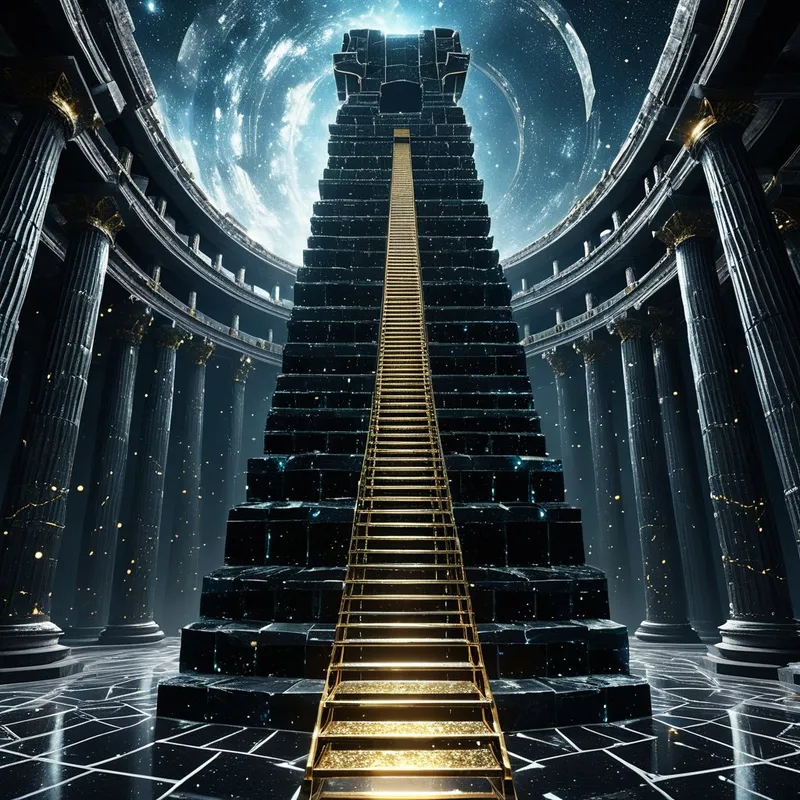
The transmutation of Competition into Sovereignty requires the heat of conscious humiliation and the pressure of radical self-honesty. The prima materia is the raw grief of realizing how much of your life-energy has been spent in an invisible tournament. The alchemical fire is lit when you stop trying to climb the ladder and instead ask, “Who built this ladder? Do I even want what is at the top?”
This is the nigredo, the blackening: the dissolution of the ego-identity built on comparative worth. It feels like a loss, a demotion, a free-fall with no safety net of status. The pressure comes from holding this space without rushing to rebuild a new, “spiritual” hierarchy. The albedo, the whitening, is the emergence of a new clarity: you begin to see others not as competitors, but as other sovereign beings on their own trajectories. Your journey decouples from theirs. The final rubedo is the embodiment of intrinsic value. You no longer carry the internal scorecard. Your authority comes from an integrated self, a Ruler in truth, whose domain is self-defined and whose worth is non-negotiable currency.

The Integration Protocol
Question 1: In the dream, what was the prize? And what, in your waking life, do you secretly believe that prize would finally make you feel?
Question 2: Who is the internal “judge” keeping score in your mind? Can you describe its voice, its fears, and what it is truly trying to protect you from?
Question 3: Imagine a world where all comparison was impossible. What is the first quality of yourself you would begin to develop or express?
Action 1 (The Grounding Refusal): For one full day, consciously refuse to quantify any aspect of your experience. Do not rate your productivity, your meal, your walk. When the mind starts to rank, simply note: “That is a measurement.” Return to the sensory reality of the moment—the texture, the temperature, the breath.
Action 2 (The Map of Internal Territories): Create a drawing, a diagram, or a mind map titled “My Kingdom.” Do not draw a hierarchy. Instead, map your inner parts as different landscapes, resources, or weather systems. Where does the “Competitor” live? Is it a fortified tower? A barren field? Give it a place without letting it run the government.
Action 3 (The Sovereignty Ritual): Write a short, formal declaration of your own intrinsic worth on a piece of paper. Be specific about qualities that have nothing to do with achievement or comparison (e.g., “the capacity for wonder,” “the texture of my silence”). Read it aloud each morning for a week. Then, burn or bury the paper as an act of returning the law to the soil of your being, not keeping it as a document to be proven.
Final Validation
The exhaustion is real. The feeling that you are running a race you never chose, for a crowd you cannot see, is a profound and legitimate suffering. It is the weight of an inherited script, written in the language of scarcity. To feel this is not a failure, but the first, crucial fracture in the facade—the point where the light gets in. You are not being prepared for a bigger battle out there. You are being summoned to lay down your arms in here. The integration of this dream is the quiet, revolutionary act of seceding from a foreign empire and coming home to a sovereignty that was, and always has been, yours by right of being. The tournament ends when you step off the court and realize you were never just a player; you are the entire, sacred field.