
The Sovereign Frequency: Dreams of Collective vs. Individual
The Somatic Echo
It begins not as a thought, but as a pressure. A deep, resonant hum in the marrow, a sensation of being tuned to a station you never chose. It is the weight of a thousand unspoken expectations settling in the diaphragm, a subtle magnetic pull in the joints, aligning you to a grid you cannot see. This is the somatic ground of the collective. Its opposite, the individual impulse, often announces itself as a sharp, electric crackle along the spine—a jolt of dissonance, a sudden, fierce need to exhale a breath that is entirely your own. The dream of this theme is the body’s first map of this ancient, internal civil war: the deep, gravitational pull of the tribe versus the centrifugal force of the self. It is the ache of a frequency trying to distinguish itself from the choir.
The Dreamer's Log
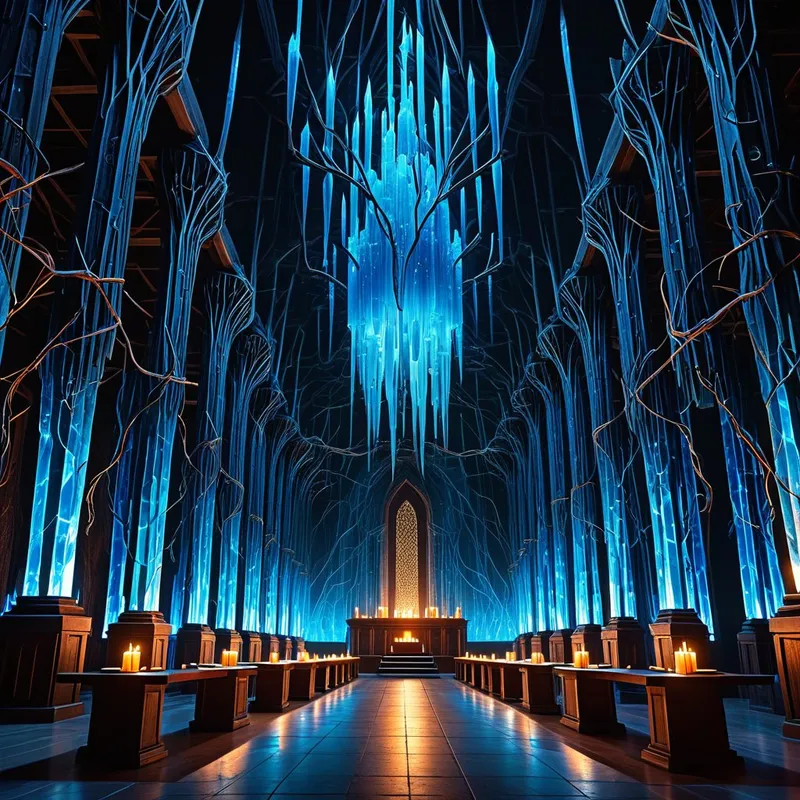
I am in a vast, silent hall of luminous crystalline servers, each one humming with a cold, blue light. My task is to tend to them, to ensure their perfect, synchronized rhythm. But my own heartbeat feels too loud, too warm, too irregular. I find a small, forgotten wooden desk in the center. On it, a single candle flickers. When I light it, the flame’s warmth causes the nearest server to fracture, and from its cracks, wild, rust-colored vines begin to sprout and climb.
The alchemy here is the candle’s humble heat transmuting cold, collective efficiency into a flawed, organic, and singular life.
The False Lead
This theme is not a simple binary of conformity versus rebellion. It is not about being a "loner" or a "joiner." To mistake it for such is to remain in the superficial politics of personality. The profound shift occurs at the level of psychic structure. It is not about rejecting the collective, but about discovering how you are uniquely composed within it. The terror is not of loneliness, but of dissolution; the grief is not for lost independence, but for a belonging that asks you to erase your signature from the contract of existence.
Psychological Architecture
Here, the Shadow work is an archaeology of consent. We must descend into the basement of the psyche and examine which parts of us joined the collective out of genuine affinity, and which parts were conscripted—through trauma, through a desperate need for safety, through the soft violence of "should." The Individuation process is the slow, meticulous task of differentiating this internal family. It is hearing the chorus of internalized voices—the parent, the culture, the tribe, the algorithm—and, with immense compassion, asking each one: "Do you speak for me, or for another?" Sovereignty is born not when you silence the chorus, but when you learn to distinguish your own note within it, when you can hold the collective as a context, not a command.
Mythic Resonance
We see this eternal negotiation in the story of the Minotaur. The creature itself is a monstrous symbol of the unintegrated individual—the raw, bull-headed passion of the self, born of a transgression against collective order, imprisoned at the heart of a labyrinth, a collective structure of immense complexity. Theseus, guided by Ariadne’s thread, does not simply slay the beast. He navigates the collective maze (the inherited structures, the expectations) using a tool of connection (the thread), to confront the isolated self. The myth is not a victory of the collective over the individual, but the arduous journey to bring the two into a conscious, if fraught, relationship. The labyrinth is both the problem and the path.
Symbolic Nodes
- Being in a Crowd Where Everyone Wears the Same Mask/Face: The terror of anonymous belonging.
- A Unique Object Melting or Merging into a Homogenous Mass: The grief of lost distinction.
- A Choir or Orchestra Where Your Voice/Instrument is Unheard or Dissonant: The struggle for authentic contribution.
- A Radio or TV Constantly Tuning Itself to Others’ Stations: The invasion of external psychic frequencies.
- A Seed Struggling to Sprout Through Concrete: The individual life force against rigid collective structure.
Archetypal Resonance
The Rebel Archetype holds the core energy of this theme. Its somatic echo is that spinal crackle of "no," the visceral refusal to be absorbed. The Rebel’s sacred function is not mere destruction for its own sake, but the necessary demolition of outgrown structures—internal and external—that stifle authentic life. Its shadow, the Outlaw, acts from wounded alienation, tearing down bridges without care for what, or who, needs to cross. The alchemical potential of the Rebel lies in its precision: it learns to dismantle only the prison walls, not the entire city, making space for the sovereign self to finally lay its foundation and build.
The Alchemical Process
The transmutation of this theme requires the heat of conscious friction. This is the pressure that arises when you deliberately pause at the point of automatic agreement, when you feel the collective pull and, instead of flowing with it, you create a moment of internal stillness. This friction generates immense psychic heat—it feels like anxiety, like isolation, like guilt for breaking rhythm. This is the nigredo, the blackening. Within this heat, the old, fused identities begin to separate. The key is to hold the tension without fleeing back into the comfort of the amorphous collective or catapulting into reactive, hollow rebellion. As the heat sustains, a clarity precipitates (albedo, the whitening). You start to see the strands: this is my family’s dream, this is my culture’s fear, this is my longing. The final rubedo, the reddening, is the integration: you return to the collective field not as raw material, but as a conscious, distinct instrument, able to play your part without losing your song, enriching the whole precisely because you are no longer merely a part of it.

The Integration Protocol
Question 1: In the last week, when did I feel a subtle, internal flinch or sigh of relief? Can I trace that sensation to a moment where a collective expectation (even a benign one) brushed against a personal, unspoken truth?
Question 2: What is one belief, habit, or preference I hold that I have never genuinely questioned, simply because "that’s how it’s done" in my family, my circle, or my culture?
Question 3: If my unique perspective were a color, a sound, or a texture, what would it be? How does it differ from the "palette" of my immediate tribe?
Action 1 (The Silent Audit): For one day, conduct an internal audit of consent. With each minor agreement—from a colleague's lunch suggestion to absorbing news media—pause for one breath and ask silently: "Do I choose this, or am I accepting it?" Do not change your actions yet; just observe the landscape of your autonomy.
Action 2 (The Boundary Sketch): Take a large piece of paper and some drawing materials. Without planning, let your hand draw an abstract shape that represents "the collective" as you feel it. Then, with a different color, draw a shape that represents "myself." Let them interact on the page—overlap, repel, contain one another. The goal is not art, but to externalize and witness the relationship’s current geometry.
Action 3 (The Dissonant Offering): In a safe group setting (a meeting, a dinner with friends), practice offering a contribution that is slightly, gently dissonant from the group consensus. It could be a contrasting viewpoint phrased as curiosity, a different music suggestion, a novel idea. Observe the internal reaction and the external response without judgment. The action is the offering itself, not the outcome.
Final Validation
This is perhaps the most fundamental and exhausting work of a conscious life: to patiently extract the jewel of self from the ore of the world. The longing to simply belong, and the terror of being swallowed by that belonging, are both utterly valid. They are the two poles of a humanity trying to remember it is made of both chorus and soloist. Do not mistake the ache of this process for a failure. It is the proof of your unique signature pressing against the page of existence. The collective needs your distinction, not your duplication. Your sovereignty is not the end of belonging, but its most mature and precious beginning.