The Architecture of the Self: Dreaming of Boundaries & Limits
The Somatic Echo
Before the image of a wall forms, before the narrative of a locked door begins, the body knows. It is a specific, hollow tension in the solar plexus—a sensation of being poured into, of density collapsing into porosity. It’s the ghost-ache in the shoulders, a weight of invisible burdens not your own. Or conversely, a brittle, metallic rigidity along the spine, a carapace grown too tight, cutting off the circulation of feeling. This is the somatic ground from which dreams of boundaries sprout. The psyche, in its infinite wisdom, translates the vague unease of eroded frontiers or the suffocation of rigid fortifications into the stark, symbolic language of dreamspace. It speaks in walls that appear overnight, oceans that refuse to be crossed, and doors that will not hold.
The Dreamer's Log
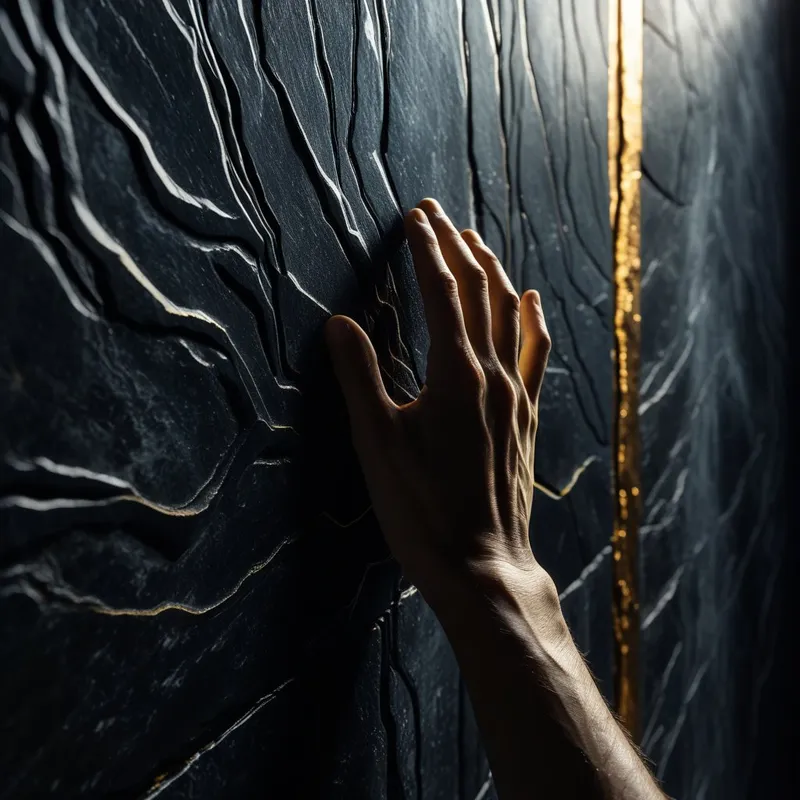
I stand before a wall in a featureless plain. It is seamless, polished to a mirror finish, and stretches to the horizon in both directions. When I press my palm against it, the stone does not feel cold, but absorbs the warmth from my hand. My reflection in the surface begins to soften, to bleed into the grain of the rock, as if I am being gently pulled into a state of stone-sleep.
Alchemical Interpretation: The dream presents the ultimate limit—the boundary between the conscious "I" and the undifferentiated substance of the unconscious, where the terror of dissolution meets the longing for complete rest.
The False Lead
This theme is not about external obstacles or simple bad luck. A dream of a locked door is not a prophecy of career stagnation; a dream of a crumbling fence is not merely a warning about a gossiping friend. To interpret it so is to remain on the literal surface, mistaking the symbol for the street sign. The boundary in the dream is always, first and foremost, an internal condition. It is the architecture of your psyche made visible. The "limit" you encounter is the current shape of your tolerance, your capacity, your definition of where "you" end and the "not-you" begins. The work is not to dismantle every wall in waking life, but to understand which walls are load-bearing structures of the soul, and which are prison facades built from fear.
Psychological Architecture
To work with these dreams is to engage in the most delicate shadow work: the mapping of the self's territory. We contain multitudes—an internal family of subpersonalities, each with its own needs and fears. The Caregiver part may build walls of silent endurance, absorbing all impact until it becomes the Martyr. The Orphan may construct a moat of distrust, forever seeing itself as the Victim behind the castle walls. The dream of a boundary exposes which part of you is currently on guard duty, and what it is afraid will cross the threshold.
Individuation, in this context, is the conscious redesign of this internal landscape. It is not the absence of boundaries, but the development of a sovereign membrane—something that can discern, filter, and engage with the world selectively. It is the movement from a brittle, defensive wall (which shatters under pressure and leaves you exposed) to a living, responsive skin (which can feel, protect, and connect simultaneously). This is the shift from the architecture of trauma—rigid, repetitive, built for a past threat—to the architecture of the soul, which is dynamic, organic, and aligned with present reality.
Mythic Resonance
Consider the myth of Psyche and Eros. The ultimate boundary is laid down by the god of love himself: Psyche must not seek to see his face. This is not a capricious rule, but a necessary condition for the relationship's sacred, transformative phase to occur. When she crosses that limit, illuminating his divine form with her lamp, the entire structure of her blissful reality shatters. Eros flees, and she is cast out into the brutal, liminal world of her epic trials. The boundary was not a prison, but a temenos—a sacred container for a specific alchemy. Her violation of it was not a simple mistake, but the necessary, painful catalyst that forced her out of passive reception and into active, heroic becoming. The limit, once transgressed, becomes the very path to her apotheosis.
Symbolic Nodes
- Walls, Fences, Moats: The classic images of separation, defense, and exclusion.
- Doors, Gates, Bridges: Thresholds representing points of decision, transition, and potential passage.
- Skins, Membranes, Veils: Permeable boundaries that suggest filtering, sensitivity, and a living interface.
- Horizons, Shorelines, Riverbanks: Natural limits that speak of expanses yet to be explored, the edge of the known world.
- Mirrors, Glass Panes, Two-Way Glass: Boundaries that reflect, distort, or allow observation without interaction, highlighting the relationship between seer and seen.
- Invisible Barriers, Force Fields, Unbreachable Air: The experience of a limit that has no physical correlate, pure psychological resistance.
Archetypal Resonance
The energy of defining the self, of saying "this is me, and this is not," of establishing order and sovereignty within one's own psyche, resonates most powerfully with The Ruler Archetype. Its shadow, the Tyrant or Control-Freak, manifests in the dreams of suffocating, inescapable fortresses or rigid, punitive laws—the internal landscape of a psyche that governs through fear and absolute control, strangling the life it seeks to protect. The Ruler's core task is to bring order to chaos, to create a stable, functional kingdom. In the realm of boundaries, this is the sacred work of discerning healthy structure from oppressive control. The somatic echo of the active Ruler is not rigidity, but a grounded, centered strength in the core—a sense of rightful authority over one's own inner domain. Its alchemical potential lies in transforming the raw, chaotic energy of undifferentiated experience (both internal and external) into a coherent, well-governed self, capable of both strong defense and graceful diplomacy.
The Alchemical Process
The transmutation here is from fused mass or shattered fragments into a sovereign entity. The prima materia is the psychic substance with no defined shape—the enmeshment, the people-pleasing fog, the trauma-bonded glue, or conversely, the scattered pieces of a self that has experienced violation. The required heat is the intense discomfort of confrontation. It is the fire of saying "no" when you have always said "yes." It is the pressure of tolerating another's disappointment, anger, or withdrawal without collapsing your own frontier to accommodate it.
The alchemical vessel is the conscious self, holding the tension between the fear of isolation (if I build a wall) and the terror of annihilation (if I have no wall). In this pressurized space, the old, brittle boundaries—constructed from borrowed beliefs and fear-based reactions—dissolve. What precipitates is not a new rule, but a new faculty: the capacity for discernment. This is the creation of the sovereign membrane, the lapis philosophorum of this work. It knows when to be permeable, to allow inspiration and connection to flow in, and when to contract, to filter out toxicity and demand respect. The grief that is transmuted is for the lost fantasy of perfect, effortless union; the sovereignty gained is the power to choose authentic connection from a place of wholeness.

The Integration Protocol
Question 1: In the dream, what is the quality of the boundary? Is it brittle or flexible, ancient or newly built, natural or manufactured? What does its texture tell you about the state of your internal defenses?
Question 2: Who or what is on the other side of the limit? An unknown threat, a loved one, a forgotten part of yourself, or simply vast emptiness? Your relationship to the "other side" defines the purpose of the boundary.
Question 3: What is the primary emotion when you encounter this limit? Is it fear, frustration, grief, relief, or a curious longing? The emotion is the key to which inner part of you is holding this frontier.
Action 1 (Somatic Cartography): For one week, pay attention to the somatic echo in your body when you feel your boundaries are being pressed in waking life. Don't analyze, just note the sensation and its location. Is it a tightening in the chest? A hollowness in the gut? Begin to map your body's own, pre-verbal boundary language.
Action 2 (Unstructured Scripting): Take the central image from your boundary dream (the wall, the door, the shore). Write from its perspective. Let it speak. "I am the wall. My purpose is not to imprison, but to…" or "I am the door. I am locked because…" Do not direct the narrative; let the symbol itself reveal its logic and its needs.
Action 3 (Threshold Ritual): Physically demarcate a threshold in your home. It could be your front door, your bedroom entrance, or even a line of tape on the floor. For one minute each day, stand consciously at this threshold. As you cross it, state a simple, intentional phrase that affirms your sovereignty, such as "I cross into my space," or "I leave behind what is not mine to carry." Let the physical act anchor the psychological principle.
Final Validation
To dream of boundaries is to be engaged in the most fundamental and exhausting work of the soul: the perpetual negotiation of selfhood. It is a sign that you are no longer sleepwalking through the borrowed territories of others' expectations or your own outdated defenses. The discomfort, the fear, the stark imagery—these are not signs of failure, but of profound engagement. Your psyche is literally rebuilding its home, stone by conscious stone. The process asks everything of you, for it is the work of becoming a true citizen of your own life, with all the rights, responsibilities, and sacred, inviolable borders that entails. You are not just dreaming of walls; you are dreaming yourself into being.