
The Alchemy of the Edge: Dreams of Boundaries & Limitation
The Somatic Echo
Before the image of a wall, before the frustration of a locked door, there is a feeling. It is a pressure in the chest, a subtle, constant hum of resistance in the solar plexus. It is the weight of an unseen barrier against the shoulders, a low-grade ache of containment. The body knows a boundary long before the mind names it. This somatic echo is not the pain of impact, but the deeper, more resonant ache of potential held in check—a psychic muscle, long unused, remembering its purpose. It is the feeling of a Self that has outgrown its old architecture, pressing against the walls of its own making, sensing the vast, terrifying freedom just beyond the plaster.
The Dreamer's Log
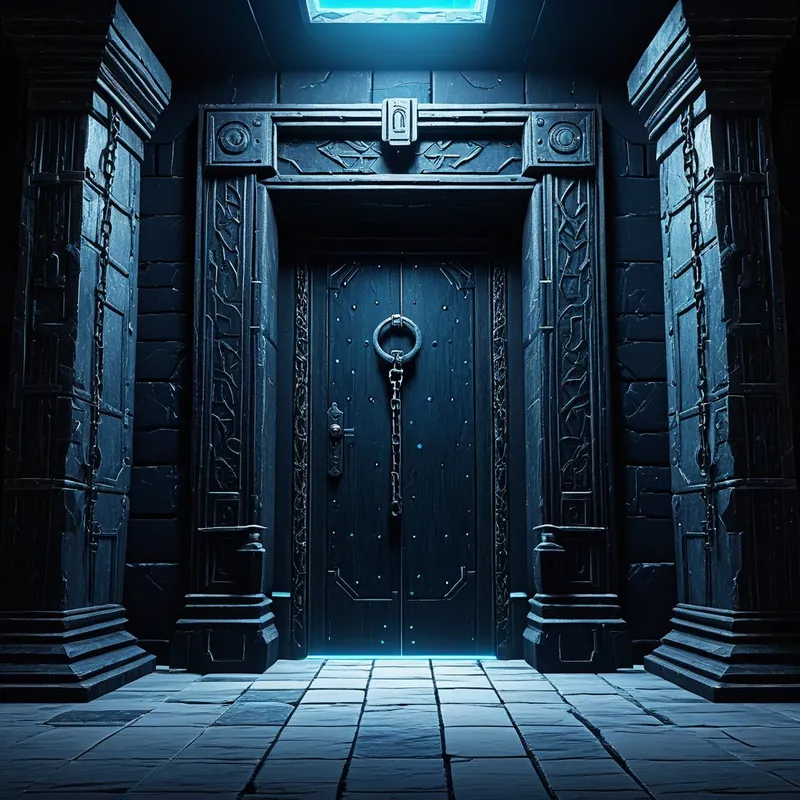
The dreamer stands in a cavernous, silent server room, walls lined with obsidian monoliths humming with a cold, blue light. In the center of the room stands a single, weathered oak door, slightly ajar, pouring out a blinding, white radiance. At their feet lies a heavy, rusted chain and a tarnished silver key. They feel an overwhelming pull toward the light, yet their feet are fused to the floor.
Alchemical Interpretation: The psyche presents the ultimate choice between the known architecture of the self (the server room) and the unformed potential of liberation (the white light), with the tools of release already provided but requiring conscious, somatic action to employ.
The False Lead
This theme is not about external oppression or simple "bad luck." To mistake the dream’s boundary for a mere obstacle placed by the world is to remain a passive character in your own story. The prison dream is not a report on your circumstances; it is a revelation of your internal governance. The limitation is not the problem—it is the symptom. The true work lies not in blaming the wall, but in asking with ruthless curiosity: Who, within me, is both the architect and the warden? The dream of limitation is an invitation to sovereignty, disguised as a report of siege.
Psychological Architecture
Here, Shadow work is the archaeology of the interior. We must meet the exiled parts—the internal family of fears, loyalties, and inherited contracts—that have been tasked with building walls for our protection. The Orphan who learned safety meant smallness. The Caregiver who walled off desire to tend to others. The Ruler who fortified a tiny kingdom out of terror of the vast, ungovernable Self. Individuation in this realm is a conscious, often agonizing, restructuring. It is not the demolition of all walls, but the deliberate, brick-by-brick relocation of them. You move the boundary from around your spirit to around your time. From around your voice to around your energy. The structure remains, but its purpose transmutes from containment to definition. You are not breaking out; you are redesigning the blueprint from the inside.
Mythic Resonance
Consider the story of Psyche and her fourth task. Sent to the Underworld, she is given a sealed box and one absolute boundary: Do not look inside. The injunction is not arbitrary cruelty; it is the final test of her hard-won sovereignty. Her previous tasks required doing, striving, heroic effort. This one requires not doing. It requires the integration of a limit. When she inevitably opens the box, she is not punished for curiosity, but subdued by a vaporous sleep—the sleep of unconsciousness, of forgetting her own completed trials. Her rescue comes not from breaking another rule, but from the reminder of her earned love (Eros). The myth tells us that the ultimate boundary is the one that guards the integration of our own experience; to violate it prematurely is to lose consciousness of our own journey.
Symbolic Nodes
- Walls, Fences, Glass Panes: The visible architecture of separation, often showing their quality—brittle, transparent, crumbling, or impossibly thick.
- Locked Doors, Gates, Turnstiles: Points of potential passage that highlight the mechanism of control (the missing key, the broken code, the authority figure).
- Mazes, Labyrinths, Endless Corridors: The experience of the boundary turned inward, a complex system of choices and dead ends within the self.
- Chains, Ropes, Shackles (especially if broken or held): The binding agreement, the weight of obligation or trauma, often presented with its state of integrity.
- Impassable Terrain: Chasms, raging rivers, sheer cliff faces representing emotional or psychic landscapes that feel unsurvivable.
- Webs, Nets, Viscous Substances: Sticky, entangling boundaries that speak of enmeshment, guilt, or suffocating relationships.
Archetypal Resonance
The energy at the core of this theme is that of The Ruler Archetype, specifically in its shadow aspect of internal tyranny. The Shadow Ruler is the psyche’s control-freak, the internal governor who mistakes rigid containment for safety and confuses domination over one's own impulses with true order. Its somatic echo is that stiff pressure in the chest, the clenched jaw of enforced control. Its alchemical potential, however, is immense: this same archetype, when integrated, holds the blueprint for conscious sovereignty. The heat of the dream is meant to force a coup—not to destroy the throne, but to enlighten the monarch. The goal is to transmute the Shadow Ruler’s fear-based tyranny into the mature Ruler’s capacity to set wise, compassionate, and flexible laws for the inner kingdom, establishing boundaries that serve life rather than stifle it.
The Alchemical Process
The transmutation here is from Statute to Covenant. A statute is an external, rigid law enforced by fear. A covenant is a living, internal agreement born of understanding and choice. The alchemical fire is the heat of conscious frustration—the moment you truly feel the limitation not as a fact of life, but as a choice of psyche. The pressure is the sustained tension of holding two truths: "This wall causes me pain" and "Some part of me built this wall for a reason." In this crucible, you do not melt the wall. You dialogue with its bricks. You thank the fear that laid the mortar. You honor the old protection while gently presenting it with the new evidence: I am stronger now. We can design a different gate. The leaden feeling of imprisonment slowly, molecule by molecule, becomes the gold of self-definition. The boundary remains, but its essence changes from a barrier that keeps you in, to a threshold that clarifies what you are for.
The Integration Protocol
Question 1: In the dream, what is the boundary made of? Is it stone, glass, light, fog, bureaucracy, flesh? What does its material tell you about the nature of the internal contract it represents?
Question 2: Who or what is on the other side of the barrier? Is it a landscape, a person, a version of yourself, or simply an unknown quality of space? What does that desired space symbolize about what your soul is currently yearning to express or experience?
Question 3: If the boundary in the dream could speak, not in words but in its primary function, what would it say? Would it say "I protect you from chaos," "I contain your shame," "I keep your power in," or "I prevent you from abandoning your post"?
Action 1 (Somatic Cartography): For one day, track the somatic echo. Without analyzing the why, simply note in a small journal the moments you feel that subtle chest pressure, shoulder hunch, or gut clench—the feeling of "no." At day's end, map these moments visually on a simple timeline. Look only for the pattern of the body's "boundary sense" firing.
Action 2 (Creative Unbuilding): Using any medium—clay, torn paper, charcoal, digital drawing—create an abstract representation of the dream's primary boundary. Then, slowly, ritually alter it. Don't destroy it. Change its texture. Add a window. Make it translucent. Grow vines over it. Let the creative act physically model the psychological process of redesign, not demolition.
Action 3 (Ritual of Edges): Find a physical edge in your environment—a shoreline, a forest path, the perimeter of a garden, even the threshold of a room. Walk its length with deliberate slowness. As you walk, internally repeat a simple covenant: "This edge defines, it does not confine." Feel the difference in your body between the two statements. Let the physical act of tracing a limit anchor the new, conscious relationship to it.
Final Validation
To dream of boundaries is to feel the ache of your own becoming. It is profoundly difficult work, for it asks you to confront not an enemy, but a protector—to negotiate with the very structures you built for survival. Honor that difficulty. The frustration, the grief, the sense of being trapped are not signs of failure, but the necessary friction of transformation. You are not stuck. You are in the precise, sacred moment between the old blueprint and the new. The dream is the architect's plan, laid bare in symbols. You hold the tarnished key. The integration is the courageous, gentle act of learning to turn it in the lock of your own soul, hearing the click of a sovereignty you were always meant to inhabit.