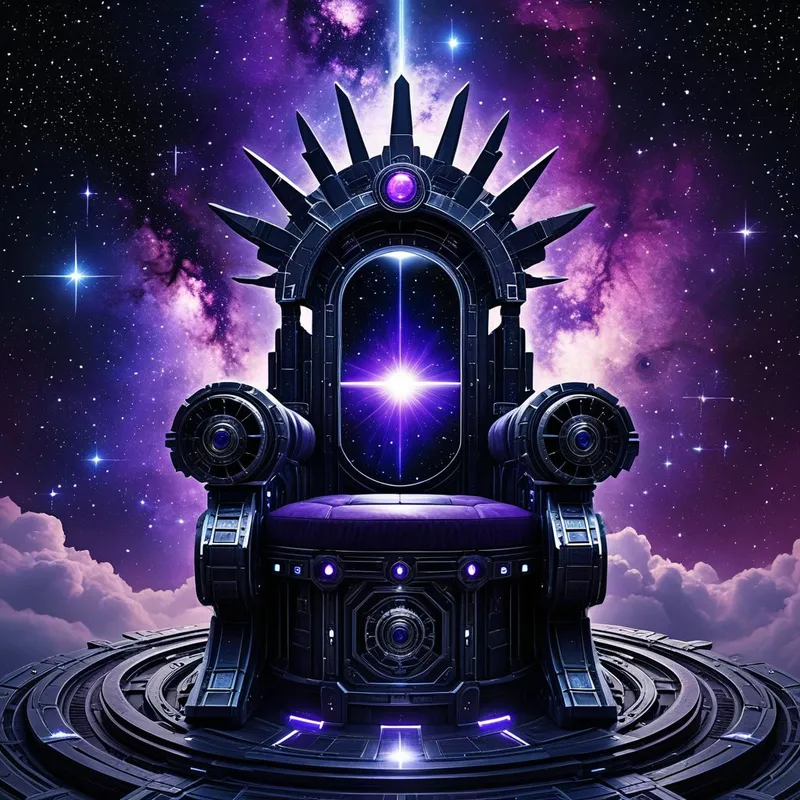
The Dream of Authority & Power: Reclaiming the Empty Throne
The Somatic Echo
Before the dream forms an image, it lands in the body as a specific, heavy weather. It is not the quickening pulse of fear, but a deeper, more glacial pressure—a sensation of being pinned. The jaw locks. The shoulders become a yoke. The breath turns shallow, held captive just beneath the sternum, as if awaiting permission. This is the somatic signature of a power dynamic turned inward, a silent, internal occupation. It is the ghost of a command not yet spoken, the architecture of an old hierarchy made flesh. You feel it as a weight, a constriction, a cold spot in the psychic landscape where your own voice has gone silent. This is the echo of a throne within you, sitting empty, while other voices—internalized parents, cultural mandates, the critical inner manager—hold court in its stead.
The Dreamer's Log
The dream is always the same. You are in a cavernous, abandoned data center, tasked with maintaining a monolithic server that hums with a malevolent, amber light. You don’t know what it does, only that you must keep it running. Warnings flash in a language you cannot read. The system is failing. A voice, synthetic and cold, issues directives that make no sense. You scramble, a technician in a temple you never chose, servicing a god you do not believe in.
Alchemical Interpretation: The dream reveals a psyche forced to maintain an obsolete internal operating system—a foreign authority whose logic you have inherited but never authored.

The False Lead
This theme is not about confronting a literal boss, a demanding parent, or an oppressive government in your waking life—though these may be its mirrors. To mistake the symbol for the substance is to remain in the courtroom, arguing a case, when the true trial is the legitimacy of the court itself. The struggle with authority in dreams is rarely a simple rebellion. It is a profound, structural inquiry: Who, or what, holds the gavel in the chambers of your own mind? It is not about bad luck or external persecution, but about the silent, often unconscious, ceding of your innate sovereignty to internalized phantoms. The conflict is interior; the occupation is psychological.
Psychological Architecture
The work here is the reclamation of a disowned self. We are born whole, with an inherent right to our own existence. Yet, to belong, to be safe, to be loved, we often exile the parts of us that are too loud, too needy, too powerful. We hand the scepter of our will to these exiles, who then rule as fearful regents—the Inner Critic as tyrant, the People-Pleaser as viceroy. Dreaming of authority figures, be they kings, generals, or faceless bureaucrats, signals that these exiled parts are staging a coup. They are not enemies, but lost citizens of your own psyche, demanding recognition. The shadow work is to dethrone no one, but to host a constitutional convention. It is to listen to the fear of the critic, the desperation of the pleaser, and to integrate their energy—not their rule—back into the sovereignty of the whole self. Individuation in this realm is the slow, courageous process of becoming the author of your own law.
Mythic Resonance
Consider the story of Theseus and the Minotaur. The labyrinth is not just a physical trap; it is the convoluted, internalized logic of a foreign power—King Minos’s demand for tribute, a law that consumes the youth of Athens. Theseus does not merely slay the beast at the center; he must first navigate the maze, a structure built by another’s will. His thread, a gift from Ariadne, is the first spark of his own strategy, his own authority within the imposed system. The victory is not brute force, but the reclamation of navigational power. The myth lives in us when we wander the psychic labyrinths built by old commandments, seeking the thread of our own truth that leads us back to our center, where the monstrous, imprisoned aspect of our power awaits not destruction, but integration.
Symbolic Nodes
- Thrones (Empty or Occupied): The seat of your innate sovereignty.
- Uniforms, Badges, Official Seals: Internalized rules and assigned roles.
- Towers, Skyscrapers, Monoliths: Rigid, impersonal structures of power.
- Microphones that are Silent or Static: The stifled personal voice.
- Being on Trial or Before a Tribunal: The psyche judging itself by external laws.
- Broken Scepters, Lost Keys, Deactivated Badges: The felt sense of disempowerment or the dissolution of old authority.
Archetypal Resonance
The core energy at play here is that of The Ruler Archetype. Its shadow, the Tyrant or Control-Freak, manifests in the somatic echo as that gripping pressure, the internal occupation by a harsh, critical, or demanding voice that seeks order through domination. The active theme of Authority & Power is the psyche’s confrontation with this shadow ruler—the internalized dictator that confuses control for leadership, and rigidity for stability. The alchemical potential lies in the integration of the Ruler’s true essence: the capacity to establish inner order, create personal boundaries, and steward the resources of the self with responsibility and compassion. To dream of this struggle is to be summoned to claim the Ruler’s mantle not over others, but over the fragmented kingdom of the self, transforming tyranny into true sovereignty.
The Alchemical Process
The transmutation of this theme requires the heat of conscious confrontation and the pressure of sustained inner dialogue. The base material is the leaden grief of self-betrayal—the countless moments you silenced your truth to appease an internal phantom. The alchemical fire is lit when you stop obeying the silent directives and instead turn to face the source of the command. This is not a battle, but a deposition. You apply pressure by asking, in the midst of the somatic echo, “Who speaks?” and “By what right?” The intense psychological process is one of dissolution—allowing the rigid, rusted architecture of internalized authority to soften and break apart in the solvent of your compassionate awareness. As the false structures dissolve, the gold that emerges is Sovereignty: the integrated, self-authored authority that comes from listening to and aligning all parts of the self. The crown is not taken; it is remembered, and in the remembering, forged anew.
The Integration Protocol
Question 1: In the dream, where did your power reside? Was it in an object you lost, a person you faced, or a space you were forbidden from entering?
Question 2: When you feel the somatic echo of this theme in waking life—the locked jaw, the shallow breath—what is the first, silent command your body is expecting to hear?
Question 3: If the internal authority figure you encounter could speak its deepest fear (not its demand), what would it say?
Action 1 (Somatic Reclamation): When you feel the constriction of the “pin,” place a hand over your sternum. Breathe slowly into that space for three cycles, not to dissolve the pressure, but to acknowledge it as a signal. Whisper, internally, “I am here. The throne is mine.” This grounds the conflict in the body, reclaiming it as your territory.
Action 2 (Unsent Letter of Authority): Write a letter from the perspective of the dream’s authority figure (the judge, the boss, the silent system). Do not let it issue commands. Instead, have it confess its origins. How did it come to power? What is it afraid will happen if it steps down? This creative expression externalizes and objectifies the internal dynamic, allowing you to see its mechanics.
Action 3 (Ritual of Nullification): Find a small stone or piece of wood. On it, inscribe a single word that represents the most hollow command you internally obey (e.g., “Perfect,” “Silent,” “Pleasing”). Take it to a crossroads—a literal intersection of paths, a shoreline, or even a sink. Acknowledge the service this old law has provided, then revoke its authority. Nullify it by submerging it in water, burying it, or letting it be carried away. This outward ritual marks the internal dissolution of a foreign decree.
Final Validation
To dream of authority and power is to walk the most profound and lonely corridor of the self—the one that leads to the empty throne room. It is difficult because it asks you to depose ghosts that feel like guardians and to claim a responsibility that is terrifying in its totality. The anxiety, the grief, the resistance are all testaments to the magnitude of the shift underway. You are not breaking rules; you are participating in the slow, magnificent archaeology of your own sovereignty. The authority you seek has never been outside you. It is the quiet, unshakable presence waiting to fill the space where the echo finally fades, when you choose, at last, to sit down.