
The Somatic Echo
Before the mind conjures the judge, the prison, or the tyrant, the body knows. It is a specific, cellular tension—a held breath in the solar plexus, a subtle clenching of the jaw as if bracing for a command. The shoulders may draw up, not in strength, but in a silent, ancient posture of awaiting permission or punishment. It is the visceral sensation of being a vessel awaiting an external will to fill it, a marionette feeling for the strings. This is the pre-verbal landscape of Authority & Control: a deep, structural hum in the nervous system that whispers of boundaries crossed, sovereignty questioned, and an internal kingdom awaiting its true ruler.
The Dreamer's Log
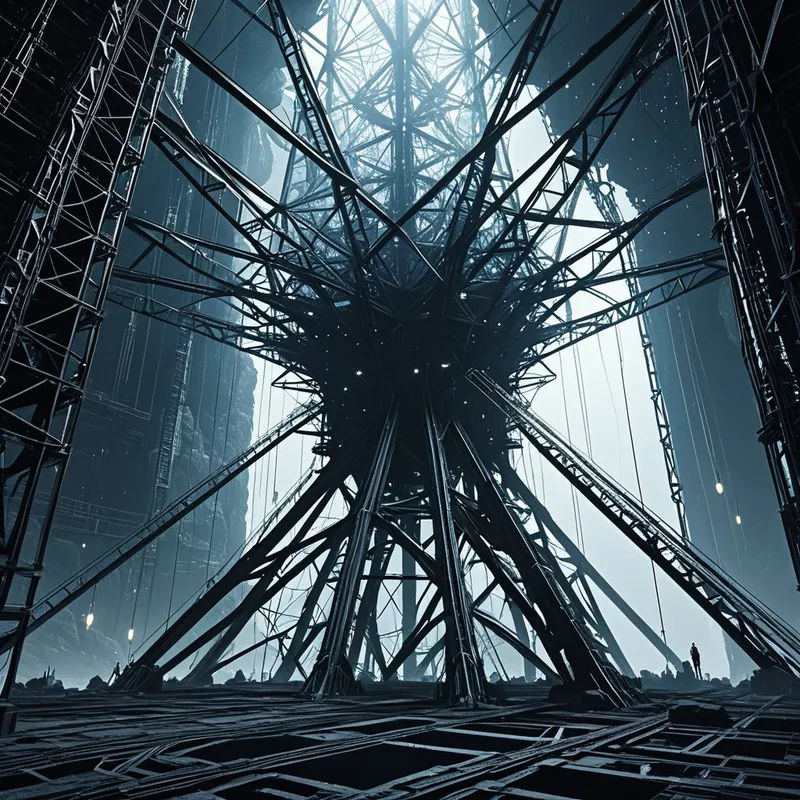
The dream is always the same: I am in the heart of a silent, cavernous data center. The server racks hum with a cold light. I have the master keycard, but my access is denied at every terminal. The system recognizes my authority but refuses my commands. I am the administrator locked out of my own mind.
Here, the dream alchemizes the paradox of the inner tyrant: you hold the keys to the kingdom but are haunted by the ghost of a protocol written by someone else.

The False Lead
This theme is not about the surface frustrations of a micromanaging boss or a stubborn bureaucracy in waking life, though these may be its costumes. To mistake the dream for a mere complaint about external circumstances is to remain a subject in your own psyche. The true territory is not about wresting control from the world, but about encountering the foreign and familiar governments that have taken up residence within you. It is the architecture of your consent, the ghost in the machine of your own will.
Psychological Architecture
The work here is shadow work of the most foundational kind: the excavation of the internal council. We are not unitary beings, but ecosystems of sub-personalities—an Internal Family System where exiles, managers, and firefighters vie for the crown. Dreams of authority expose which part has seized the throne. Is it the relentless Inner Taskmaster, driving you with a whip of "should"? The People-Pleasing Diplomat, negotiating your worth at the table of others' approval? Or the Fearful Sentinel, who mistakes control for safety, locking down the entire kingdom to protect it from a single, perceived threat?
This is the individuation process in its raw, political form. It is the slow, often turbulent journey from a psyche governed by unconscious, inherited, or trauma-forged authorities toward a conscious, embodied Self. The terror in these dreams is the terror of the system realizing it is no longer serving the true sovereign. The grief is for the parts of you that have been exiled, silenced, or forced into servitude by a false, internal regime.
Mythic Resonance
Consider the story of Theseus and the Minotaur. The labyrinth is not just a physical prison; it is the convoluted, self-replicating bureaucracy of a false authority—King Minos’s demand for tribute and control. Theseus does not merely slay the beast at the center; he must first navigate the maze, a metaphor for understanding the complex, defensive architecture of the psyche. His thread, gifted by Ariadne, is the connecting line of consciousness, the breath that remembers the way back to the Self. The victory is not just over the monster, but over the entire system of oppression, allowing him to reclaim his own ship and set sail under his own banner.
Symbolic Nodes
- Locks, Keys, and Keycards: The mechanics of permission and access to your own inner spaces.
- Empty Thrones or Occupied Desks: The seat of power, awaiting its rightful or challenging its current occupant.
- Uniforms, Robes, or Badges: The costumes of legitimacy and role, questioning who you are beneath the assigned identity.
- Failing or Overriding Technology: The breakdown or hijacking of your own mental and emotional operating systems.
- Silent, Judgmental Audiences or Panels: The internalized gaze of external authority, forever watching and assessing.
- Impenetrable Buildings or Glass Walls: The architecture of separation between you and your own agency.
Archetypal Resonance
The energy at the core of this theme resonates most powerfully with The Ruler Archetype—or more precisely, its disowned or corrupted shadow, The Shadow Ruler. The Shadow Ruler is the internal tyrant, the control-freak, the part that believes order must be imposed through sheer will, fear, or rigid structure. Its somatic echo is that stiff, armoured posture, the breath held to maintain a precarious command. Its alchemical potential lies in its deepest desire: for a harmonious, well-ordered kingdom. The transformation is not about destroying the Ruler, but about healing it from a tyrant into a true sovereign—one who leads from integration, wisdom, and care for the entire internal realm, rather than dominating it from a place of fear.
The Alchemical Process
The transmutation of Authority & Control is the Nigredo of Sovereignty—a blackening, a dissolution of the old, rigid structures. The required heat is the unbearable friction between who you have been told to be and the faint, persistent pulse of who you are. The pressure is the weight of responsibility you have avoided by letting others (internal or external) rule.
This alchemy occurs in the silent coup of awareness. You must first feel the cold metal of the inner chains—not to fight them, but to know their texture. Then, in a moment of profound interior courage, you must depose the shadow government not with violence, but with witnessing. You thank the Inner Tyrant for its misguided protection. You listen to the Exiled Child it locked away. You integrate the Rebel it feared. This is the alchemical solve et coagula: dissolve the autocratic regime, and reconstitute the inner kingdom as a collaborative, conscious ecosystem with the Self as the compassionate, embodied monarch.
The Integration Protocol
Question 1: In the dream, who or what holds the authority? Is it a face, a voice, a system, or a sensation? What is the first, wordless feeling that arises when you meet it?
Question 2: Where in your waking life do you feel this same somatic echo—this clenching, bracing, or shrinking? Is it in a relationship, a workplace, or when facing a particular task or decision?
Question 3: If the controlling force in the dream were a protector, what is it so desperately trying to keep safe or in order? What chaos does it fear?
Action 1 (Somatic Reclamation): For one minute, sit or stand with deliberate, regal posture. Feel your feet on the ground, your spine long. Breathe into your solar plexus. Do not do anything with this authority. Simply inhabit the physical space of it, feeling the difference between wearing armor and being embodied.
Action 2 (Council of Parts): Engage in unstructured, stream-of-consciousness writing. Let the different "authority" voices in you speak. Let the Taskmaster write its demands. Then let the Exiled part it controls answer back. Don't judge or edit. Simply transcribe the internal parliament.
Action 3 (Ritual of Nullification): Find an object that symbolizes an external or internal "rule" you are ready to dissolve—a business card, a old list of "shoulds," a uniform item. In a private ritual, consciously thank it for its service, then nullify it. Tear it, bury it, or let it float away on water. This is not destruction, but a ceremonial release of a contract that no longer serves your sovereignty.
Final Validation
To dream of authority and control is to walk the most demanding and noble path—the path back to your own throne. It is difficult because it asks you to become responsible in the deepest sense: able to respond from your core, not from conditioning. It is terrifying because it means the external gods and internal jailers must fall. But in that silent, post-revolution dawn, you are not left with anarchy. You are left with a kingdom. Your own. And you are finally, breathlessly, home.