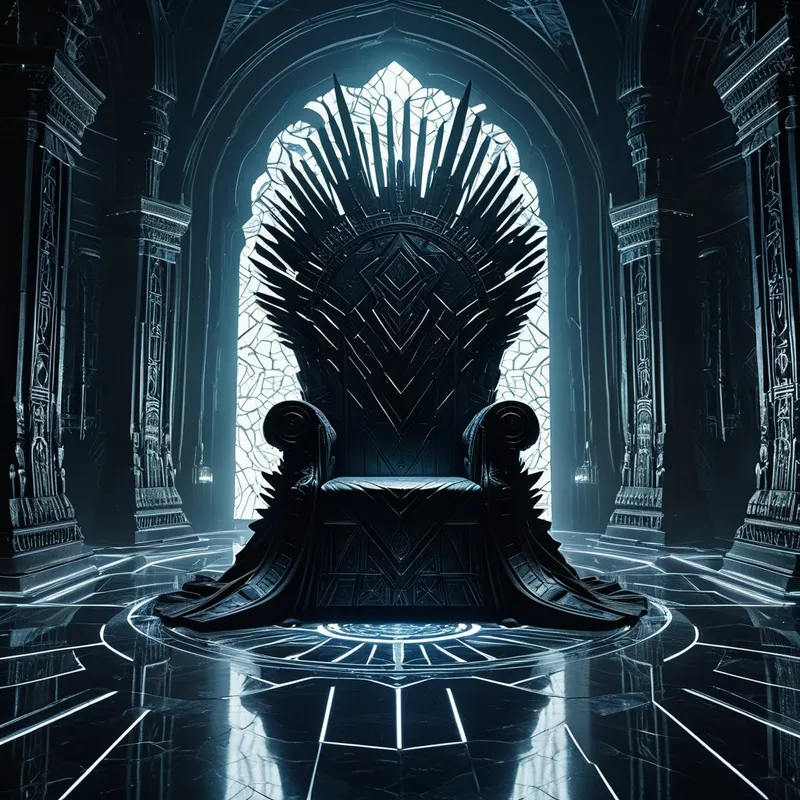
The Sovereign in the Shadow: Dreams of Authority and Power
The Somatic Echo
Before the mind conjures a king, a judge, or a locked door, the body knows. It is a specific, hollow pressure in the solar plexus—not the flutter of anxiety, but the weight of a stone. It’s a metallic taste at the back of the tongue, the ghost of swallowed words. The shoulders may brace, not for a blow, but for the invisible mantle of a role that does not fit. The breath becomes shallow, held in a chest that feels both too empty and too full, as if containing a silent edict you did not write but are compelled to obey. This is the somatic ground from which dreams of authority and power grow. It is the felt sense of a structure—internal or external—that demands alignment, a psychic architecture pressing against the soft tissue of your being.
The Dreamer's Log
The dreamer stands in a cavernous, humming server room. Banks of silent machines pulse with cold light. In the center, on a stark concrete floor, rests a simple wooden lectern, empty. A voice, synthesized and omnipresent, issues a command: “You must deliver the address.” The dreamer approaches, but finds no speech, no notes—only a profound, paralyzing certainty that the correct words exist just beyond memory, and that failure is catastrophic.
This is not a dream about public speaking. It is the psyche’s stark portrait of the internalized authority—the inner command module—demanding performance from an authentic self that has been muted, its native language erased by the expectation of a perfect, external script.

The False Lead
Do not mistake this theme for mere social anxiety or a simple fear of your boss. Those are surface ripples. The dream of authority and power at its depth is not about navigating external hierarchies. It is about the civil war within your own governance. It is the conflict between the internalized “shoulds”—the inherited rules, the parental echoes, the cultural commandments etched into your psychic substrate—and the nascent, often terrified, voice of your own sovereign will. A dream of being powerless before a tyrant is not a prophecy of victimhood; it is a diagnostic image of where you have surrendered your inner throne. The terror is not of the external figure, but of the exiled ruler within you who has forgotten how to wear their own crown.
Psychological Architecture
This dream theme signals the psyche engaging in the most profound of shadow work: the dismantling of the internal colonial government. We each house a parliament of inherited voices—the critic, the taskmaster, the appeaser, the martyr. In dreams of disempowerment, these partial selves have coalesced into a shadow regime, a pseudo-authority that rules through guilt, fear, and the hollow promise of safety through compliance. The individuation process here is a quiet, relentless coup. It begins not with rebellion, but with recognition. You must first feel the stone in your belly, the catch in your breath, and ask: Whose law am I breathing?
It is the work of listening past the booming edicts to the whisper beneath the lectern. That whisper is your own authority, not as domination, but as authorship. It is the power to author your own values, to sanction your own desires, to judge your own actions by a law written in the language of your soul’s truth. This is not about becoming a tyrant over yourself or others. It is the transition from a subject in your own mind to a sovereign—a complex, compassionate, and accountable ruler of your inner kingdom.
Mythic Resonance
Consider the story of Theseus and the Minotaur. The labyrinth is not just a physical prison; it is the convoluted, internalized logic of a foreign power—King Minos’s demand for tribute, a law that devours the youth of Athens. Theseus’s power is not fully realized when he slays the beast. It is realized when he re-members himself, using Ariadne’s thread to trace his way back out, to navigate the maze of imposed authority by holding onto the lifeline of his own connection and purpose. The thread is the somatic awareness, the felt sense of truth that guides you through the internal labyrinth of “should” and “must” back to your own center. The myth whispers that true authority is the capacity to find your way home through the maze of inherited rule.
Symbolic Nodes
- Empty Thrones, Podiums, Judgement Seats: The void where authentic authority should be, or the pressure to occupy a role without the inner sanction to do so.
- Muted or Silenced Voices (Broken Phones, Gagged Mouths, Soundless Screams): The suppression of your authentic expression by internalized censorship.
- Architectural Giants (Towering Courthouses, Impersonal Government Buildings, Endless Corridors): The overwhelming, often faceless, structure of internalized law and order.
- Fragile or Ill-Fitting Crowns/Robes: The uncomfortable burden of a power you feel unworthy of or that is not truly yours to wield.
- Being on Trial with Unknown Charges: The psyche’s sense of being perpetually judged by an internal court whose statutes you have never read.
Archetypal Resonance
The core energy of this theme resonates most powerfully with The Ruler Archetype, and specifically, the journey from its shadow to its integrated expression.
The Shadow Ruler—the Tyrant or Control-Freak—is the active force in the terror of these dreams. It is the internalized voice that demands perfect order through domination, that confuses power with control, and sovereignty with isolation. Its somatic echo is that rigid pressure, the clenched jaw of enforced compliance. Yet, its presence is a perverted signal of a profound need: the need for a secure, well-ordered inner world. The alchemical potential lies in transmuting this tyrannical energy into the true Sovereign. The integrated Ruler does not dominate parts of the self; it orchestrates them. It establishes inner law not through fear, but through conscious value, creating a kingdom of the psyche where every exiled part—the orphan, the rebel, the innocent—has a dignified place and purpose. The power it seeks is not over, but for—the authority to steward the wholeness of the self.
The Alchemical Process
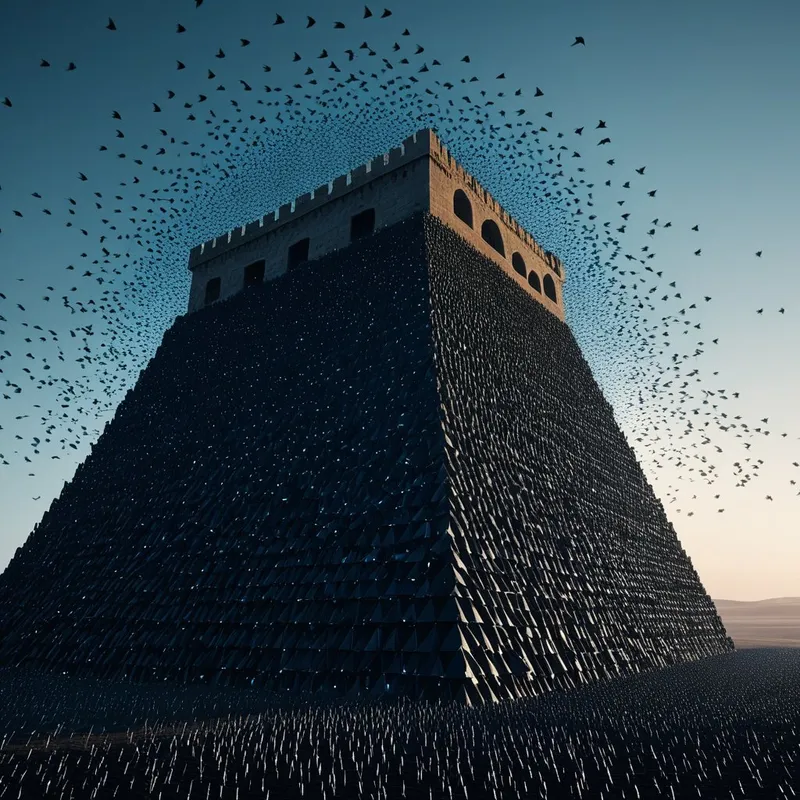
The transmutation here is Sovereignty Through Dissolution. The base material is the rigid, internalized authority structure—the inner fortress of “should.” The heat is applied through conscious discomfort: you must willingly sit in the feeling of powerlessness, the rage at the invisible jailer, the grief for the self that was forced into exile. This is the nigredo, the blackening.
The pressure is the sustained question: Who speaks? Is this my truth, or an echo? As you apply this pressure, the fortress begins to dissolve. Its black stones—the unquestioned rules—soften. This is not destruction, but a change of state. The alchemical albedo, the whitening, appears as you recognize these rules were never yours; they were absorbed, ingested. The liberated material then re-coalesces, not as a fortress, but as a living architecture. The authority is no longer a centralized, tyrannical command node, but a distributed, resilient network—a council of self. Your will becomes less an edict and more a consensus, a harmony built from listening to all the parts of your inner kingdom. The gold produced is Authentic Sanction: the deep, unshakable permission to be, to choose, and to author your life from a center you govern yourself.
The Integration Protocol
Question 1: In the dream, where did the authority seem to reside? Was it in a person, a building, a voice, or an unspoken rule? Now, feel into your body—where do you sense the echo of that authority when you are awake?
Question 2: If the authority figure in your dream were a protector of some fragile part of you, what might it be trying to protect? What catastrophe does it believe its control is preventing?
Question 3: Imagine you could address the source of that authoritative pressure from a place of complete, calm sovereignty. Not to rebel or plead, but to simply declare your own law. What is the first sentence of that declaration?
Action 1 (Somatic Re-Mapping): For one week, when you feel that familiar pressure of “should” or external demand, pause. Place a hand on your solar plexus. Breathe into the sensation. Instead of fighting it or obeying it, silently ask it: “What do you need me to know?” Do not seek an answer in words; wait for a shift in the sensation—a softening, a movement, a release of heat or tension. This re-maps the authority from an external command to an internal communication.
Action 2 (Creative Abdication): Take a large piece of paper. Draw, collage, or write in a stream-of-consciousness style the “Book of Laws” you feel you live under. Let it be messy, absurd, cruel. Title it “The Inherited Code.” When finished, perform a simple ritual: fold it, seal it, or place it in a drawer. Verbally state: “I acknowledge you were installed for a reason. I now revoke your ultimate authority.” This act creatively externalizes and contains the shadow government.
Action 3 (The Edict of the Self): Craft a personal “charter” or “edict” of no more than three sentences. This is not a to-do list or affirmation, but a foundational statement of your own sovereignty. Example: “I hold the authority to define my own worth. I sanction my own rest and my own striving. My inner court judges by the standard of compassion, not perfection.” Write it beautifully. Place it where you will see it daily, not as a demand, but as a reminder of the throne you are learning to occupy.
Final Validation
To dream of authority and power is to walk the most sacred and treacherous ground of the self—the seat of your own governance. The fear, the paralysis, the rage are all honest. They are the testament of a soul that has been living under a foreign flag, feeling the profound wrongness of it in its very bones. This discomfort is not your failure; it is your integrity crying out from the dungeon. The path to sovereignty is not paved with instant confidence, but with the courage to feel the weight of the false crown, to finally remove it, and in the terrifying, liberating silence that follows, to begin listening for the quiet, authentic rhythm of your own rule. The power you seek is not out there. It is waiting, in the rubble of the dissolved fortress, to be recognized as your own.