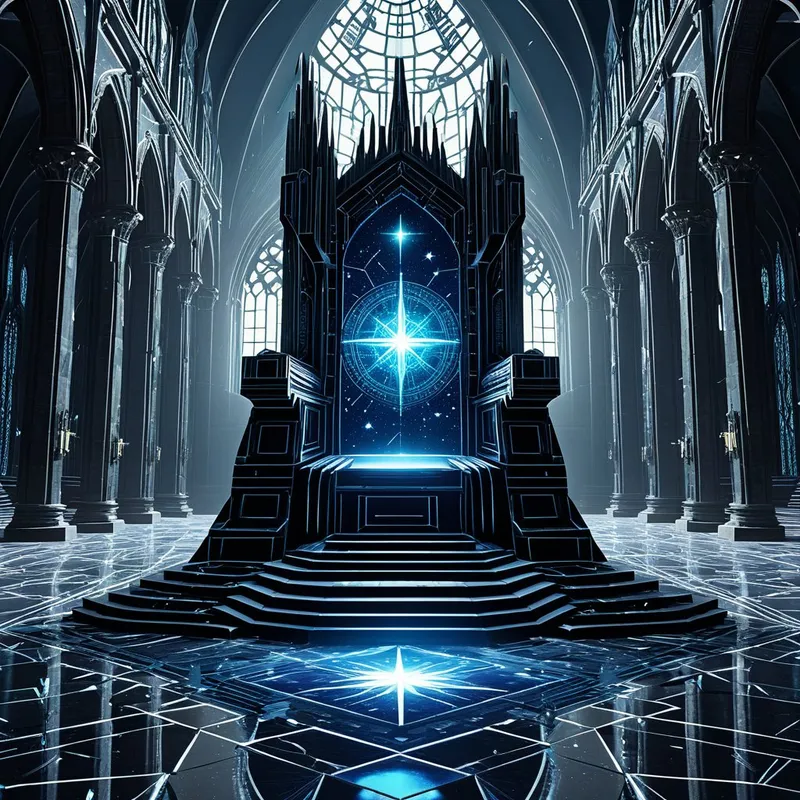
The Inner Throne: Authority, Control, and the Dream of Sovereignty
The Somatic Echo
It begins not as a thought, but as a texture in the body. A cold, metallic taste at the back of the tongue. A rigidity in the jaw, a clenching in the solar plexus as if bracing for a blow that never lands. The shoulders hunch, not from weight, but from an invisible harness. The breath becomes shallow, rationed, as if monitored by some internal committee. This is the somatic signature of a psyche grappling with the architecture of Authority and Control. It is the felt sense of an internal system under a law not its own, a kingdom where the ruler is a ghost, and the citizens are frozen in compliance. Before the dream images arrive, the body already knows: the inner parliament is in session, and the debate is one of revolution.
The Dreamer's Log
The dream is simple, stark. You are in the driver’s seat of a familiar car, but the steering wheel is locked, immovable. The vehicle is accelerating down a winding mountain road on its own. Your foot searches for a brake that isn’t there. In the rearview mirror, you see only an empty backseat, yet you feel a presence there, dictating the turns, controlling the speed. A calm, disembodied voice from the radio says, “Destination is assured.”
This is not a dream about driving. It is the psyche’s stark report on the illusion of agency, where the structures of supposed control are revealed as mere theater, operated by an unseen, internalized authority.

The False Lead
Do not mistake this theme for a simple narrative of external oppression or bad luck. The dream is not merely replaying a difficult boss or a rigid parent. That is the surface costume. The profound work lies beneath, in the internalization of that authority. The dream is pointing to the psychic software you downloaded and now run as your own operating system—the inner critic that wears a crown, the compliance that masquerades as choice, the rebellion that is still defined by the throne it seeks to topple. This is about the structure of your inner governance, not the specific politicians currently in power.
Psychological Architecture
To work with this dream is to enter the shadowy chambers of your own internal family system. Here, you may meet the Inner Tyrant—a subpersonality forged from early experiences of necessary obedience, now fossilized into a rigid, fear-based rule. It believes its harsh laws are what keep you safe, successful, acceptable. Opposite it, often in silent protest, is the Exiled Rebel, the part that holds all the rage, creativity, and wildness deemed too dangerous by the regime. The conflict between them creates a civil war that drains your vitality.
The individuation process here is the arduous, compassionate work of dethronement and integration. It is not about assassinating the Tyrant, for that only creates a power vacuum soon filled by another shadow. It is about witnessing its fear, thanking it for its misguided protection, and gently retiring it from executive command. Simultaneously, it is about welcoming the Rebel out of exile, not to burn everything down, but to contribute its fire for vision and authenticity. The goal is to form a new, conscious inner council—a sovereignty where the mature Self, the true Ruler, can listen to all parts without being controlled by any.
Mythic Resonance
This psychic drama echoes in the hall of myths. Consider the story of Theseus and the Minotaur. The labyrinth is not just a physical prison; it is the convoluted, oppressive structure of a psyche ruled by a foreign power (King Minos, the external authority). The Minotaur at its center is the monstrous, unconscious hybrid born of that oppressive system (the result of shame and hidden desire). Theseus’s journey is not one of brute force alone. He must use a thread—a symbol of connection to consciousness, to the larger world beyond the labyrinth’s law—to navigate, slay the internalized beast, and find his way back out to reclaim his own throne in Athens. The thread is the lifeline of Self-awareness that prevents us from getting lost in our own defensive, controlling structures.
Symbolic Nodes
- Locked Doors/Gates, Immovable Steering Wheels, Muted Microphones: The architecture of frustrated agency.
- Empty Thrones, Abandoned Control Panels, Ghostly Presences: The haunting absence or invisibility of the ruling principle.
- Uniforms, Badges, Crowns (worn by others or oneself): The internal identification with a role of authority.
- Inescapable Rooms, Labyrinths, Pre-programmed Vehicles: The psyche experienced as a prison of its own design.
- Rebellious Acts that Fail or Backfire (e.g., a gun that fires flowers): The Shadow Rebel’s impotent or misguided expression.
Archetypal Resonance
The core energy of this theme resonates most powerfully with The Shadow Ruler.
The Shadow Ruler archetype is the corrupted core of this dream theme. Its energy is not about leadership, but about the terror of chaos that manifests as rigid control, micromanagement of the inner and outer world, and a tyranny born of deep insecurity. The somatic echo—the clenched jaw, the shallow breath—is the body living under this shadow regime. Its alchemical potential, however, is immense. The heat of this dream is the pressure that forces a confrontation with this inner dictator. The potential is the transmutation of that fear-based control into true sovereignty: the capacity for wise, compassionate, and confident self-governance that creates order not through domination, but through alignment, integrity, and authentic authority.
The Alchemical Process
The alchemical vessel for this work is the uncomfortable, liminal space where your old structures of control are failing, but new autonomy has not yet cohered. The nigredo, the blackening, is the despair and disorientation of realizing your inner government is a puppet regime. The heat is applied through the conscious feeling of the rage of the Rebel and the cold fear of the Tyrant—simultaneously, without acting out either.
The transmutation occurs in the albedo, the whitening, when you cease fighting the structure and begin to study it with detached curiosity. You ask the Tyrant, “What are you so afraid will happen if you step down?” You ask the Rebel, “What do you truly want to build, not just destroy?” In this dialogue, the rigid, metallic elements of control begin to soften, to become porous. The new compound that forms in the rubedo, the reddening, is Sovereignty. It is an authority that comes from integrated wholeness, not imposed will. It is the ability to set boundaries from love, not fear; to make choices from desire, not obligation; to lead your own life from a throne of conscious Selfhood.

The Integration Protocol
Question 1: In the dream, who or what holds the ultimate authority? Is it a figure, a system, a voice, or the absence of one? How does that mirror a governing principle in your waking life?
Question 2: Where in your body do you feel the sensation of being "under control" or of needing to "take control"? Describe the physical texture of that feeling.
Question 3: If the controlling force in your dream were to resign its post, what forgotten or exiled part of you would first step forward into the space left behind?
Action 1 (The Grounding Edict): For one hour, practice making micro-choices based solely on subtle somatic yes/no responses. Choose a snack, a route, a song not by logic or "should," but by tuning into the faintest sense of expansion (yes) or contraction (no) in your body. This retrains your system to recognize internal authority.
Action 2 (The Rebel's Canvas): Engage in a creative act with one rule: it must be intentionally "imperfect" or "unfinished." Use a medium you usually try to control (words, paint, clay). Let it be messy, unresolved, or deliberately "flawed." Do not fix it. This ritualizes the dethronement of the inner perfectionist/tyrant.
Action 3 (The Sovereignty Ritual): Find a small stone or natural object. Hold it and consciously project into it all the feelings of external pressure, obligation, and rigid control you carry. Then, go to a body of moving water (a stream, the sea) or even a steady-flowing sink. With intention, place the stone in the water and release it, visualizing the water dissolving and carrying away the energy of control, while you reclaim the energy of your own authentic authority.
Final Validation
To dream of authority and control is to be entrusted with a profound and difficult truth: that the chains you feel are, in their deepest sense, held by parts of yourself. This realization can feel like a crushing responsibility, a second imprisonment. Honor that grief. And then, see the profound liberation it implies. For if the prison is internal, so too is the key. The power to dissolve the old contracts, to restructure the inner kingdom, to move from a subject of fear to the sovereign of your own soul—this power has been, and always will be, dreaming within you, waiting for you to awaken and claim your throne.