
The Dream of Assessment: The Silent Hall of Mirrors
The Somatic Echo
Before the mind conjures the courtroom, the examination hall, or the judging panel, the body knows. It is a cold, metallic taste at the back of the tongue. A hollowness in the solar plexus, as if a vital organ has been temporarily removed for inspection. The shoulders tighten, bracing for a weight that has not yet descended. The breath becomes shallow, rationed, as if the very air in the room is being measured and could be found wanting. This is the somatic prelude to the dream of assessment—a visceral, cellular awareness that something within you is being called to account. It is not fear of the external judge, but the terrifying intimacy of an internal audit, where every forgotten promise, every unlived potential, and every exiled feeling stands in line, waiting to be seen.
The Dreamer's Log
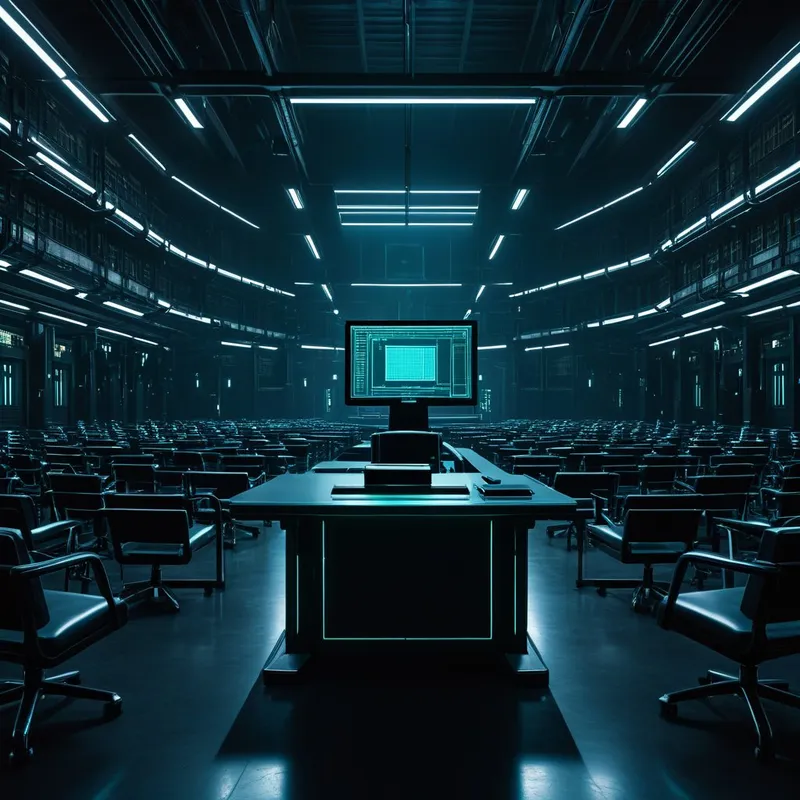
You are in a vast, sterile examination hall, lit by a cold, sourceless light. A single terminal glows on a steel desk. The screen displays a single question in a language you once knew but have forgotten. Faceless proctors, shimmering like bad reception, watch from the shadows. You know, with a certainty that chills your marrow, that your entire future depends on an answer you cannot formulate.
This dream is the psyche’s alchemical crucible, where the raw material of your unlived life is heated by the pressure of a silent, impossible question, forcing a transmutation of identity.
The False Lead
An assessment dream is not a prophecy of failure, nor is it a mere replay of workplace anxiety or school trauma. To mistake it for such is to take the summons for the sentence. The terror is not about failing a test imposed from the outside world; it is about confronting the internal ledger where your soul’s true commitments are recorded. It is not about “bad luck” or external judgment, but about the profound, structural shift that occurs when the psyche demands you witness the gap between who you have been and who you are called to become. The dream is not punishing you for the gap; it is illuminating the gap so you may build a bridge.
Psychological Architecture
Beneath the surface narrative of judgment lies the deep Shadow work of reclamation. The psyche, in its move toward wholeness (Individuation), conducts a periodic inventory. It calls forth all the disowned parts—the timid child, the furious rebel, the arrogant genius, the weeping lover—and places them in the sterile light of consciousness. This is not an act of cruelty, but of desperate love. A system cannot integrate what it refuses to see.
The “assessment” is the ego’s experience of this summoning. The ego, which believes itself to be the sole manager of the personality, sits at the desk and is presented with the totality of the self it has tried to manage, suppress, or ignore. The forgotten language on the screen is the native tongue of the soul, obscured by the noise of daily persona. The faceless proctors are the archetypal witnesses of the unconscious, impersonal and exacting in their demand for authenticity. The work here is to endure the exposure, to sit in the humiliating silence of not knowing, and to realize that the “answer” is not an intellectual datum, but the willingness to turn and face the exiled fragments in the shadows of the hall. Sovereignty is born not from passing the test, but from dissolving the illusion that you are merely the one being tested, and realizing you are also the hall, the question, and the silent, waiting potential.
Mythic Resonance
We see this eternal process in the myth of Osiris. The god-king is dismembered, his parts scattered across the land. His wife, Isis, does not simply mourn; she undertakes a relentless, piece-by-piece assessment of the kingdom to find every fragment. She must recognize each part—the hand that ruled, the heart that loved, the viscera that knew passion—and reassemble them into a new, sovereign whole, one that rules the underworld of the psyche. The assessment dream is your Isis-moment: the call to search the forgotten landscapes of your inner world, to recognize and reclaim the scattered, dismembered aspects of your true self, not to restore a dead past, but to compose a more complete and resilient being.
Symbolic Nodes
- Examination Halls/Courtrooms: The psyche’s internal justice and education systems.
- Forgotten Test Answers/Languages: Unaccessed wisdom or unlived aspects of the self.
- Faceless Judges/Teachers/Doctors: The impersonal, archetypal authority of the Self (the total psyche) demanding accountability.
- Being Watched or Observed: The activation of consciousness turning inward upon itself.
- Missing Tools (Broken Pen, Blank Paper): A confrontation with perceived inadequacy or unpreparedness for the soul’s calling.
- A List or Ledger: The psychic inventory of actions, debts, and potentials.
Archetypal Resonance
The core energy of the Assessment dream is the severe, clarifying light of The Sage Archetype. This is not the gentle teacher, but the Sage in its aspect as the relentless examiner, the keeper of the library of self-knowledge. Its somatic echo is the sharp, focused attention that stills the body and exposes every flaw. Its alchemical potential lies in its refusal to accept easy answers or comforting illusions. The Shadow Sage—the Dogmatic, Judgmental critic—is the trap within this theme; it is the voice that mistakes the assessment for a condemnation, turning the search for truth into a prison of perpetual inadequacy. The integrated Sage uses the assessment not to punish, but to discern, offering the profound liberation that comes only from seeing things exactly as they are.
The Alchemical Process
The transmutation here is from the Lead of Judgment to the Gold of Discernment. The intense heat and pressure are generated by the sustained, uncomfortable gaze—the act of holding a part of yourself in awareness without flinching, justifying, or condemning. You must allow the shame of the exposed failure, the grief for the abandoned path, the terror of the unknown question to fully inhabit you. This is the nigredo, the blackening.
The alchemical fire is the courage to ask, “What if this feeling is not a verdict, but a data point? What if this exiled part is not trash, but a lost resource?” As you do, the judgment (an external-seeming sentence) begins to dissolve into discernment (an internal faculty of wise perception). The faceless proctor integrates; you internalize the witnessing function. You are no longer just the one on trial, but also the court stenographer, recording the truth of your being without editorializing. The gold is the sovereign authority that comes from having faced your own complete ledger and accepted responsibility for all its entries—the glorious, the mundane, and the shameful.

The Integration Protocol
Question 1: Where in my waking life do I feel the cold, metallic taste of being “on the spot”? Is it a situation, or is it a part of myself I am afraid to acknowledge?
Question 2: If the unanswerable question in the dream were a messenger, not a judge, what forgotten piece of my soul is it trying to return to me?
Question 3: What would happen if I stopped trying to “pass” this internal test and instead simply witnessed, with curiosity, all the “characters” (anxious, arrogant, helpless, brilliant) that show up for it?
Action 1 (The Silent Audit): For one day, carry a small notebook. Do not record events. Instead, note every micro-moment of self-judgment or evaluation—every “I should have,” “I’m not good at,” “They think I’m.” Do not analyze. Just collect the data as an impartial witness.
Action 2 (The Exile’s Portrait): Engage in unstructured, creative expression. Using any medium (clay, paint, collage, digital scribbles), give form to the “you” that feels most judged or inadequate in the dream. Do not make it beautiful or acceptable. Let it be raw. This gives a body to the exiled fragment, the first step in dialogue.
Action 3 (The Sovereign Decree): Create a simple ritual. Light a candle. Speak aloud, to the empty room: “I hereby dissolve the court of external judgment. I am the hall, the witness, and the becoming. My assessment is my own.” Extinguish the candle. The ritual marks the conscious shift from being assessed to holding the power of assessment.
Final Validation
The dream of assessment is profoundly difficult because it touches the core wound of our conditional existence: the fear that at our essence, we are not enough. To feel this in the vulnerable theater of sleep is a brutal grace. Yet, this very terror is the sign of a psyche courageous enough to demand its own wholeness. You are not being sentenced; you are being summoned. The silence after the unanswerable question is not a void, but a womb. From this raw, examined place, where every shadow is accounted for, you build a sovereignty that cannot be shaken, because it is founded on the unshakable ground of a self finally known.