
The Alchemy of Dread: Anxiety & Fear in the Dreamscape
The Somatic Echo
Before the mind can name it—before the word “anxiety” forms—the body knows. It is a low-frequency hum in the marrow, a silent vibration that tightens the fascia like a drying hide. The breath becomes shallow, a prisoner in the upper chest. The stomach is not a pit, but a dense, cold stone. This is the somatic echo: the body’s ancient, pre-verbal language broadcasting a simple, urgent signal. Something is out of alignment. A pressure is building in the system. It is the psyche’s tectonic plate shifting deep beneath the surface of conscious life, sending tremors up through the flesh. This visceral knowing is the raw material, the prima materia, of the dream. The dream does not create the fear; it gives the fear an image, a stage, a story. It pulls the somatic echo up into the realm of symbol, where it can be seen, and therefore, eventually, known.
The Dreamer's Log (Case Vignette)
I am in a vast, windowless server room. The air is cold and hums with a deep, subsonic frequency. I am not supposed to be here. My task is critical: I must find the source of a single, blinking red alert on a console lost among thousands. But the aisles between the black monoliths stretch into impossible, repeating perspectives. The hum grows louder, synchronizing with my heartbeat. I start to run, but the floor is slick, and the red light is always just around the next corner, blinking, blinking, blinking…
This is not a dream about IT failure. It is the psyche’s stark portrait of a self surveilling its own unconscious processes, terrified of an error it cannot locate but knows is catastrophic.

The False Lead
The most common, and most dangerous, misinterpretation of the anxiety dream is to take its narrative at face value. It is not a prophecy of literal failure, a prediction of social humiliation, or a replay of past trauma meant to re-traumatize. The chasing monster is not your boss; the falling sensation is not a warning about your career. These are the dream’s brilliant, terrifying disguises. To mistake the symbol for the thing itself is to be forever haunted by shadows. The anxiety dream is not about the content of the fear, but about the structure of the fear. It points not to an external threat, but to an internal fissure—a place where your sense of sovereignty has been compromised, where a part of you feels orphaned from your own center of command.
Psychological Architecture
Beneath the chilling narrative lies a profound architectural drama. This is the Shadow work of reintegration. The psyche, in its movement toward wholeness (Individuation), must reclaim disowned energies. Often, what we label “anxiety” is actually suppressed power, unlived life, or a voice of truth we have silenced. The part of you that is ambitious, angry, desirous, or fiercely independent gets exiled to the Shadow lands. But an exiled part does not die; it gathers energy in the dark. It then knocks on the door of consciousness not as itself, but as a monster. The dream of being chased is often the ego being pursued by its own disowned strength. The dream of being unprepared for an exam is the psyche confronting its own un-integrated knowledge and capability. The terror is the friction of re-entry, the psychic immune system reacting to the return of a vital, but long-foreign, aspect of the self. The architecture here is one of dissolution and reassembly: the old, fragile identity must soften to admit these powerful guests.
Mythic Resonance
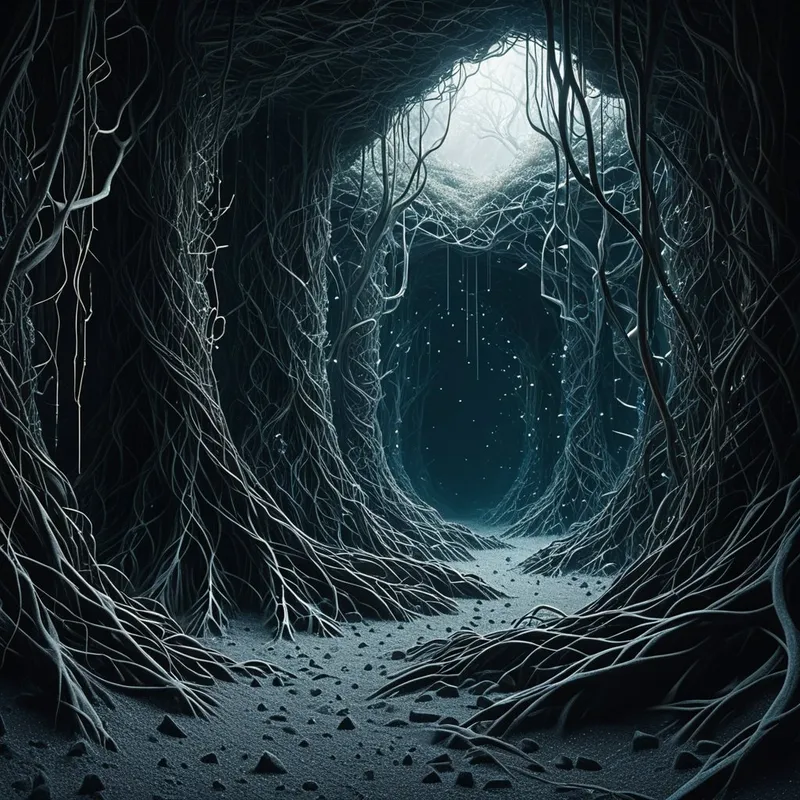
We see this eternal process in the Greek myth of the Labyrinth. The kingdom of Crete is plagued by the terror of the Minotaur—a monstrous hybrid born of a repressed transgression, fed on human sacrifice, and hidden at the heart of an impossible maze. The kingdom’s anxiety is palpable, a somatic echo through the land. The hero Theseus does not simply slay the beast. He must first descend into the convoluted, dark architecture (the unconscious), use a thread (the connection to consciousness, Ariadne’s clue), and confront the monstrous hybrid of animal and human (the disowned, instinctual self). The victory is not just over the beast, but over the maze itself; it is a reclamation of the center. Your anxiety dream is your personal labyrinth, and the Minotaur is not your enemy, but a forgotten part of your nature waiting to be met, named, and integrated.
Symbolic Nodes
- Being Chased/Pursued: The pressure of disowned aspects of the self or unlived life.
- Falling: A loss of control, or more deeply, a surrender of a rigid ego position.
- Being Naked in Public: The fear of the authentic, vulnerable self being exposed.
- Teeth Falling Out: Anxiety about efficacy, powerlessness to communicate or nourish oneself.
- Lost or Trapped: Feeling constrained by life circumstances or internal paradigms with no visible exit.
- Missing a Crucial Vehicle (bus, plane, train): Fear of a life path passing you by, of being out of sync with your own destiny.
Archetypal Resonance
The energy at the core of the anxiety dream is most potently expressed by The Shadow Ruler Archetype. The Ruler archetype governs order, control, responsibility, and sovereignty. In its shadow aspect, this need for control becomes tyrannical, not over a kingdom, but over the inner landscape. The Shadow Ruler is the internal control-freak, the panicked administrator of the psyche who, sensing a subsystem (an emotion, a desire, an intuition) operating outside its jurisdiction, sends in the alarm of anxiety. The somatic echo—the tightness, the shallow breath—is the feeling of this tyrannical rule, a lockdown of the system. The alchemical potential lies in transforming this shadow energy into the true Ruler’s grace: not through tighter control, but through the establishment of a wise, compassionate, and secure inner sovereignty that can hold all parts of the self without fear of rebellion.
The Alchemical Process
The transmutation of anxiety requires the heat of conscious attention and the pressure of compassionate endurance—the solve et coagula of the soul. First, the solve: you must allow the solid, fearful story of the dream to dissolve. Do not fight the monster; stop running. Turn and face the pursuer in the dream’s aftermath. This act alone applies immense heat, breaking down the rigid identification with the terrified ego. Then, the coagula: from that dissolved state, ask the fear what it truly is. Is it power? Is it a message? Is it a forgotten child? This inquiry begins the recombination. You are not trying to eliminate the anxiety, but to change its state—from a free-floating terror that haunts you, to a specific, named energy that can be reintegrated into your psychic structure. The leaden weight of dread, held in this crucible of non-judgmental awareness, can slowly transmute into the gold of discernment and inner authority.
The Integration Protocol
Question 1: When you feel the somatic echo of this fear in waking life, where in your body does it reside most strongly? If that sensation had a texture, a temperature, and a shape, what would they be?
Question 2: If the pursuing force or looming disaster in your dream were not an enemy, but a lost, desperate part of you trying to get your attention, what might it be trying to say or deliver?
Question 3: What area of your waking life feels the most "out of your control," and how might the need for absolute control (the Shadow Ruler) be masking a deeper need for authentic sovereignty?
Action 1 (Somatic Anchoring): When anxiety arises, bypass the story. Place your hand on the part of your body where you feel the echo most intensely. Breathe into that space for three cycles. Do not try to change the sensation; simply acknowledge its presence with the warmth of your hand and breath, as you would a startled animal.
Action 2 (Dream Re-scripting): In a journal, re-write the ending of your anxiety dream. Do not simply make it "happy." Instead, give yourself a new action. If you were chased, turn and ask the pursuer a single question. If you were falling, notice what you see as you fall. This creative act rewires the neural pathway of helplessness.
Action 3 (Ritual of Sovereignty): Find a small stone. Hold it, and for a moment, let it represent the dense, cold fear. Then, take it outside. Dig a small hole, place the stone inside, and cover it. As you do, state aloud: "I return this unformed power to the earth. I choose to reclaim my authority in its mature form." This ritual externalizes the internal alchemy.
Final Validation
To have these dreams is not a sign of weakness or brokenness. It is evidence of a psyche that is alive, dynamic, and courageously attempting its own reorganization. The very terror you experience is a measure of the power seeking to come home. It is difficult, deeply so, because it asks you to descend into the labyrinth of your own making and meet what you have hidden there. But remember: the thread that guides you out is woven from your own willingness to turn and look. The sovereignty you seek on the other side of fear is not a calm devoid of feeling, but a profound capacity to hold all of your experience, even the trembling echoes, as part of your rightful, integrated kingdom.