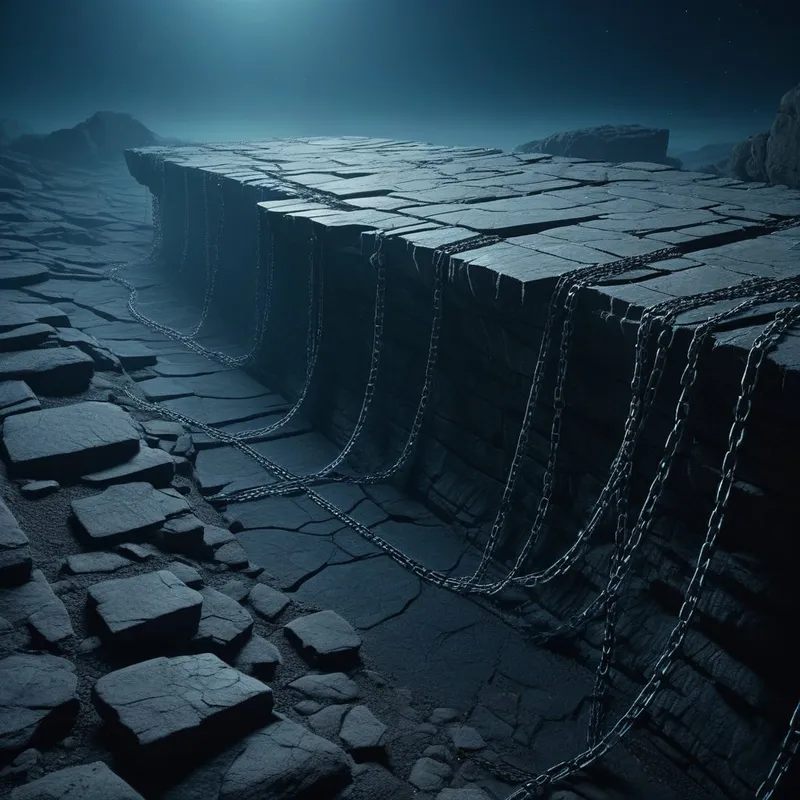
The Ledger in the Blood: On the Dream of Ancestral Debt
It begins not as a thought, but as a posture. A specific, learned curvature of the spine. It is the sensation of walking into a room where a vital conversation has just ceased, the air thick with an argument you did not hear but whose emotional residue coats your tongue like ash. It is a gravity in the shoulders that has nothing to do with your own burdens, a phantom weight settled deep in the marrow, humming with a frequency of old griefs, silenced rages, and unpaid vows. This is the somatic echo of ancestral debt—a ledger kept not in books, but in the nervous system, passed down like a recessive gene for melancholy or a too-quick temper. Before the mind can articulate the dream of forgotten obligations, the body already knows its balance is off, carrying a load that belongs to another lifetime.
The Dreamer's Log
I am in a vast, silent bank of polished obsidian. A teller with no face hands me a statement. The balance is not in currency, but in units of time and silence—a staggering deficit. I am told I must pay, or something precious will be forfeited. I wake with my jaw clenched, a metallic taste of panic in my mouth.
The dream alchemically interprets as: The psyche presenting the bill for inherited emotional labor and unlived lives, demanding conscious acknowledgment before it claims your future as collateral.

The False Lead
This is not a curse, nor is it the simplistic notion of "family karma" that implies a passive fate. To mistake it for such is to remain a debtor in a system you believe is immutable. The dream of ancestral debt is not about literal ghosts demanding reparation; it is about the living architecture of your perceptions, your triggers, your capacities for joy and contraction, which were built with borrowed—and often toxic—materials. It is not bad luck; it is unconscious inheritance. The terror lies not in the debt itself, but in the implicit belief that you are only the inheritor, and not also the potential liquidator of the estate.
Psychological Architecture
To engage with this dream is to enter the vault of the internal family. Here, you do not find singular traumas, but patterns—repeating algorithms of collapse, avoidance, or overcompensation. A part of you (the Manager) works tirelessly to service this debt, perhaps through perfectionism, through care-taking that drains you, through a career chosen to satisfy a ghost’s ambition. Another part (the Exile) holds the raw, undigested grief, shame, or fear that the ancestor could not process, and which now flavors your anxieties. The Shadow Work here is forensic and compassionate: to sit with these internal parts and ask, "Whose pain are you carrying? Whose voice is this that says I am not enough?" The individuation process demands you perform a psychic audit. You must differentiate between the authentic voice of your soul and the internalized recording of an ancestor’s unmet need, their broken promise, their stifled cry. This is the slow, meticulous work of untangling your own melody from the chorus of the past.
Mythic Resonance
We see this in the Greek tale of the House of Atreus, where the curse of betrayal and cannibalism passes through generations, from Tantalus to Agamemnon to Orestes. Each heir is bound to re-enact or avenge the crimes of the past, their lives not their own but installments in a bloody saga. The cycle only breaks when Orestes, after being hounded by the Furies (the embodied guilt of the lineage), submits to a trial—a conscious, witnessed examination of the debt—at Athens. The myth tells us the debt cannot be ignored or violently refused; it must be brought before the light of conscious reason and divine mercy to be dissolved. Similarly, the Norse myth of Sigurd involves him awakening to a legacy of dragon-slaying and broken oaths not his own, inheriting a sword and a destiny that requires him to navigate a web of past treacheries to claim his own path.
Symbolic Nodes
- Ledgers, Bills, or Invoices: With incomprehensible or emotional currencies.
- Tax Authorities or Bank Tellers: Faceless, bureaucratic figures of demand.
- Inherited Houses: Particularly ones that are decaying, labyrinthine, or haunted by presences.
- Heavy Jewelry or Crowns: Ornaments of status that feel like shackles.
- Family Heirlooms: That pulse, weep, or demand something.
- Being Pursued for a Parent's Crime.
- A Garden You Must Tend: That is choked with weeds not of your planting.
Archetypal Resonance
The energy here is most potently that of The Shadow Ruler. Not the Sovereign who governs from authentic authority, but the heir who has inherited a crumbling kingdom and its massive debts. This Shadow Ruler operates from a place of burdened control, anxiety, and a deep-seated fear of the system's collapse—a system they did not design but feel utterly responsible for maintaining. The somatic echo of the clenched jaw and heavy shoulders is the posture of this burdened ruler, trying to hold together an inherited structure with personal willpower. The alchemical potential lies in the agonizing but necessary transition from this Shadow Ruler—the stressed steward of a failing legacy—to the true Sovereign. The Sovereign does not just manage inherited territory; they have the courage to survey it honestly, dismantle what is rotten, and declare what laws will truly govern their own life.
The Alchemical Process
The transmutation of ancestral debt is an alchemy of conscious recognition and sacred refusal. The base material is the leaden, unquestioned assumption that "this is just how we are" or "this is my duty." The heat and pressure are applied the moment you dare to feel the full weight of the inheritance and, instead of collapsing under it or reflexively rebelling, you ask: "Does this contract serve life? Does this debt belong to me?" This is the nigredo, the blackening—a descent into the grief of realizing how much of your life energy has been diverted to service a phantom loan. The albedo, the whitening, is the clarifying separation: "This is their story. This is my story. This is the tangled knot where they meet." The final rubedo, the reddening, is the generation of your own psychic currency—your values, your boundaries, your authentic desires—and using it to issue a new decree. You transmute the debt into sovereignty by paying it off with a currency the ancestors never possessed: conscious choice.

The Integration Protocol
Question 1: When you feel that deep, familiar weight of "not enough" or "too much," can you trace its emotional texture? Does it feel like your own fresh anxiety, or like a well-worn, handed-down garment of worry?
Question 2: What unspoken family rule or expectation feels most like a law you did not write but are expected to enforce? What would happen if you quietly repealed it, just for yourself?
Question 3: If you could return one specific piece of emotional or psychic inheritance to your lineage with a note attached, what would it be and what would the note say?
Action 1 (Somatic Audit): For one week, practice noticing the bodily sensation of obligation or anxiety the moment it arises. Place a hand on the part of your body that holds it (chest, gut, shoulders) and silently ask, "How old is this feeling? Is it mine?" Do not analyze, just listen to the somatic answer.
Action 2 (Creative Nullification): Take a piece of paper. On it, draw or write in abstract symbols the shape and texture of the ancestral debt as you sense it. Then, using water, fire (safely), or by tearing and burying it, perform a simple ritual of nullification. The act is not about magic, but about your psyche witnessing you physically engaging with and altering the symbolic form of the burden.
Action 3 (Boundary as Tribute): Identify one small, recurring situation where you automatically defer, people-please, or shrink to service the "debt." Consciously choose to act differently, not with rebellion, but with calm, internal sovereignty. This new action is not a rejection of your past, but the first installment of a new kind of tribute—paid to your own future.
Final Validation
It is a profound and lonely courage, to feel the weight of centuries in your bones and to choose not to pass it on, but to let it end with you. To do so may feel like a betrayal, for you are dissolving a contract that others still believe is sacred. This is the difficulty. But remember: the true betrayal is not of the ancestors; it is of the unborn—those who will come after you, who wait for you to balance this ledger so they might begin their lives free of its compound interest. Your conscious grief, your righteous anger, your firm "no" to what is not yours, is the alchemical fire. In that heat, the debt does not vanish; it is transmuted. It becomes the fertile ground, the deep root system, from which your own sovereign tree—twisted by the storms of the past, but reaching uniquely toward its own sun—finally grows.