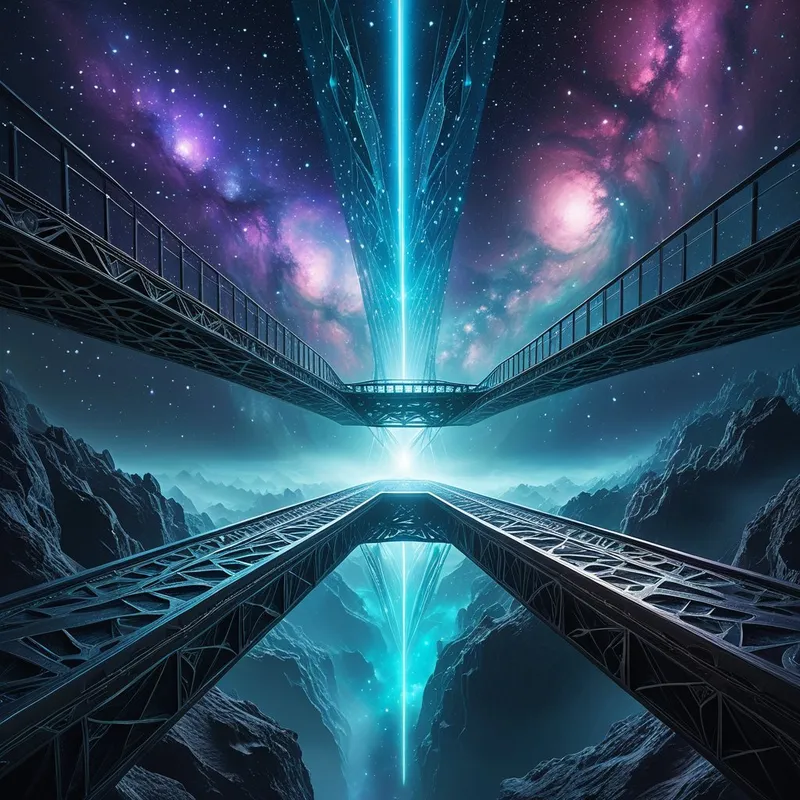
The Summons at the Crossroads: On the Dream of Alternative Paths
It begins not as a thought, but as a hollowing. A sudden, vertiginous drop in the solar plexus, as if the floor of your certainty has dissolved into a lattice of possibilities, each strand vibrating with a different future. The body knows the crossroads before the mind can map it—a tightness in the jaw from paths not spoken, a phantom ache in the legs from roads not walked. This is the Somatic Echo: the visceral tremor of potentiality. It is the psyche’s way of bypassing the curated narratives of the conscious mind to deliver a direct, physiological telegram: Your current structure is being questioned by your deeper architecture.
The Dreamer's Log
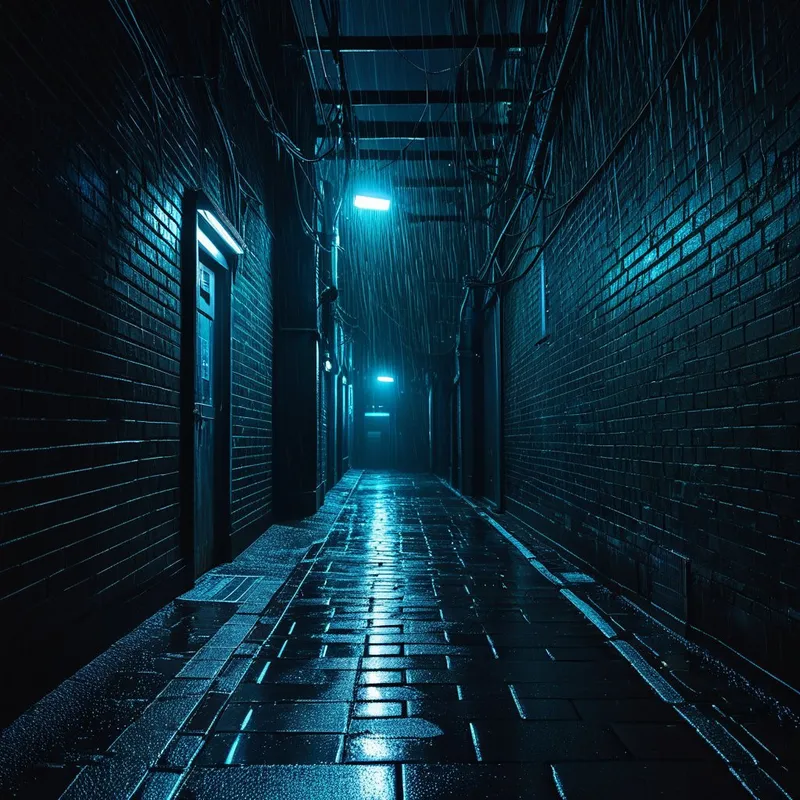
The dreamer stands in a rain-slicked alley, the familiar route home blocked by fallen scaffolding. A forgotten service terminal flickers to life on a brick wall, displaying a shimmering, three-dimensional map of the city. It highlights a route they never knew existed—a path through steam vents and rooftop gardens, leading not home, but to the glowing spire of a library they’d only seen in childhood books. The known way is barred; the unknown way glows.
This dream is an alchemical ignition: the collapse of the habitual (the blocked path) forces a communion with archived potential (the library spire), initiating a recalibration of personal navigation.
The False Lead
This theme is not about regret for a single, specific “wrong turn” in the past—that is the territory of grief and nostalgia. Nor is it a fantasy of escape from consequence. The dream of Alternative Paths is a profound structural signal. It speaks to the living, breathing present tension between the self you have constructed and the selves your psyche still holds in potential. It is the difference between mourning a closed door and realizing your entire house has multiple, unseen foundations. The terror is not of having chosen poorly, but of the terrifying responsibility of ongoing, conscious creation.
Psychological Architecture
To encounter this dreamspace is to be invited into the deepest chambers of Shadow work. Here, we do not meet a monster, but a council of ghosts—the vibrant, un-lived versions of ourselves. The disciplined artist you abandoned for security whispers beside the devoted parent you feared becoming. The shadow here is not a repressed trauma, but a repressed destiny. The Individuation process at this juncture is a brutal and beautiful diplomacy. It requires you to sit at the table with these spectral delegates, not to choose one to crown, but to acknowledge their existence as part of your wholeness. You are not fixing a mistake; you are dissolving the illusion of a singular, linear identity and reassembling your sovereignty from a field of potentials. The grief felt is for the necessary death of the story that you are only one thing.
Mythic Resonance
This is the eternal human firmware, most elegantly coded in the myth of The Garden of Forking Paths—not just Borges’s labyrinth, but the ancient, pre-verbal understanding of time as a sprawling, synchronous tree. It echoes in Odysseus, who yearns for the straight path home to Ithaca but is fundamentally shaped, made whole and wise, by the archipelago of detours, monsters, and seductions that are the path. The straight road is the ego’s fantasy; the winding, branching, alternative route is the soul’s curriculum.
Symbolic Nodes
- Forked Roads/Bridges/Staircases: The classic architecture of choice.
- Maps, Glowing Terminals, or Compasses: Interfaces with hidden knowledge or new navigation systems.
- Blocked or Washed-Out Familiar Routes: The forced cessation of autonomic living.
- Mirrors Showing Different Reflections: The visual representation of parallel selves.
- Overgrown Garden Gates or Secret Doors: Access points to neglected aspects of the inner world.
- Vehicles That Change Form or Destination: The transforming vessel of the Self.
Archetypal Resonance
The core energy here is that of The Explorer Archetype. Not the wanderer fleeing pain, but the Seeker in its most profound expression: the one who understands that the territory is ultimately internal.
The somatic echo—the hollow pull, the restlessness—is the Explorer’s engine igniting, sensing a horizon within. This archetype resonates because the theme’s core is not about correcting a path, but about discovering the inherent multiplicity of the landscape of Self. Its alchemical potential lies in its willingness to trade the false comfort of the known map for the terrifying, sovereign authority of the compass. The shadow—the Aimless or Alienated wanderer—appears only when we mistake the call for external novelty rather than internal revelation. The true Explorer knows the alternative path always leads back to, and deepens, the center.
The Alchemical Process
The transmutation here is from Paralysis to Potentiation. The base lead is the freezing anxiety of infinite choice, the grief for the "one right life" now seen as fiction. The alchemical fire is applied through a conscious, sustained holding of that contradiction: to fully feel the weight of all paths without rushing to choose one. This is the nigredo, the blackening. You must let the old, singular identity dissolve in the acid of possibility. The pressure is the unbearable tension of being undefined. From this limbo, the albedo emerges—not as a chosen path, but as a dawning realization: you are not on a path, you are the pathmaker. The gold is the achieved sovereignty where every choice, past or future, is reclaimed as an expression of a multifaceted, creative self. The path does not define you; you define the path by walking it.
The Integration Protocol
Question 1: Where in my waking life do I feel a subtle, somatic pull (a curiosity, a resonance) that I have been rationalizing away as "impractical" or "not me"?
Question 2: If I imagined the "me" that walked the most vivid alternative path in my dream, what core quality or value does that version embody that my current life structure minimizes?
Question 3: What familiar, "safe" route in my daily life feels most like a blocked alley—performed out of habit, but no longer leading to a place that nourishes?
Action 1 (Somatic Cartography): For one week, carry a small notebook. When you feel that hollow pull or restlessness (the somatic echo), stop. Don't analyze. Instead, jot down three concrete, immediate options for your next action—one routine, one slightly novel, one seemingly absurd. Do not judge or choose; simply record. You are mapping the micro-crossroads of your day.
Action 2 (Council of Selves): Set a timer for 20 minutes. Write a dialogue between your current self and the self from the most compelling alternative path in your dream. Do not aim for resolution. Let them speak. Ask that other self: "What do you know that I have forgotten?" This is creative diplomacy.
Action 3 (Ritual of the Unchosen): Find a small stone. Hold it, and pour into it your grief or anxiety for a specific path not taken—not as regret, but as acknowledgment. Then, take it to a crossroads (a literal intersection, a forked trail, a river junction). Place it there, stating aloud: "I release you from the burden of being the only way. I honor your place in my field." Walk away without looking back. This ritual externalizes the internal release of linear destiny.
Final Validation
The disorientation is real. The grief for the simpler story of a single, fated life is legitimate. It is terrifying to be the architect of your own becoming when you were taught to be a pilgrim on a pre-laid road. But this terror is the raw material of your sovereignty. The dream of alternative paths is not a punishment for getting lost. It is a summons from your own core, confirming a profound and liberating truth: you were never lost. You were always, and only, expanding. The maze is not a trap; it is the shape of your freedom.