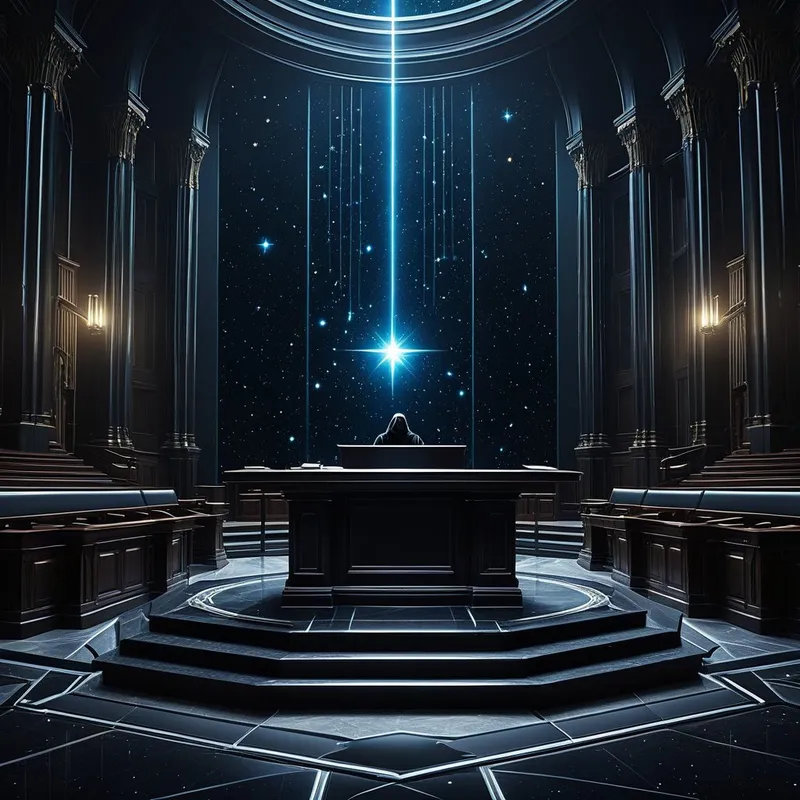
The Somatic Echo
It begins not as a thought, but as a weight. A density in the solar plexus, a cold, metallic taste at the back of the throat. It is the feeling of an unpaid debt, not to a bank, but to the soul—a ledger left unbalanced in some forgotten internal vault. The body remembers what the conscious mind has neatly filed away: the unspoken apology, the integrity compromised for comfort, the promise you made to yourself in a moment of clarity and broke in a moment of fear. This is the somatic echo of accountability. It manifests as a low-grade hum of unease, a subtle tension in the jaw that speaks of words swallowed, or a restless leg that wants to run from the witness stand you’ve erected in your own psyche. Justice, in the dreamscape, is not an external verdict to be won, but an internal equilibrium desperately seeking restoration. The body feels the tilt of the inner scales long before the dream images arrive to illustrate it.
The Dreamer's Log
The dreamer stands in a vast, silent data archive. Endless rows of servers hum, but one terminal flickers with an error. A file, labeled with their own name, is corrupted. The log shows a cascade of failures originating from a single, ignored command entered years ago. To fix it, they must manually re-enter every subsequent command, feeling the consequence of each keystroke.
This is the psyche forcing a forensic audit, a meticulous review of cause and effect where you are both the system administrator and the flawed code.

The False Lead
Do not mistake this theme for a simple dream of persecution or bad luck. It is not the universe punishing you, nor is it a sign to seek vengeance in the waking world. The courtroom in the dream is your own psyche; the plaintiff and the defendant are both aspects of you. The cry for justice is not a cry for retribution against others, but a profound demand for acknowledgment from the self. It is the difference between the Shadow Orphan’s wail of “Why is this happening to me?” and the sovereign’s inquiry of “How did I participate in creating this reality?” The former keeps you trapped in the dock; the latter invites you to pick up the gavel.
Psychological Architecture
This dream theme signals a critical phase in the Individuation process: the reclamation of personal authority from the internal exiles. We fragment ourselves to survive. The part that spoke the harsh truth is locked away to preserve a relationship. The part that accepted poor treatment is buried to maintain an identity of strength. The part that desires a different life is silenced to honor old loyalties. These exiled fragments do not disappear; they become a silent jury, a chorus of ghosts in the basement of consciousness. Their collective verdict is the somatic weight, the unease.
The Shadow work here is to turn toward this internal tribunal, not as a criminal before a judge, but as a sovereign reconvening a scattered council. It is to listen to the prosecution—the voice of the betrayed innocent, the furious rebel, the neglected child—and to hear its testimony not as an attack, but as a fractured piece of your own truth seeking wholeness. Justice, in this deep psychological sense, is the act of giving each exiled part a dignified hearing, allowing its experience to be validated and integrated into a more complete, more authentic self. The process is the antithesis of self-blame; it is the arduous, compassionate reconstruction of a self that can hold its own complexity without fracture.
Mythic Resonance
We see this eternal process in the myth of Themis, the Greek Titaness of Divine Law and Order. She is not the punisher; she is the embodiment of the natural, foundational order of things—what is right and proper. She is often blindfolded, not to ignore evidence, but to represent impartiality, the internal scale that weighs actions against the intrinsic law of one’s own being. Her daughter is Dike, the spirit of justice, retribution, and mortal law. The myth tells us that true justice (Dike) must be born from natural order (Themis). In our terms, right action in the world must stem from the restoration of right order within.
Similarly, the Egyptian concept of Ma’at—the cosmic principle of truth, balance, and harmony—required that one’s heart be weighed against her feather in the afterlife. The goal was not a light heart devoid of experience, but a heart in balance. A heart heavy with unacknowledged deceit or self-betrayal would tip the scales. The dream is this weighing ceremony happening in real-time, a psychic preparation for living a life in alignment, where your internal truth is not a burden that sinks you, but a measure of your integrity.
Symbolic Nodes
- Scales, Balances, Level Surfaces: The direct image of weighing, evaluation, and the search for equilibrium.
- Ledgers, Lists, Unpaid Bills: The accounting of actions, debts (karmic or psychological), and unresolved obligations.
- Courtrooms, Judges, Gavels: The internalization of law, judgment, and the need for a formal verdict or resolution.
- Broken Contracts, Torn Documents: Violations of trust, particularly self-trust and broken promises to the self.
- Being Pursued or Put on Trial: The sense of a consequence finally catching up, often representing the self confronting the self.
- Cleaning, Fixing, Repairing Foundational Cracks: The active process of restoring integrity to a compromised internal structure.
Archetypal Resonance
The energy at the core of this theme is The Ruler Archetype, specifically emerging from its shadow state. The Shadow Ruler is the internal tyrant or control-freak who maintains order through suppression, blame (of self or others), and rigid, fear-based laws. The dream of accountability is often the collapse of this brittle, tyrannical regime. The exiled parts are staging a revolution. The profound call, however, is not to destroy the throne, but to heal the monarch. The alchemical potential is to transform the Shadow Ruler’s need for control into the Sovereign’s capacity for wise, compassionate authority. This is the shift from blaming the citizenry (your parts) for unrest to listening to their grievances and integrating their needs into a more just, resilient kingdom of the self. The somatic echo is the weight of the crown worn poorly; the integration is learning to wear it with authenticity and balance.
The Alchemical Process
The transmutation here is from Lead of Blame (which is static and heavy) into the Gold of Sovereign Responsibility (which is active and freeing). The alchemical fire is the unbearable heat of self-confrontation without the escape hatch of self-flagellation. It is the Nigredo—the blackening—of staring unflinchingly at your own ledger: the times you chose comfort over courage, silence over truth, allegiance to an old self over the call of a new one.
The pressure is applied by holding two contradictory truths in the heart’s crucible: “I did the best I could with what I had and my actions (or inactions) created consequences.” This is not the dualistic heat of “good vs. evil,” but the transformative heat of “cause and effect meeting compassion.” The old, brittle identity—the one that either plays the perfect victim or the harsh judge—must dissolve in this heat. What begins to coalesce is the sovereign: the one who can acknowledge fault without shattering, who can feel regret without being defined by it, who can make amends to the self and others from a place of wholeness, not inadequacy. The gold is the quiet, unshakeable authority that comes from having faced your own court and integrated the verdict.

The Integration Protocol
Question 1: Where in my life does my body feel the weight of an "unpaid debt"? Is it a relationship, a project, a promise to myself? Don't think—feel. Let the sensation point to the ledger.
Question 2: If a part of me were to take the witness stand in my defense, what would it most desperately want the jury (the rest of me) to understand? What testimony have I been silencing?
Question 3: What one law, imposed by an old version of myself, is now causing rebellion in my internal kingdom? Is it a law of perfection, of constant pleasing, of never needing?
Action 1 (The Silent Audit): For one day, carry a small stone in your pocket. Each time you feel the somatic echo—the pang of guilt, resentment, or unease—transfer the stone to your other pocket. This is not about solving, just noticing and physically acknowledging the internal tally.
Action 2 (The Exile's Portrait): Using any medium—crayons, collage, digital art—create an image of one exiled part. The one who was "too much," "too needy," "too angry." Don't make it pretty. Make it true. Then, write a short letter from that part's perspective, beginning with "What you need to know about why I act this way is..."
Action 3 (The Sovereign's Decree): Write a one-sentence "law" for your inner kingdom that replaces an old, punitive rule. Make it a law of compassion, not control. (e.g., replace "Thou shalt not fail" with "All citizens are allowed to learn.") Speak it aloud to yourself with authority.
Final Validation
This work is not for the faint of heart. To sit in the self-constructed courtroom of your soul, to hear the echoes of your own betrayals and unmet promises, is a profound and often terrifying courage. It is easier by far to blame the external world, to play the orphaned victim of circumstance. But your dreams have brought you here because a deeper, more authentic law is demanding recognition. The path to true justice—the inner Ma’at, the right order of Themis—begins with this brave, compassionate audit of the self. By facing the ledger, you are not condemning yourself; you are finally claiming the authority to close the old books and write, with a steadier hand, the story of a sovereign.