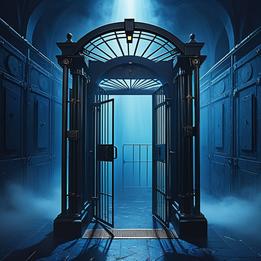
Turnstile
A mechanical gate that controls passage, often representing transitions, access, and the flow of life between different states or spaces.
Turnstile Dream Meaning
A mechanical gate that controls passage, often representing transitions, access, and the flow of life between different states or spaces.
Interpretive Themes
Cultural Lenses
Jungian Perspective
View Context →Represents the threshold between conscious and unconscious realms, a liminal space where transformation occurs. Historically seen in initiation rituals; modernly symbolizes personal growth through psychological integration.
Freudian Perspective
View Context →Symbolizes sexual intercourse or bodily openings, with the turning motion representing rhythmic penetration. Historically linked to taboo passages; modernly reflects anxieties about intimacy or repression of desires.
Gestalt Perspective
View Context →Represents the dreamer's own boundaries or parts of self in conflict. Historically, barriers in perception; modernly, how one navigates internal divisions or projects control onto the environment.
Cognitive Perspective
View Context →Reflects mental schemas for decision-making or problem-solving. Historically, cognitive gates in memory; modernly, symbolizes processing transitions or accessing stored information in daily life.
Evolutionary Perspective
View Context →Stems from ancestral needs for territorial boundaries and safe passage. Historically, physical barriers for survival; modernly, represents social navigation and resource access in complex societies.
East Asian Perspective
View Context →In Feng Shui, symbolizes the flow of qi (energy) and balance between yin and yang. Historically, gateways in temples; modernly, represents harmony in transitions, like career changes or family entries.
European Perspective
View Context →Linked to medieval city gates and industrial revolution controls. Historically, symbols of class access; modernly, reflects bureaucratic systems or public transport秩序的 in urban life.
Modern Western Perspective
View Context →Associated with consumerism, ticketed events, and security culture. Historically, post-industrial control; modernly, symbolizes meritocracy, exclusivity, or the pace of urban existence and digital access.
Global/Universal Perspective
View Context →A cross-cultural symbol for life's passages, from birth to death. Historically, rites of passage; modernly, represents universal experiences of change, barriers, and the human need for order in transitions.
Middle Eastern Perspective
View Context →Evokes ancient bazaar gates and religious pilgrimage checkpoints. Historically, trade route controls; modernly, symbolizes spiritual journeys, hospitality boundaries, or political divisions in daily life.
African Perspective
View Context →Connected to village entrances and communal initiation spaces. Historically, thresholds for elders; modernly, represents ancestral guidance in transitions, community access, or post-colonial identity shifts.
Latin American Perspective
View Context →Relates to colonial fortifications and festival entrances. Historically, symbols of resistance; modernly, embodies migration, cultural blending, or economic barriers in vibrant, layered societies.
Want a deeper analysis?
Get a personalized interpretation of your entire dream including this symbol.
Interpret My DreamCommon Appearances & Contexts
| Context | Emotion | Interpretation |
|---|---|---|
| Context Stuck at turnstile | Emotion Frustration | Interpretation Feeling blocked. |
| Context Smooth passage through | Emotion Relief | Interpretation Easy transition. |
| Context Bypassing turnstile | Emotion Defiance | Interpretation Breaking rules. |
| Context Turnstile malfunction | Emotion Confusion | Interpretation Uncertain direction. |
| Context Guarding turnstile | Emotion Power | Interpretation Controlling access. |
| Context Queue at turnstile | Emotion Impatience | Interpretation Waiting for change. |
| Context Turnstile in nature | Emotion Disorientation | Interpretation Man-made intrusion. |
| Context Child at turnstile | Emotion Innocence | Interpretation New experiences. |
| Context Turnstile spinning freely | Emotion Liberation | Interpretation No restrictions. |
| Context Broken turnstile | Emotion Vulnerability | Interpretation Lack of protection. |
| Context Multiple turnstiles | Emotion Overwhelm | Interpretation Many choices. |
| Context Turnstile as portal | Emotion Wonder | Interpretation Mystical passage. |
Interpret Your Full Dream
Beyond this symbol, every dream carries a unique story. Share your dream for a personalized AI-powered interpretation.