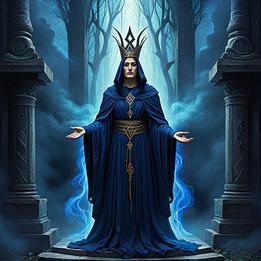
Thelema
A spiritual philosophy founded by Aleister Crowley emphasizing individual will, divine law, and magical practice as the path to enlightenment.
Thelema Dream Meaning
A spiritual philosophy founded by Aleister Crowley emphasizing individual will, divine law, and magical practice as the path to enlightenment.
Interpretive Themes
Individual Will
highDreams may reflect personal destiny struggles.
Spiritual Rebellion
highCould indicate a breaking from tradition.
Divine Law
mediumSuggests alignment with a higher order.
Transformation
mediumMay symbolize a desire for profound change.
Mysticism
lowCould represent a search for deeper meaning.
Mythological Resonance
Horus
EgyptianThe crowned and conquering child who avenged his father Osiris, representing the new aeon of individual divine authority.
Prometheus
GreekDefied the gods to bring fire (knowledge and power) to humanity, embodying rebellious enlightenment.
Cultural Lenses
Jungian Perspective
View Context →Symbolizes the individuation process—integrating the shadow and aligning with the Self. Thelema's 'True Will' reflects the archetype of the Hero's journey toward wholeness, often appearing in dreams as a call to authenticity.
Freudian Perspective
View Context →May represent repressed desires (id) breaking free from societal superego constraints. The 'Do what thou wilt' motto could symbolize unconscious libidinal drives seeking expression, with ritual elements as sublimation.
Gestalt Perspective
View Context →Seen as a projection of the dreamer's unfinished business with authority or self-direction. Each symbol (e.g., rituals, texts) represents a part of the self needing integration to achieve completeness.
Cognitive Perspective
View Context →Reflects schemas related to autonomy, purpose, and metaphysical belief systems. The brain processes existential questions through familiar esoteric frameworks, aiding in problem-solving or identity construction.
Evolutionary Perspective
View Context →Taps into adaptive mechanisms for social hierarchy and meaning-making. Thelema's emphasis on will and magic may echo ancestral rituals for control over uncertainty, enhancing survival through perceived agency.
Modern Western Perspective
View Context →Often viewed through countercultural or occult lenses, symbolizing rebellion against mainstream religion. In dreams, it can indicate a search for alternative spirituality or identity in a secular age.
European Perspective
View Context →Rooted in Western esotericism (e.g., Hermeticism, Kabbalah), it represents a historical lineage of magical thought. Dreams may connect to cultural narratives of mysticism and individualism from the Renaissance onward.
Middle Eastern Perspective
View Context →Might be interpreted through Sufi or Gnostic parallels, emphasizing divine union and inner truth. In dreams, it could symbolize a personal jihad (struggle) for spiritual enlightenment beyond orthodox practices.
East Asian Perspective
View Context →Viewed alongside Taoist 'Wu Wei' or Buddhist concepts of Dharma, suggesting alignment with natural law. Dreams may reflect harmony with one's path, though the magical aspects might seem foreign.
South Asian Perspective
View Context →Comparable to Hindu 'Dharma' or Tantric practices, focusing on will as a spiritual discipline. In dreams, it could symbolize the pursuit of moksha (liberation) through personalized ritual and intent.
African Perspective
View Context →May resonate with traditional systems like Ifá, where destiny (Orí) is realized through ritual. Dreams could indicate a calling to engage with ancestral wisdom or personal orí (inner head) alignment.
Global/Universal Perspective
View Context →Represents the universal human quest for purpose and transcendence. Across cultures, dreams of Thelema-like symbols often reflect deep desires for autonomy, meaning, and connection to the divine.
Historical Authorities
Want a deeper analysis?
Get a personalized interpretation of your entire dream including this symbol.
Interpret My DreamThe Oracle's Prediction
Combine multiple symbolsYou will face a choice between conformity and authentic expression.
Timeframe
Seasonal (~3 Months)
Intensity
Deep
Common Appearances & Contexts
| Context | Emotion | Interpretation |
|---|---|---|
| Context Ritual performance | Emotion Focused | Interpretation Seeking control or power. |
| Context Receiving a message | Emotion Awestruck | Interpretation Divine revelation or calling. |
| Context Breaking rules | Emotion Liberated | Interpretation Rejecting constraints. |
| Context Ancient temple | Emotion Reverent | Interpretation Connecting to tradition. |
| Context Writing a book | Emotion Inspired | Interpretation Creating personal doctrine. |
| Context Being judged | Emotion Defiant | Interpretation Asserting individuality. |
| Context Light from darkness | Emotion Hopeful | Interpretation Transformation through will. |
| Context Lost in maze | Emotion Confused | Interpretation Searching for true will. |
| Context Crowning ceremony | Emotion Empowered | Interpretation Self-deification or mastery. |
| Context Burning symbols | Emotion Angry | Interpretation Destroying old beliefs. |
| Context Meeting a guide | Emotion Curious | Interpretation Seeking esoteric knowledge. |
| Context Scaling a mountain | Emotion Determined | Interpretation Pursuit of enlightenment. |
Interpret Your Full Dream
Beyond this symbol, every dream carries a unique story. Share your dream for a personalized AI-powered interpretation.