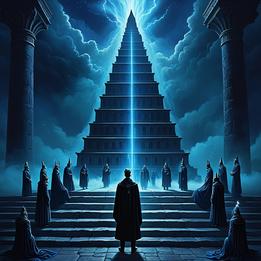
The Hierarchy
A structured system of ranking, power, and social order, often representing authority, status, and one's position within a group or society.
The Hierarchy Dream Meaning
A structured system of ranking, power, and social order, often representing authority, status, and one's position within a group or society.
Interpretive Themes
Mythological Resonance
Caste System
HinduThe varna system organizing society into hierarchical classes, representing both cosmic order and social limitation.
Jacob's Ladder
BiblicalThe ladder connecting earth and heaven with angels ascending and descending, representing spiritual hierarchy and connection between realms.
Cultural Lenses
Jungian Perspective
View Context →Represents the psyche's internal structure: ego, persona, shadow, anima/animus, and Self. Hierarchies in dreams mirror the individuation process, where integrating unconscious elements leads to wholeness and self-realization.
Freudian Perspective
View Context →Symbolizes the superego's imposition of societal rules and the id's primal desires. Dream hierarchies often reflect childhood power dynamics with parents, revealing repressed conflicts about authority and sexual competition.
Gestalt Perspective
View Context →Each level of the hierarchy represents an aspect of the self in conflict or dialogue. The dreamer projects parts of their personality onto different ranks, exploring integration of fragmented self-concepts.
Cognitive Perspective
View Context →Reflects the brain's schema for processing social information and threat detection. Hierarchies in dreams may consolidate memories of social interactions, rehearsing responses to status challenges or authority figures.
Evolutionary Perspective
View Context →Rooted in ancestral survival mechanisms, where social ranking determined resource access and mating opportunities. Dreams of hierarchies activate ancient neural pathways for navigating group dynamics and dominance hierarchies.
East Asian Perspective
View Context →In Confucian tradition, hierarchies reflect cosmic order (li) and harmonious relationships. Modern interpretations balance filial piety with contemporary critiques of rigid social structures in corporate and family contexts.
South Asian Perspective
View Context →Historically tied to caste (varna) and dharma (duty). Contemporary dreams may wrestle with these inherited structures while incorporating spiritual hierarchies from yoga and meditation practices.
Middle Eastern Perspective
View Context →Blends tribal kinship hierarchies with Islamic concepts of ummah (community) equality before God. Modern dreams often contrast traditional patriarchal structures with aspirations for merit-based advancement.
European Perspective
View Context →Draws from feudal systems, class structures, and Enlightenment critiques. Contemporary interpretations focus on bureaucratic hierarchies, social mobility, and tensions between meritocracy and inherited privilege.
African Perspective
View Context →Integrates elder-based communal hierarchies with colonial/post-colonial power structures. Dreams often explore tensions between traditional respect for age and modern educational/economic status markers.
North American Perspective
View Context →Emphasizes meritocratic ideals alongside realities of systemic inequality. Dreams frequently involve corporate ladders, social media influence hierarchies, and the American Dream narrative of upward mobility.
Latin American Perspective
View Context →Navigates complex layers of colonial legacy, economic class, and indigenous community structures. Modern dreams often reflect aspirations for social justice amid persistent hierarchical divisions.
Historical Authorities
Want a deeper analysis?
Get a personalized interpretation of your entire dream including this symbol.
Interpret My DreamThe Oracle's Prediction
Combine multiple symbolsA clear advancement opportunity will present itself within an existing structure.
Timeframe
Lunation (~29 Days)
Intensity
Deep
Power dynamics in a key relationship will come into focus for renegotiation.
Timeframe
Immediate (Next 48h)
Intensity
Deep
Common Appearances & Contexts
| Context | Emotion | Interpretation |
|---|---|---|
| Context Climbing ladder | Emotion Determination | Interpretation Career advancement desire. |
| Context Falling from top | Emotion Fear | Interpretation Loss of status. |
| Context Observing from below | Emotion Envy | Interpretation Social comparison. |
| Context Rebelling against order | Emotion Defiance | Interpretation Challenging authority. |
| Context Creating new hierarchy | Emotion Pride | Interpretation Establishing control. |
| Context Being at pinnacle | Emotion Isolation | Interpretation Loneliness of power. |
| Context Equalizing levels | Emotion Hope | Interpretation Desire for fairness. |
| Context Hierarchy collapsing | Emotion Chaos | Interpretation Fear of disorder. |
| Context Serving superiors | Emotion Submission | Interpretation Accepting lower role. |
| Context Ignoring ranks | Emotion Liberation | Interpretation Rejecting social norms. |
| Context Fixed position | Emotion Frustration | Interpretation Feeling stuck. |
| Context Mentoring others | Emotion Responsibility | Interpretation Leadership role. |
Interpret Your Full Dream
Beyond this symbol, every dream carries a unique story. Share your dream for a personalized AI-powered interpretation.