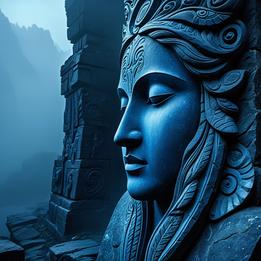
Stone Carving
Stone carvings represent permanence and the manifestation of artistic expression, often with sacred connotations.
Stone Carving Dream Meaning
Stone carvings represent permanence and the manifestation of artistic expression, often with sacred connotations.
Interpretive Themes
Artistic Expression
highStone carvings showcase human creativity and vision.
Cultural Heritage
highCarvings are often linked to significant cultural narratives and identities.
Sacredness
highMany carvings hold religious or spiritual meanings.
Timelessness
mediumStone’s durability symbolizes enduring legacies.
Spiritual Connection
mediumCarvings often serve as conduits for spiritual reflections.
Mythological Resonance
Pygmalion
GreekA sculptor who carved a statue of a woman so perfect he fell in love with it; Aphrodite brought it to life as Galatea.
Code of Hammurabi
MesopotamianLaws carved into a basalt stele to establish enduring justice, depicting the king receiving authority from the sun god Shamash.
Cultural Lenses
Middle Eastern Perspective
View Context →Carvings depicted gods and pharaohs, often found in tombs. Meant to ensure safe passage to the afterlife. [Ancient Egypt] Carvings were key to Egyptian spiritual beliefs.
European Perspective
View Context →Carvings depicted nature, mythology, and spiritual symbols. Used in ceremonial contexts to invoke protection. [Celtic] Celtic carvings are often intricately designed with knots and spirals.
Historical Authorities
Want a deeper analysis?
Get a personalized interpretation of your entire dream including this symbol.
Interpret My DreamThe Oracle's Prediction
Combine multiple symbolsA long-term project or skill will finally gain recognition or solidify.
Timeframe
Seasonal (~3 Months)
Intensity
Deep
Common Appearances & Contexts
| Context | Emotion | Interpretation |
|---|---|---|
| Context Admiring a large stone carving | Emotion Awe | Interpretation This indicates a desire for deeper meaning or connection to history. |
| Context Carving stone yourself | Emotion Creativity | Interpretation This may represent personal expression and making one's mark in the world. |
| Context Discovering ancient stone carvings | Emotion Intrigue | Interpretation This can signify an interest in ancestry and cultural heritage. |
| Context Walking past a stone carving in a cemetery | Emotion Solitude | Interpretation This might reflect feelings of loss and mourning. |
| Context Encountering a stone carving depicting a deity | Emotion Reverence | Interpretation This indicates respect and contemplation of the divine. |
| Context Seeing stone carvings deteriorate | Emotion Sadness | Interpretation This signifies fear of losing cultural history or identity. |
| Context Engaging in a ritual around a stone carving | Emotion Connection | Interpretation This may symbolize a yearning to participate in cultural practices. |
| Context Having a conversation with a stone carving | Emotion Nostalgia | Interpretation This could indicate a connection with past generations. |
| Context Seeing a stone carving illuminated by the sun | Emotion Joy | Interpretation This signifies a moment of realization or enlightenment. |
| Context Finding personal messages within a stone carving | Emotion Elation | Interpretation Reflects a deep personal connection with spiritual guidance. |
| Context Creating a stone carving as an offering | Emotion Devotion | Interpretation This indicates a desire to express gratitude or reverence. |
| Context Living near ancient stone carvings | Emotion Security | Interpretation This can symbolize connection to cultural roots and identity. |
| Context Traveling to see famous stone carvings | Emotion Adventure | Interpretation Reflects a quest for knowledge and exploration of humanity's history. |
Interpret Your Full Dream
Beyond this symbol, every dream carries a unique story. Share your dream for a personalized AI-powered interpretation.