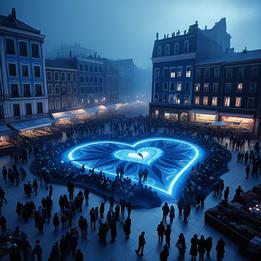
Plaza
A central public square symbolizing community, gathering, and social interaction, often representing the heart of a city or society.
Plaza Dream Meaning
A central public square symbolizing community, gathering, and social interaction, often representing the heart of a city or society.
Interpretive Themes
Mythological Resonance
The Roman Forum
RomanThe central plaza of ancient Rome where law, commerce, and social life intersected, representing the heart of civic identity.
Templo Mayor Plaza
AztecThe sacred central square of Tenochtitlan where ritual, market, and community life converged in the city's spiritual and social center.
Cultural Lenses
Jungian Perspective
View Context →Represents the collective unconscious and social persona. The plaza as mandala symbolizes wholeness and the center of psychic life where individual meets collective consciousness.
Freudian Perspective
View Context →Symbolizes social libido and repressed desires for public recognition. The open space may represent exhibitionistic tendencies or fear of social judgment regarding hidden impulses.
Gestalt Perspective
View Context →Represents the relationship between figure (individual) and ground (society). The plaza shows how one organizes social space and perceives oneself within community context.
Cognitive Perspective
View Context →Mental schema for social navigation and memory organization. The plaza represents cognitive mapping of social relationships and processing of interpersonal information.
Evolutionary Perspective
View Context →Modern manifestation of ancestral gathering spaces for safety, mate selection, and resource sharing. Represents evolved need for social bonding and community surveillance.
European Perspective
View Context →Historical centers of civic life, from Roman forums to medieval market squares. Symbolizes democratic ideals, public discourse, and the tension between individual and state authority.
Latin American Perspective
View Context →Zócalo or plaza mayor as heart of community life, blending indigenous gathering traditions with colonial architecture. Site of festivals, protests, and daily social interaction.
Middle Eastern Perspective
View Context →Ancient souk squares and mosque courtyards as centers of commerce, worship, and social exchange. Represents intersection of spiritual and worldly community life.
East Asian Perspective
View Context →Temple courtyards and imperial squares representing harmony between human society and cosmic order. Space for collective rituals and demonstration of social hierarchy.
North American Perspective
View Context →Town squares and civic centers symbolizing frontier community building and democratic ideals. Modern plazas often represent commercial rather than purely civic spaces.
African Perspective
View Context →Traditional village gathering spaces under trees or in central compounds. Represents oral tradition, community decision-making, and intergenerational knowledge transmission.
Global/Universal Perspective
View Context →Fundamental human need for communal gathering spaces across all civilizations. Represents the universal tension between individual identity and social belonging in shared public realms.
Historical Authorities
Want a deeper analysis?
Get a personalized interpretation of your entire dream including this symbol.
Interpret My DreamThe Oracle's Prediction
Combine multiple symbolsA significant new connection will enter your social sphere.
Timeframe
Seasonal (~3 Months)
Intensity
Deep
A collaborative project will require public presentation or group coordination.
Timeframe
Lunation (~29 Days)
Intensity
Deep
Common Appearances & Contexts
| Context | Emotion | Interpretation |
|---|---|---|
| Context Empty plaza | Emotion Isolation | Interpretation Social disconnection or loneliness. |
| Context Crowded plaza | Emotion Overwhelm | Interpretation Social pressure or anxiety. |
| Context Festive plaza | Emotion Joy | Interpretation Community celebration or belonging. |
| Context Protest in plaza | Emotion Defiance | Interpretation Social justice or rebellion. |
| Context Lost in plaza | Emotion Confusion | Interpretation Directionless in social life. |
| Context Speaking in plaza | Emotion Exposure | Interpretation Public vulnerability or expression. |
| Context Market plaza | Emotion Abundance | Interpretation Resource exchange or opportunity. |
| Context Ancient plaza | Emotion Awe | Interpretation Connection to heritage or history. |
| Context Fountain plaza | Emotion Renewal | Interpretation Emotional cleansing or refreshment. |
| Context Deserted plaza | Emotion Abandonment | Interpretation Social rejection or exclusion. |
| Context Nighttime plaza | Emotion Mystery | Interpretation Hidden aspects of self. |
| Context Childhood plaza | Emotion Nostalgia | Interpretation Innocent social connections. |
Interpret Your Full Dream
Beyond this symbol, every dream carries a unique story. Share your dream for a personalized AI-powered interpretation.