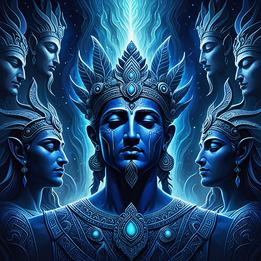
Many-faced God
A deity with multiple faces or aspects, representing the multifaceted nature of divinity, reality, or consciousness across spiritual traditions.
Many-faced God Dream Meaning
A deity with multiple faces or aspects, representing the multifaceted nature of divinity, reality, or consciousness across spiritual traditions.
Interpretive Themes
Mythological Resonance
Brahma
HinduThe creator god often depicted with four faces representing the four Vedas and the four directions, symbolizing omniscience and the totality of creation.
Janus
RomanThe god of beginnings, gates, transitions, and endings, depicted with two faces looking to the past and future simultaneously.
Avalokiteshvara
BuddhistThe bodhisattva of compassion sometimes depicted with eleven heads or a thousand arms, representing the ability to perceive and respond to all suffering simultaneously.
Cultural Lenses
Jungian Perspective
View Context →Represents the Self archetype integrating multiple aspects of personality (persona, shadow, anima/animus). Historical: Rooted in mandala symbolism. Modern: Individuation process toward wholeness.
Freudian Perspective
View Context →Symbolizes fragmented psyche or repressed desires manifesting as multiple identities. Historical: Linked to dream censorship. Modern: Suggests unresolved conflicts between id, ego, superego.
Gestalt Perspective
View Context →Represents unfinished business or multiple perspectives needing integration. Historical: Part-whole relationships. Modern: Encourages dialogue between different aspects of self for closure.
Cognitive Perspective
View Context →Manifests cognitive schemas about identity or divinity. Historical: Pattern recognition. Modern: Brain processing multiple self-concepts or belief systems simultaneously.
Evolutionary Perspective
View Context →Adaptive advantage of seeing multiple perspectives for survival. Historical: Threat assessment. Modern: Brain's way of processing complex social or spiritual information.
South Asian Perspective
View Context →Linked to deities like Brahma (four faces) representing creation, knowledge, and the Vedas. Historical: Vedic origins. Modern: Symbol of omniscience in Hinduism.
East Asian Perspective
View Context →Associated with Avalokiteshvara (Guanyin) with multiple manifestations showing compassion. Historical: Buddhist adaptation. Modern: Represents merciful attention to all suffering.
Middle Eastern Perspective
View Context →Ancient Mesopotamian multi-faced deities like Lamassu guarded palaces. Historical: Protective spirits. Modern: Rare in Abrahamic traditions but appears in mystical Kabbalah as divine aspects.
European Perspective
View Context →Medieval Green Man or Janus (two-faced) symbolizing transitions. Historical: Pagan and Roman origins. Modern: Literary symbol in works like Game of Thrones.
African Perspective
View Context →Orishas like Elegua manifesting in multiple forms guiding crossroads. Historical: Yoruba traditions. Modern: Diasporic religions emphasize multifaceted divine accessibility.
North American Perspective
View Context →Some Indigenous trickster figures change faces. Historical: Oral traditions. Modern: Symbol of adaptability in contemporary Native spirituality.
Modern Western Perspective
View Context →Popularized by fantasy as death deity (Many-Faced God). Historical: Literary invention. Modern: Represents anonymity, change, and equality in death in media.
Historical Authorities
Want a deeper analysis?
Get a personalized interpretation of your entire dream including this symbol.
Interpret My DreamThe Oracle's Prediction
Combine multiple symbolsA profound revelation about the interconnected nature of reality will emerge.
Timeframe
Seasonal (~3 Months)
Intensity
Deep
Common Appearances & Contexts
| Context | Emotion | Interpretation |
|---|---|---|
| Context Worshiping in temple | Emotion Reverence | Interpretation Seeking divine guidance. |
| Context Faces changing rapidly | Emotion Confusion | Interpretation Overwhelmed by choices. |
| Context One face speaks | Emotion Clarity | Interpretation Receiving specific wisdom. |
| Context Faces merging | Emotion Peace | Interpretation Achieving inner unity. |
| Context Hiding from faces | Emotion Fear | Interpretation Avoiding self-truths. |
| Context Counting the faces | Emotion Curiosity | Interpretation Analyzing life aspects. |
| Context Faces arguing | Emotion Anxiety | Interpretation Internal conflict present. |
| Context Offering to faces | Emotion Hope | Interpretation Seeking multifaceted blessings. |
| Context Faces in mirror | Emotion Shock | Interpretation Confronting multiple selves. |
| Context Building the statue | Emotion Purpose | Interpretation Creating personal divinity. |
| Context Faces disappearing | Emotion Loss | Interpretation Losing perspectives. |
| Context Choosing a face | Emotion Determination | Interpretation Committing to path. |
Interpret Your Full Dream
Beyond this symbol, every dream carries a unique story. Share your dream for a personalized AI-powered interpretation.