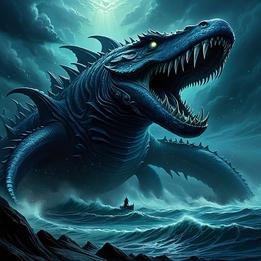
Leviathan
A primordial sea monster representing chaos, the unconscious, and overwhelming power, often seen as a divine or cosmic adversary.
Leviathan Dream Meaning
A primordial sea monster representing chaos, the unconscious, and overwhelming power, often seen as a divine or cosmic adversary.
Interpretive Themes
Cultural Lenses
Jungian Perspective
View Context →Archetype of the collective unconscious representing primal chaos and untamed psychic energy. Symbolizes the shadow or the Self that must be integrated for wholeness.
Freudian Perspective
View Context →Represents repressed libidinal energy or id forces. The sea symbolizes the unconscious; the monster embodies sexual or aggressive impulses breaking through repression.
Gestalt Perspective
View Context →Projection of one's own overwhelming aspects. The dreamer is both the leviathan and its observer, representing internal conflict between chaos and control.
Cognitive Perspective
View Context →Mental schema for processing overwhelming threats. Brain's way of conceptualizing large-scale problems through familiar mythological framework to reduce cognitive load.
Evolutionary Perspective
View Context →Evolutionary memory of primal predators or natural disasters. Represents deep-seated fear of uncontrollable forces that threatened ancestral survival.
Middle Eastern Perspective
View Context →In Hebrew tradition, primordial sea monster defeated by God (Job 41, Psalms 74). Represents chaos before creation, now controlled by divine order.
European Perspective
View Context →Medieval Christian symbol of Satan or heresy. Later Romantic symbol of sublime nature's terrifying power beyond human comprehension or control.
Modern Western Perspective
View Context →Metaphor for systemic problems like climate change or capitalism. Represents forces too large for individuals to confront, requiring collective action.
East Asian Perspective
View Context →Similar to dragon but more chaotic. In Chinese myth, represents unpredictable natural forces like floods. In Japanese, may be sea kami requiring appeasement.
Global/Universal Perspective
View Context →Cross-cultural archetype of chaos monster. Appears as Tiamat (Mesopotamia), Jörmungandr (Norse), Makara (Hindu), representing primordial disorder versus cosmic order.
African Perspective
View Context →In some West African traditions, represents dangerous water spirits. In modern context, symbolizes colonial or post-colonial forces overwhelming traditional ways.
Oceanian Perspective
View Context →In Polynesian myth, represents destructive sea forces. In Maori tradition, similar to taniwha - water guardians that can be protective or dangerous depending on treatment.
Want a deeper analysis?
Get a personalized interpretation of your entire dream including this symbol.
Interpret My DreamCommon Appearances & Contexts
| Context | Emotion | Interpretation |
|---|---|---|
| Context Fleeing monster | Emotion Panic | Interpretation Avoiding major challenge. |
| Context Controlling leviathan | Emotion Triumph | Interpretation Mastering inner chaos. |
| Context Leviathan rising | Emotion Dread | Interpretation Unconscious surfacing. |
| Context Leviathan sleeping | Emotion Unease | Interpretation Latent power present. |
| Context Leviathan attacking | Emotion Terror | Interpretation Overwhelmed by forces. |
| Context Leviathan speaking | Emotion Awe | Interpretation Ancient wisdom emerging. |
| Context Leviathan dying | Emotion Melancholy | Interpretation End of era. |
| Context Leviathan protecting | Emotion Security | Interpretation Powerful ally present. |
| Context Leviathan transforming | Emotion Wonder | Interpretation Chaos becoming order. |
| Context Leviathan in storm | Emotion Fear | Interpretation Emotional turmoil overwhelming. |
| Context Leviathan in calm | Emotion Peace | Interpretation Acceptance of power. |
| Context Leviathan hunting | Emotion Anxiety | Interpretation Pursued by problem. |
Interpret Your Full Dream
Beyond this symbol, every dream carries a unique story. Share your dream for a personalized AI-powered interpretation.