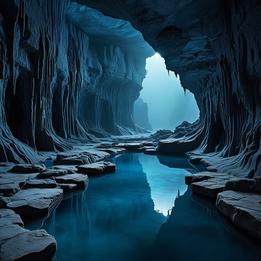
Karst
A landscape shaped by water dissolving soluble rock, creating caves, sinkholes, and underground rivers. Symbolizes hidden depths, transformation, and the interplay of surface and subterranean worlds.
Karst Dream Meaning
A landscape shaped by water dissolving soluble rock, creating caves, sinkholes, and underground rivers. Symbolizes hidden depths, transformation, and the interplay of surface and subterranean worlds.
Interpretive Themes
Mindfulness
highCaves represent the unconscious mind.
Transformation Through Erosion
highDissolution leading to new forms.
Duality of Surface/Depth
mediumVisible landscape vs. hidden voids.
Fragility and Stability
mediumGround that can collapse unexpectedly.
Natural Mystery
lowEvokes wonder and the unknown.
Mythological Resonance
The Labyrinth of Crete
GreekDaedalus built the labyrinth to contain the Minotaur—a hidden, complex structure beneath the surface world.
The Peach Blossom Spring
ChineseA fisherman discovers a hidden utopian valley through a cave in a karst mountain, representing revelation of ideal worlds.
Cultural Lenses
Jungian Perspective
View Context →Represents the collective unconscious—a hidden, ancient psychic layer shaped by archetypal forces. Caves symbolize the womb of transformation, where ego dissolves to access deeper wisdom. Modern: metaphor for shadow work.
Freudian Perspective
View Context →Symbolizes repressed desires and childhood trauma buried in the unconscious. Caves represent the female genitalia; exploration signifies sexual curiosity. Sinkholes indicate sudden return of repressed material.
Gestalt Perspective
View Context →The figure-ground relationship of surface stability versus hidden voids. Represents unfinished business—what is unseen or avoided. Exploration is integrating disowned parts of self into awareness.
Cognitive Perspective
View Context →Metaphor for memory networks and schemas shaped by experience (erosion). Caves represent latent knowledge; getting lost reflects cognitive disorganization. Modern: akin to neural pathways.
Evolutionary Perspective
View Context →Taps into ancestral memories of caves as shelters and dangers. Evokes innate responses to darkness, enclosed spaces, and water sources. Modern: primal awe/fear of geological forces.
East Asian Perspective
View Context →In Daoism, represents the void (wu) from which all forms emerge. Caves are portals to immortality; karst landscapes like Guilin symbolize harmony between yin (caves) and yang (peaks). Modern: spiritual retreat sites.
South Asian Perspective
View Context →In Hinduism, caves are meditation sites where ascetics seek moksha. Karst formations symbolize maya—illusory surface over spiritual reality. Ritual: cave temples like Ellora. Modern: pilgrimage destinations.
European Perspective
View Context →Medieval: caves as entrances to underworld, homes of dragons or saints. Romantic era: sublime terror in karst landscapes. Historical: mining symbolism. Modern: adventure tourism and conservation.
African Perspective
View Context →In San rock art, caves are ritual spaces connecting to spirit world. Karst formations seen as ancestral dwellings. Ritual: initiation ceremonies in caves. Modern: cultural heritage sites.
Latin American Perspective
View Context →In Mesoamerican cultures, caves (cenotes) are portals to Xibalba (underworld). Karst symbolizes cyclical death/rebirth. Ritual: sacrifices in sinkholes. Modern: sacred ecological sites.
Middle Eastern Perspective
View Context →In Islamic tradition, caves are places of revelation (Hira) and refuge (Seven Sleepers). Karst deserts symbolize divine hiddenness. Historical: caravanserais near springs. Modern: archaeological significance.
Global/Universal Perspective
View Context →Cross-culturally, caves represent birth, death, and transformation. Karst evokes universal awe at geological time and hidden water sources. Modern: UNESCO geoparks symbolizing Earth's memory.
Historical Authorities
Want a deeper analysis?
Get a personalized interpretation of your entire dream including this symbol.
Interpret My DreamThe Oracle's Prediction
Combine multiple symbolsA hidden truth will be revealed through patient observation.
Timeframe
Seasonal (~3 Months)
Intensity
Deep
Common Appearances & Contexts
| Context | Emotion | Interpretation |
|---|---|---|
| Context Exploring a cave | Emotion Curiosity | Interpretation Delving into subconscious. |
| Context Ground collapsing | Emotion Fear | Interpretation Foundation giving way. |
| Context Finding hidden water | Emotion Relief | Interpretation Discovering inner resources. |
| Context Mapping formations | Emotion Focus | Interpretation Charting internal landscape. |
| Context Lost underground | Emotion Anxiety | Interpretation Disoriented in psyche. |
| Context Emerging into light | Emotion Liberation | Interpretation Insight from depths. |
| Context Water carving rock | Emotion Awe | Interpretation Time's transformative power. |
| Context Stalactites growing | Emotion Patience | Interpretation Slow, persistent development. |
| Context Sinkhole appearing | Emotion Shock | Interpretation Sudden revelation. |
| Context Echoing chambers | Emotion Loneliness | Interpretation Amplified inner voice. |
| Context Crystal formations | Emotion Wonder | Interpretation Hidden beauty within. |
| Context Flooded passage | Emotion Overwhelm | Interpretation Emotions blocking access. |
Interpret Your Full Dream
Beyond this symbol, every dream carries a unique story. Share your dream for a personalized AI-powered interpretation.