Spiritual & Myth

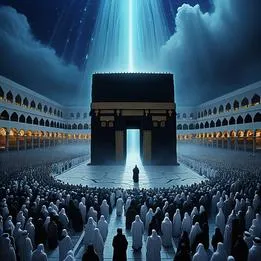
Kaaba Dream Meaning

The Kaaba is the holiest site in Islam, a cuboid structure in Mecca that Muslims face during prayer, symbolizing unity, devotion, and the center of the spiritual world.

Common Appearances & Contexts

Context Emotion Interpretation
Approaching the Kaaba Awe Seeking divine connection.
Circling the Kaaba Devotion Commitment to faith.
Touching the Kaaba Reverence Direct sacred contact.
Seeing from afar Longing Desire for spiritual home.
Inside the Kaaba Wonder Profound inner revelation.
Kaaba in ruins Despair Faith crisis or loss.
Building the Kaaba Purpose Creating spiritual foundation.
Kaaba glowing Hope Divine guidance present.
Unable to reach Frustration Spiritual obstacles faced.
Kaaba moving Confusion Shifting beliefs or values.
Kaaba alone Solitude Personal spiritual journey.
Kaaba crowded Belonging Community and unity.

Interpretive Themes

Cultural Lenses

Middle Eastern Perspective

View Context →

In Islam, the Kaaba is the holiest site, built by Abraham and Ishmael, representing the qibla (direction of prayer) and the unity of the Muslim ummah (community). Historically and ritually central to Hajj, it symbolizes submission to Allah and spiritual purification.

Jungian Perspective

View Context →

The Kaaba represents the Self archetype—the center of the psyche and wholeness. It symbolizes the individuation process, where one integrates unconscious and conscious elements to achieve psychological unity and spiritual fulfillment.

Freudian Perspective

View Context →

The Kaaba may symbolize phallic imagery or paternal authority, reflecting unconscious desires for structure, order, and submission to a higher power. It can represent repressed religious or familial conflicts and the need for moral guidance.

Gestalt Perspective

View Context →

The Kaaba represents a holistic symbol of the dreamer's current spiritual or existential focus. It encourages exploration of the dreamer's relationship to faith, community, and personal center, integrating fragmented aspects of self into a unified whole.

Cognitive Perspective

View Context →

The Kaaba activates schemas related to religion, pilgrimage, and community. It reflects cognitive processes of meaning-making, goal orientation (e.g., spiritual quests), and the mental representation of sacred spaces as anchors for belief and identity.

Evolutionary Perspective

View Context →

The Kaaba taps into evolved tendencies for sacred spaces that promote group cohesion, ritual behavior, and social bonding. It may reflect adaptive mechanisms for reducing existential anxiety through shared beliefs and communal practices.

Global/Universal Perspective

View Context →

As a universal symbol, the Kaaba represents the sacred center found in many cultures—a point of orientation, spiritual focus, and communal unity. It echoes archetypal themes of pilgrimage, devotion, and the human search for divine connection.

South Asian Perspective

View Context →

In South Asian contexts, particularly among Muslim communities, the Kaaba symbolizes spiritual aspiration and piety. It is often referenced in poetry and art, representing a journey of the soul and a reminder of faith's centrality in daily life.

Modern Western Perspective

View Context →

In secular or multicultural Western contexts, the Kaaba is viewed as a symbol of Islamic identity and religious diversity. It may evoke themes of tolerance, interfaith dialogue, or geopolitical awareness, reflecting globalized perspectives on faith.

African Perspective

View Context →

In African Muslim traditions, the Kaaba is a symbol of spiritual return and ancestral connection, often integrated with local rituals. It represents the unity of the global Muslim community and the endurance of faith across diverse cultures.

East Asian Perspective

View Context →

In East Asia, particularly among Muslim minorities, the Kaaba symbolizes religious devotion and cultural integration. It may be interpreted through lenses of harmony and balance, aligning with local philosophical concepts while maintaining Islamic spiritual significance.

European Perspective

View Context →

Historically, in European contexts, the Kaaba was often viewed through Orientalist or colonial lenses. Today, it is more commonly recognized as a key symbol of Islam, reflecting themes of religious pluralism, migration, and intercultural exchange in contemporary society.

AI-Powered

Interpret Your Full Dream

Beyond this symbol, every dream carries a unique story. Share your dream for a personalized AI-powered interpretation.