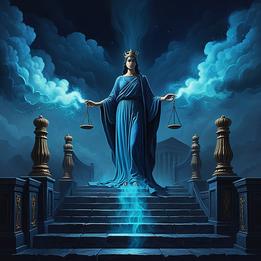
Judicial Process
A structured system for determining justice, resolving disputes, and applying societal rules, often involving authority, judgment, and consequences.
Judicial Process Dream Meaning
A structured system for determining justice, resolving disputes, and applying societal rules, often involving authority, judgment, and consequences.
Interpretive Themes
Mythological Resonance
Weighing of the Heart
EgyptianIn the Hall of Ma'at, the deceased's heart is weighed against the feather of truth to determine their fate in the afterlife.
Themis and Dike
GreekThemis (divine order) and her daughter Dike (human justice) represent the cosmic and earthly aspects of judicial process.
Cultural Lenses
Global/Universal Perspective
View Context →Universal symbol of societal order and moral judgment, appearing in ancient legal codes and modern justice systems worldwide as a mechanism for maintaining social harmony and resolving conflicts.
Jungian Perspective
View Context →Represents the Self's process of individuation, where unconscious contents are brought to consciousness for judgment and integration, symbolizing the psyche's internal court of justice.
Freudian Perspective
View Context →Manifestation of the superego's moral judgments, often reflecting repressed guilt, childhood punishment fears, or unresolved conflicts with paternal authority figures from early development.
Gestalt Perspective
View Context →Projection of internal conflicts onto external legal structures, where different parts of the self argue their case in a dream courtroom, representing fragmented aspects needing integration.
Cognitive Perspective
View Context →Mental simulation of decision-making processes, problem-solving scenarios, or social rule evaluation, reflecting waking cognitive patterns of judgment, fairness assessment, and consequence prediction.
Evolutionary Perspective
View Context →Adaptive mechanism for navigating social hierarchies and group norms, reflecting ancestral needs for conflict resolution, reputation management, and understanding punishment/reward systems in tribal societies.
East Asian Perspective
View Context →In Confucian-influenced cultures, represents hierarchical harmony and collective responsibility; in modern contexts, may reflect tension between traditional familial duty and individual legal rights in rapidly changing societies.
South Asian Perspective
View Context →Connected to dharma (cosmic law) and karma in Hindu/Buddhist traditions, where judicial processes mirror cosmic justice; modern dreams often reflect colonial legal legacies and contemporary bureaucratic challenges.
Middle Eastern Perspective
View Context →Historically tied to Islamic Sharia courts and tribal mediation systems; modern dreams may reflect tensions between traditional religious law, secular legal systems, and post-colonial state authority.
European Perspective
View Context →Rooted in Roman law traditions and Enlightenment ideals of rational justice; contemporary dreams often engage with welfare state bureaucracies, human rights frameworks, and post-war reconciliation processes.
African Perspective
View Context →Blends traditional community-based dispute resolution (like Ubuntu philosophy) with colonial legal systems; modern dreams may reflect struggles with corruption, transitional justice, or land rights conflicts.
North American Perspective
View Context →Heavily influenced by adversarial common law systems and constitutional rights; contemporary dreams often engage with mass incarceration, racial justice movements, and consumer protection litigation culture.
Historical Authorities
Want a deeper analysis?
Get a personalized interpretation of your entire dream including this symbol.
Interpret My DreamThe Oracle's Prediction
Combine multiple symbolsA formal review or evaluation that will determine significant opportunities.
Timeframe
Immediate (Next 48h)
Intensity
Deep
A hidden ethical dilemma requiring careful discernment.
Timeframe
Lunation (~29 Days)
Intensity
Deep
Common Appearances & Contexts
| Context | Emotion | Interpretation |
|---|---|---|
| Context Being judged | Emotion Fear | Interpretation Fear of criticism. |
| Context Witnessing trial | Emotion Anxiety | Interpretation Observing fairness issues. |
| Context Arguing case | Emotion Frustration | Interpretation Feeling misunderstood. |
| Context Receiving verdict | Emotion Relief | Interpretation Resolution achieved. |
| Context Escaping court | Emotion Guilt | Interpretation Avoiding accountability. |
| Context Judge's perspective | Emotion Power | Interpretation Exercising control. |
| Context Jury deliberation | Emotion Uncertainty | Interpretation Weighing decisions. |
| Context Legal paperwork | Emotion Overwhelm | Interpretation Bureaucratic stress. |
| Context Courtroom chaos | Emotion Confusion | Interpretation System breakdown. |
| Context Pleading innocence | Emotion Desperation | Interpretation Seeking validation. |
| Context Sentencing phase | Emotion Dread | Interpretation Facing consequences. |
| Context Appealing decision | Emotion Hope | Interpretation Seeking second chance. |
Interpret Your Full Dream
Beyond this symbol, every dream carries a unique story. Share your dream for a personalized AI-powered interpretation.