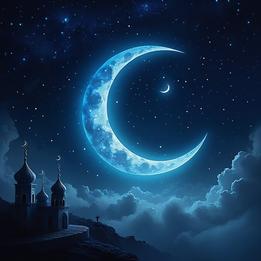
Islamic Crescent
A celestial symbol representing faith, divine guidance, and spiritual illumination in Islam, often associated with the lunar calendar and revelation.
Islamic Crescent Dream Meaning
A celestial symbol representing faith, divine guidance, and spiritual illumination in Islam, often associated with the lunar calendar and revelation.
Interpretive Themes
Divine Guidance
highOften linked to prophetic dreams or clarity.
Spiritual Growth
highSuggests a phase of deepening belief.
Cyclical Renewal
mediumReflects lunar phases and life transitions.
Cultural Identity
mediumMay indicate pride or belonging.
Illumination
highSymbolizes hope and enlightenment.
Mythological Resonance
Muhammad's Night Journey
IslamicProphet's miraculous ascent through heavens, receiving divine revelations.
Sin (Moon God)
MesopotamianAncient lunar deity of wisdom and time, whose crescent symbolized celestial cycles.
Cultural Lenses
Jungian Perspective
View Context →An archetype of the Self or wholeness, symbolizing the integration of conscious and unconscious, often representing spiritual maturation and the individuation process in modern depth psychology.
Freudian Perspective
View Context →May symbolize latent sexual or paternal themes, such as phallic imagery or authority figures, reflecting subconscious desires or conflicts with religious or familial structures in psychoanalytic theory.
Gestalt Perspective
View Context →Represents an aspect of the self, such as faith or intuition, inviting the dreamer to explore its role in their current life situation and personal integration in experiential therapy.
Cognitive Perspective
View Context →A mental schema related to belief systems or cultural identity, activated during sleep to process emotions, memories, or cognitive dissonance in contemporary psychological frameworks.
Evolutionary Perspective
View Context →Taps into ancient human associations with the moon for navigation, timekeeping, and safety, reflecting adaptive mechanisms for social cohesion and survival in evolutionary psychology.
Middle Eastern Perspective
View Context →Deeply tied to Islam as a symbol of faith, divine revelation, and the lunar calendar, historically used in flags and art to represent spiritual guidance and cultural identity in the region.
South Asian Perspective
View Context →Often associated with Islamic communities in the subcontinent, symbolizing piety and cultural heritage, while also intersecting with pre-Islamic lunar symbolism in local traditions and rituals.
European Perspective
View Context →Historically linked to the Ottoman Empire and Crusades, viewed as a symbol of the 'Other' or exoticism, but in modern times, it represents religious diversity and multiculturalism in secular contexts.
African Perspective
View Context →In regions with significant Muslim populations, it symbolizes faith and community, often integrated with indigenous spiritual practices and used in art to denote divine protection and social unity.
Modern Western Perspective
View Context →Commonly recognized as an emblem of Islam, it can evoke themes of religious identity, multiculturalism, or geopolitical tensions, reflecting contemporary debates on faith and diversity in globalized societies.
East Asian Perspective
View Context →Primarily seen as a foreign religious symbol, associated with Muslim minorities, but may also resonate with traditional lunar symbolism in cultures like China or Japan, where the moon represents yin or beauty.
Global/Universal Perspective
View Context →Widely acknowledged as a symbol of Islam, transcending borders to represent faith, guidance, and cultural identity, while also connecting to universal human themes of spirituality and celestial wonder.
Historical Authorities
Want a deeper analysis?
Get a personalized interpretation of your entire dream including this symbol.
Interpret My DreamThe Oracle's Prediction
Combine multiple symbolsA period of divine guidance or prophetic insight.
Timeframe
Lunation (~29 Days)
Intensity
Deep
Common Appearances & Contexts
| Context | Emotion | Interpretation |
|---|---|---|
| Context Seeing a bright crescent in a dark sky | Emotion peaceful | Interpretation Finding spiritual comfort or guidance during difficult times. |
| Context Holding or wearing a crescent | Emotion proud | Interpretation Embracing one's faith or cultural identity with confidence. |
| Context A crescent transforming into a full moon | Emotion hopeful | Interpretation Anticipating spiritual fulfillment or completion of a journey. |
| Context A crescent on a flag or building | Emotion reverent | Interpretation Feeling connected to a community or divine presence. |
| Context A crescent appearing in water | Emotion reflective | Interpretation Introspection about faith or emotional depths. |
| Context A crescent guiding through a maze | Emotion relieved | Interpretation Divine assistance in navigating life's complexities. |
| Context A crescent with stars | Emotion inspired | Interpretation Harmony between spiritual and worldly aspirations. |
| Context A fading or broken crescent | Emotion anxious | Interpretation Doubts about faith or fear of losing guidance. |
| Context A crescent in a childhood setting | Emotion nostalgic | Interpretation Reconnecting with early spiritual influences or roots. |
| Context A crescent during a storm | Emotion resilient | Interpretation Faith providing stability amid chaos or crisis. |
| Context A crescent in a dream of travel | Emotion curious | Interpretation Spiritual exploration or a pilgrimage of the soul. |
| Context A crescent appearing unexpectedly | Emotion awed | Interpretation Sudden spiritual insight or a call to faith. |
Interpret Your Full Dream
Beyond this symbol, every dream carries a unique story. Share your dream for a personalized AI-powered interpretation.