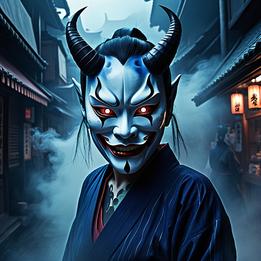
Hannya Mask
A Japanese Noh theater mask representing a woman transformed by jealousy and rage into a vengeful demon, symbolizing the destructive power of intense negative emotions.
Hannya Mask Dream Meaning
A Japanese Noh theater mask representing a woman transformed by jealousy and rage into a vengeful demon, symbolizing the destructive power of intense negative emotions.
Interpretive Themes
Emotional Transformation
highCore to the mask's origin story.
Duality of Human Nature
highMask shows sorrow and rage simultaneously.
Unresolved Conflict
mediumOften linked to betrayal or loss.
Spiritual Possession
mediumEmotion as an external, consuming entity.
Cathartic Expression
lowTheater allows safe exploration of darkness.
Mythological Resonance
Medusa
GreekA beautiful woman transformed into a monstrous gorgon whose gaze turns men to stone, born from betrayal and rage.
Kali
HinduThe fierce goddess of time and destruction, who dances on corpses yet represents the necessary dissolution for rebirth.
Cultural Lenses
Jungian Perspective
View Context →Represents the 'Shadow' archetype—the repressed, jealous, and aggressive aspects of the psyche. Dreaming of it signals confrontation with these denied traits for potential integration and wholeness.
Freudian Perspective
View Context →May symbolize repressed sexual jealousy (penis envy) or rage from the id, transformed by the superego into a monstrous, culturally recognizable form to express taboo desires.
Gestalt Perspective
View Context →You are the Hannya. The dream asks you to embody the mask's jealousy and rage. What part of your life feels betrayed or vengeful? What message does this 'demon' have for you?
Cognitive Perspective
View Context →A mental schema for 'dangerous, transformed emotion.' The dream may reflect cognitive distortions like catastrophizing a betrayal or mind-reading others' malice, personifying these thought patterns.
Evolutionary Perspective
View Context →Personifies extreme mate-guarding jealousy and retaliatory rage—adaptive emotions for deterring rivals and punishing betrayal. The dream may activate threat-detection systems related to social status or partnership.
East Asian Perspective
View Context →In Japanese Noh, it's a woman consumed by jealousy, becoming an oni (demon). Historically, it warns of karmic consequences of obsession. Modernly, it's a potent cultural icon of tragic emotion and artistic expression.
Modern Western Perspective
View Context →Often divorced from its tragic narrative, seen as a 'cool' symbol of inner strength, resilience, or protection against external evils in tattoo culture, losing nuance about internal emotional demons.
Global/Universal Perspective
View Context →A cross-cultural archetype of the 'scorned woman' or 'vengeful spirit,' akin to Medusa or La Llorona. Speaks to universal fears of emotional extremity and the monstrous potential within love turned sour.
European Perspective
View Context →Parallels exist in Gothic and folk traditions (e.g., scorned witches, vengeful furies). It represents the medieval/Romantic fear of female passion unbound by societal restraint, leading to supernatural peril.
South Asian Perspective
View Context →Resonates with concepts like the asura (power-seeking demi-god) or rakshasa (demon) born from intense negative karma. Reflects the Buddhist/Hindu view of how unchecked emotions (kleshas) lead to suffering and lower rebirth.
Middle Eastern Perspective
View Context →Could be interpreted through Jinn lore—a spirit that possesses and twists a person due to intense grief or injustice. The mask is the visible mark of that spiritual affliction and inner turmoil.
African Perspective
View Context →May align with masquerade traditions where masks embody spirits or ancestors. The Hannya could represent a specific ancestor spirit of vengeance or a warning against community-destroying emotions like envy.
Historical Authorities
Want a deeper analysis?
Get a personalized interpretation of your entire dream including this symbol.
Interpret My DreamThe Oracle's Prediction
Combine multiple symbolsA hidden resentment will surface, demanding acknowledgment.
Timeframe
Lunation (~29 Days)
Intensity
Deep
An intense emotional confrontation approaches.
Timeframe
Immediate (Next 48h)
Intensity
Deep
Common Appearances & Contexts
| Context | Emotion | Interpretation |
|---|---|---|
| Context Seeing the mask on a wall | Emotion Unease | Interpretation A suppressed negative emotion or memory is watching you. |
| Context Wearing the mask yourself | Emotion Power | Interpretation You may be embracing or acting out a vengeful or jealous side. |
| Context The mask is chasing you | Emotion Panic | Interpretation A powerful negative emotion from your past is resurfacing. |
| Context The mask is crying | Emotion Pity | Interpretation Recognizing the profound sorrow beneath someone's (or your own) anger. |
| Context Shattering the mask | Emotion Relief | Interpretation Overcoming a long-held grudge or cycle of jealousy. |
| Context Trying to paint the mask | Emotion Frustration | Interpretation Struggling to understand or articulate a complex, painful emotion. |
| Context The mask is on someone you love | Emotion Betrayal | Interpretation Perceiving hidden malice or envy in a close relationship. |
| Context Buying the mask in a shop | Emotion Curiosity | Interpretation Consciously exploring your own capacity for darker feelings. |
| Context The mask is laughing | Emotion Dread | Interpretation A negative emotion has taken full control and is mocking you. |
| Context The mask is melting | Emotion Confusion | Interpretation Intense negative feelings are dissolving, but their form is unclear. |
| Context A child holding the mask | Emotion Alarm | Interpretation A nascent or innocent part of you is being corrupted by strong emotion. |
| Context The mask in a mirror | Emotion Shock | Interpretation Confronting a vengeful or jealous aspect of your own reflection. |
Interpret Your Full Dream
Beyond this symbol, every dream carries a unique story. Share your dream for a personalized AI-powered interpretation.