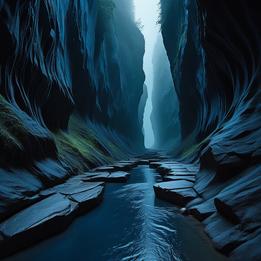
Gulch
A deep, narrow ravine or valley, often formed by water erosion, symbolizing hidden depths, obstacles, or a passage through difficult terrain.
Gulch Dream Meaning
A deep, narrow ravine or valley, often formed by water erosion, symbolizing hidden depths, obstacles, or a passage through difficult terrain.
Interpretive Themes
Hidden Depths
highSymbolizes subconscious or repressed material.
Obstacle or Challenge
highRepresents life difficulties or fears.
Passage or Transition
mediumIndicates a transformative journey.
Isolation or Separation
mediumReflects social or emotional distance.
Erosion or Decay
lowSuggests loss or weakening foundations.
Cultural Lenses
Jungian Perspective
View Context →Represents the shadow or collective unconscious—a deep, often frightening part of the psyche containing repressed traits and archetypal patterns, requiring integration for wholeness.
Freudian Perspective
View Context →Symbolizes female genitalia or birth canal, reflecting sexual anxieties, desires, or trauma related to reproduction, penetration, or maternal relationships.
Gestalt Perspective
View Context →Seen as a projection of the dreamer's inner conflict or gap between aspects of self, such as mind and body, urging awareness and resolution.
Cognitive Perspective
View Context →A mental schema for processing obstacles or emotional divides, possibly linked to real-life stressors like financial gaps or relationship rifts.
Evolutionary Perspective
View Context →Triggers primal fears of falling, predators in hidden terrain, or resource scarcity, reflecting adaptive responses to dangerous landscapes.
Global/Universal Perspective
View Context →Commonly viewed as a natural barrier or hidden place, symbolizing challenges, secrets, or transitions across cultures, often with spiritual or mythic undertones.
East Asian Perspective
View Context →In traditions like Daoism, represents yin energy—receptive, hidden, and feminine—associated with valleys in feng shui as places of potential and quiet power.
South Asian Perspective
View Context →Linked to concepts like maya (illusion) or samsara (cycle of suffering), symbolizing earthly attachments or karmic obstacles one must transcend spiritually.
Middle Eastern Perspective
View Context →In desert cultures, signifies life-giving wadis or perilous divides, often appearing in religious texts as metaphors for trials or divine separation.
European Perspective
View Context →In folklore, seen as haunted or mystical sites, like fairy glens or troll dens, representing the unknown and supernatural boundaries in the landscape.
African Perspective
View Context →Viewed as ancestral pathways or spiritual thresholds in many traditions, where rituals might be performed to communicate with spirits or mark transitions.
North American Perspective
View Context →In Indigenous cultures, often sacred sites for vision quests or storytelling, symbolizing connection to land and teachings about resilience and navigation.
Want a deeper analysis?
Get a personalized interpretation of your entire dream including this symbol.
Interpret My DreamCommon Appearances & Contexts
| Context | Emotion | Interpretation |
|---|---|---|
| Context Falling into gulch | Emotion Fear | Interpretation Loss of control, vulnerability. |
| Context Crossing a gulch | Emotion Determination | Interpretation Overcoming a challenge. |
| Context Hiding in gulch | Emotion Anxiety | Interpretation Avoidance, seeking safety. |
| Context Discovering a gulch | Emotion Curiosity | Interpretation Uncovering hidden truths. |
| Context Water in gulch | Emotion Hope | Interpretation Emotional flow, cleansing. |
| Context Dry, barren gulch | Emotion Despair | Interpretation Emotional drought, stagnation. |
| Context Building over gulch | Emotion Pride | Interpretation Mastering obstacles, bridging divides. |
| Context Gulch widening | Emotion Alarm | Interpretation Growing separation, escalating problems. |
| Context View from gulch edge | Emotion Awe | Interpretation Perspective on depth, scale. |
| Context Trapped in gulch | Emotion Panic | Interpretation Feeling stuck, limited options. |
| Context Gulch as boundary | Emotion Resignation | Interpretation Accepting limits, divisions. |
| Context Descending into gulch | Emotion Anticipation | Interpretation Exploring the unknown, subconscious. |
Interpret Your Full Dream
Beyond this symbol, every dream carries a unique story. Share your dream for a personalized AI-powered interpretation.