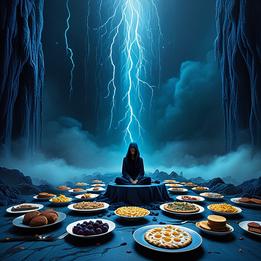
Excess
Dreaming of excess symbolizes overwhelming abundance, imbalance, or a warning against overindulgence in waking life.
Excess Dream Meaning
Dreaming of excess symbolizes overwhelming abundance, imbalance, or a warning against overindulgence in waking life.
Interpretive Themes
Mythological Resonance
Midas
GreekKing Midas wished that everything he touched would turn to gold, but his excessive desire left him unable to eat or drink, turning abundance into curse.
Sodom and Gomorrah
BiblicalCities destroyed for excessive sin and indulgence, representing divine judgment against boundless consumption.
Cultural Lenses
Jungian Perspective
View Context →Excess represents the shadow aspect of abundance - unintegrated desires and unconscious material overflowing into consciousness, requiring balance through individuation and self-regulation.
Freudian Perspective
View Context →Excess symbolizes repressed libidinal energy or oral fixation, representing unconscious desires for overindulgence and pleasure-seeking behaviors from early developmental stages.
Gestalt Perspective
View Context →Excess represents unfinished business or unmet needs manifesting as overwhelming stimuli, indicating the dreamer's avoidance of addressing core issues in waking life.
Cognitive Perspective
View Context →Excess reflects cognitive overload or processing errors, where the brain struggles to manage information, emotions, or stimuli, indicating need for better coping strategies.
Evolutionary Perspective
View Context →Excess represents ancestral survival mechanisms gone awry - hoarding instincts from scarcity environments now maladaptive in modern abundance, triggering anxiety about resource management.
East Asian Perspective
View Context →In Taoist and Buddhist traditions, excess violates the principle of moderation (zhongyong), representing imbalance in yin-yang harmony and warning against disrupting natural flow through overaccumulation.
South Asian Perspective
View Context →In Hindu philosophy, excess represents attachment (raga) and greed (lobha), obstacles on the path to moksha, with traditional stories warning against the karmic consequences of overindulgence.
Middle Eastern Perspective
View Context →In Islamic dream interpretation, excess often warns against israf (wastefulness) and violating principles of moderation, while in pre-Islamic traditions, it could signal divine testing of character.
European Perspective
View Context →Drawing from Greek philosophy (Aristotle's golden mean) and Christian morality (seven deadly sins), excess represents moral failing and imbalance, with historical associations to decadence and decline.
African Perspective
View Context →In many African traditions, excess disrupts communal harmony and ancestral balance, with rituals often redistributing surplus to maintain social equilibrium and prevent spiritual disharmony.
North American Perspective
View Context →In Indigenous traditions, excess violates principles of reciprocity and balance with nature, while in contemporary contexts reflects consumer culture anxieties and environmental concerns.
Latin American Perspective
View Context →Merging Indigenous concepts of balance (such as Inca ayni) with Catholic teachings on moderation, excess warns against disrupting social and spiritual harmony through overaccumulation.
Historical Authorities
Want a deeper analysis?
Get a personalized interpretation of your entire dream including this symbol.
Interpret My DreamThe Oracle's Prediction
Combine multiple symbolsA financial windfall will arrive, but with hidden costs if not managed wisely.
Timeframe
Seasonal (~3 Months)
Intensity
Deep
A relationship may become imbalanced through over-giving or over-taking.
Timeframe
Lunation (~29 Days)
Intensity
Deep
Common Appearances & Contexts
| Context | Emotion | Interpretation |
|---|---|---|
| Context Overflowing containers | Emotion Anxiety | Interpretation Emotional overwhelm present |
| Context Endless food | Emotion Guilt | Interpretation Overindulgence concerns |
| Context Money piles | Emotion Fear | Interpretation Wealth anxiety |
| Context Cluttered spaces | Emotion Frustration | Interpretation Need organization |
| Context Too many people | Emotion Overwhelm | Interpretation Social exhaustion |
| Context Excessive noise | Emotion Irritation | Interpretation Mental overload |
| Context Unending tasks | Emotion Exhaustion | Interpretation Burnout warning |
| Context Overgrown nature | Emotion Awe | Interpretation Uncontrolled growth |
| Context Multiple selves | Emotion Confusion | Interpretation Identity fragmentation |
| Context Excessive speed | Emotion Panic | Interpretation Life moving fast |
| Context Too much light | Emotion Discomfort | Interpretation Overexposure fear |
| Context Endless water | Emotion Dread | Interpretation Emotional flooding |
Interpret Your Full Dream
Beyond this symbol, every dream carries a unique story. Share your dream for a personalized AI-powered interpretation.