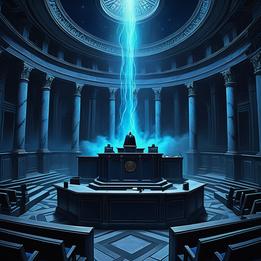
Courtroom
A space of judgment, justice, and societal rules, often representing internal or external evaluation of actions, guilt, or moral conflict.
Courtroom Dream Meaning
A space of judgment, justice, and societal rules, often representing internal or external evaluation of actions, guilt, or moral conflict.
Interpretive Themes
Moral Accountability
highDreamer may feel guilty or defensive.
External Judgment
highSocial anxiety or performance pressure.
Inner Conflict Resolution
mediumDecision-making or internal debate.
Power Dynamics
mediumFeeling powerless or seeking control.
Truth Seeking
lowUncertainty about a situation.
Mythological Resonance
Themis
GreekGoddess of divine law and order, often depicted holding scales and a sword, representing balanced justice and the power to cut through deception.
The Weighing of the Heart
EgyptianIn the Hall of Ma'at, the deceased's heart is weighed against the feather of truth; if balanced, they pass to the afterlife, symbolizing ultimate moral accountability.
Cultural Lenses
Jungian Perspective
View Context →Represents the archetype of judgment and the Self's integration process. The courtroom is where conscious and unconscious elements are weighed, often symbolizing the individuation journey toward wholeness.
Freudian Perspective
View Context →Symbolizes the superego's punishment of the id's desires. The judge represents paternal authority, the defendant repressed urges, and the trial reflects internal conflict between morality and instinct.
Gestalt Perspective
View Context →Every element (judge, jury, defendant) represents disowned parts of the self. The dreamer is all roles simultaneously, and the courtroom drama reveals internal polarities seeking integration.
Cognitive Perspective
View Context →Reflects the brain's threat detection and social evaluation systems. The courtroom scenario activates neural pathways associated with fairness perception, error detection, and social consequence prediction.
Evolutionary Perspective
View Context →Taps into ancient social monitoring mechanisms. Courtrooms represent tribal justice systems where status, reputation, and group cohesion were enforced for survival advantage.
Global/Universal Perspective
View Context →Across cultures, represents societal order versus individual transgression. From village councils to divine judgment, it embodies universal human concerns with fairness, punishment, and social harmony.
East Asian Perspective
View Context →In Confucian-influenced cultures, represents filial piety and social harmony disruption. Historically connected to imperial magistrates; modernly reflects family honor and collective responsibility pressures.
South Asian Perspective
View Context →Connected to dharma (cosmic law) and karma. The courtroom may symbolize the divine court of Yama, judge of the dead, or modern legal systems blending colonial and traditional justice.
Middle Eastern Perspective
View Context →Evokes both Islamic sharia courts and ancient Mesopotamian legal codes. Symbolizes divine judgment (Yaum al-Din) and communal justice, with strong emphasis on witness testimony and oath-taking.
European Perspective
View Context →Draws from Greco-Roman forums, medieval trials by ordeal, and Enlightenment justice ideals. Represents rationalism versus tradition, with modern associations to human rights courts and bureaucratic systems.
African Perspective
View Context →Often connects to ancestral councils and palaver trees where communities resolve disputes. Modern dreams may blend traditional restorative justice with colonial court systems' adversarial nature.
Modern Western Perspective
View Context →Associated with media trials, cancel culture, and workplace tribunals. Less about formal justice than public opinion, social media judgment, and personal brand management in digital age.
Historical Authorities
Want a deeper analysis?
Get a personalized interpretation of your entire dream including this symbol.
Interpret My DreamThe Oracle's Prediction
Combine multiple symbolsA formal evaluation or audit that will clarify your professional standing.
Timeframe
Lunation (~29 Days)
Intensity
Deep
A conflict requiring mediation or a clear boundary-setting conversation.
Timeframe
Immediate (Next 48h)
Intensity
Deep
Common Appearances & Contexts
| Context | Emotion | Interpretation |
|---|---|---|
| Context Being judged | Emotion Fear | Interpretation Fear of exposure. |
| Context Judging others | Emotion Anger | Interpretation Projecting blame outward. |
| Context Witnessing trial | Emotion Curiosity | Interpretation Observing internal conflict. |
| Context Defending oneself | Emotion Anxiety | Interpretation Justifying actions. |
| Context Serving as jury | Emotion Responsibility | Interpretation Weighing moral choices. |
| Context Court in chaos | Emotion Confusion | Interpretation Internal disorder. |
| Context Winning case | Emotion Relief | Interpretation Vindication achieved. |
| Context Losing case | Emotion Shame | Interpretation Self-condemnation felt. |
| Context Empty courtroom | Emotion Isolation | Interpretation Lonely self-judgment. |
| Context Ancient courtroom | Emotion Awe | Interpretation Archetypal judgment. |
| Context Modern courtroom | Emotion Stress | Interpretation Contemporary pressures. |
| Context Being judge | Emotion Power | Interpretation Taking control. |
Interpret Your Full Dream
Beyond this symbol, every dream carries a unique story. Share your dream for a personalized AI-powered interpretation.