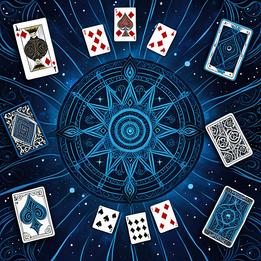
Cartomancy
Divination using playing cards to reveal hidden truths, patterns, or future possibilities through symbolic interpretation.
Cartomancy Dream Meaning
Divination using playing cards to reveal hidden truths, patterns, or future possibilities through symbolic interpretation.
Interpretive Themes
Decision-Making
highCards suggest patterns but not fixed outcomes.
Hidden Knowledge
highSymbols reveal what conscious mind misses.
Pattern Recognition
mediumHuman tendency to create narratives.
Guidance Seeking
highReflects decision-making anxiety.
Mystery & Magic
mediumConnection to mystical traditions.
Mythological Resonance
The Cards
RomaniTraditional fortune-telling decks evolved from playing cards, used by Romani travelers to divine destiny and counsel communities during migrations.
The Fool
TarotRepresents the querent beginning a journey of discovery through the cards, stepping into the unknown with trust in symbolic guidance.
Cultural Lenses
Jungian Perspective
View Context →Archetypal symbols in cards represent collective unconscious patterns. Cartomancy accesses synchronicity - meaningful coincidences revealing psychological truths about the dreamer's individuation process.
Freudian Perspective
View Context →Cards symbolize repressed desires and childhood memories. The act of divination represents wish-fulfillment and sexual symbolism (suits as phallic, round cards as feminine).
Gestalt Perspective
View Context →Each card represents parts of self in relationship. Cartomancy reveals how dreamer organizes experience into meaningful wholes and projects internal conflicts onto external symbols.
Cognitive Perspective
View Context →Pattern-seeking behavior and confirmation bias in interpreting random card arrangements. Reflects brain's predictive processing and tendency to find narratives in ambiguity.
Evolutionary Perspective
View Context →Adaptive advantage in detecting patterns for survival. Cartomancy taps into evolved agency detection and causal reasoning systems that helped ancestors predict environmental changes.
European Perspective
View Context →Rooted in 14th century playing cards from Mamluk Egypt, evolving into French cartomancy traditions. Historically associated with Romani culture and Victorian parlor games, now popular in New Age movements.
Middle Eastern Perspective
View Context →Origins in Mamluk card games with Islamic geometric patterns. Some Sufi traditions use card symbolism for spiritual contemplation, while mainstream Islam generally prohibits fortune-telling practices.
East Asian Perspective
View Context →Often blended with local divination like I Ching or omikuji. Playing cards introduced via Western contact, sometimes adapted with Asian symbolism. Modern popularity in Japan's spiritual consumer culture.
Latin American Perspective
View Context →Syncretic blend of Spanish cartomancy with indigenous and African spiritual traditions. Used in curanderismo and espiritismo for healing and guidance, often alongside other divination methods.
Modern Western Perspective
View Context →Psychological tool for self-reflection rather than prediction. Popular in therapy as projective technique. Commercialized through apps and social media, often divorced from traditional meanings.
Global/Universal Perspective
View Context →Cross-cultural human desire to find meaning in randomness. Universal appeal of symbolic systems for navigating uncertainty, though specific interpretations vary widely by cultural context and belief systems.
African Perspective
View Context →Limited traditional use due to different divination systems (like cowrie shells). Modern adoption through colonial influence, sometimes blended with indigenous practices in diaspora communities.
Historical Authorities
Want a deeper analysis?
Get a personalized interpretation of your entire dream including this symbol.
Interpret My DreamCommon Appearances & Contexts
| Context | Emotion | Interpretation |
|---|---|---|
| Context Reading cards | Emotion Anxious | Interpretation Fear of unknown future. |
| Context Shuffling deck | Emotion Uncertain | Interpretation Life feels random. |
| Context Card spreads | Emotion Hopeful | Interpretation Seeking clarity patterns. |
| Context Tarot comparison | Emotion Confused | Interpretation Multiple truth sources. |
| Context Playing cards | Emotion Nostalgic | Interpretation Childhood games connection. |
| Context Fortune telling | Emotion Excited | Interpretation Anticipation of revelation. |
| Context Card meanings | Emotion Frustrated | Interpretation Information overload struggle. |
| Context Online reading | Emotion Skeptical | Interpretation Digital spirituality conflict. |
| Context Historical cartomancy | Emotion Awed | Interpretation Ancient wisdom respect. |
| Context Card rejection | Emotion Defiant | Interpretation Rebelling against fate. |
| Context Accurate prediction | Emotion Frightened | Interpretation Losing control fear. |
| Context Teaching cartomancy | Emotion Empowered | Interpretation Sharing esoteric knowledge. |
Interpret Your Full Dream
Beyond this symbol, every dream carries a unique story. Share your dream for a personalized AI-powered interpretation.