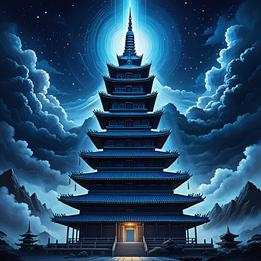
Buddhist Pagoda
A multi-tiered tower representing spiritual ascent, enlightenment, and the connection between earthly and divine realms in Buddhist tradition.
Buddhist Pagoda Dream Meaning
A multi-tiered tower representing spiritual ascent, enlightenment, and the connection between earthly and divine realms in Buddhist tradition.
Interpretive Themes
Mythological Resonance
Stupa of Sanchi
BuddhistAn ancient Indian stupa housing relics of the Buddha, symbolizing the journey from earthly suffering to nirvana—a architectural map of enlightenment.
Pagoda of Six Harmonies
ChineseBuilt to calm tidal waves, this pagoda represents the harmony between human, nature, and the divine—a structure that tames chaos through spiritual order.
Cultural Lenses
Jungian Perspective
View Context →Represents the Self archetype and individuation process; tiers symbolize layers of consciousness integrating toward wholeness. A mandala-like structure indicating psychic balance and spiritual center.
Freudian Perspective
View Context →Phallic symbol representing masculine power and sexual sublimation; ascent may indicate repressed desires for dominance or achievement transformed into spiritual striving.
Gestalt Perspective
View Context →Represents the dreamer's need for structure and meaning; each tier could be an unfinished aspect of self requiring integration into complete personal experience.
Cognitive Perspective
View Context →Mental schema for processing spiritual concepts; represents organized belief structures and cognitive frameworks for understanding transcendence and higher consciousness.
Evolutionary Perspective
View Context →Symbolizes human need for sacred spaces that promote group cohesion and meaning-making; architectural form triggers innate responses to verticality as power and protection.
East Asian Perspective
View Context →In China, Japan, and Korea, pagodas house sacred relics and represent cosmic mountains; historically centers of Buddhist practice, now cultural landmarks blending spiritual and national identity.
South Asian Perspective
View Context →Originating in Indian stupa architecture, represents Buddha's enlightenment and the dharma; tiers symbolize stages of the Noble Eightfold Path toward nirvana in Theravada tradition.
Modern Western Perspective
View Context →Often exoticized symbol of Eastern wisdom and mindfulness; appears in meditation apps and wellness spaces as shorthand for spiritual practice divorced from religious context.
Global/Universal Perspective
View Context →Cross-cultural symbol of sacred verticality connecting earth and sky; appears in various forms as ziggurats, pyramids, and church spires representing human aspiration toward the divine.
Middle Eastern Perspective
View Context →Resonates with minaret architecture in Islamic tradition as call to prayer and spiritual elevation; shares symbolic verticality but differs in religious function and decorative elements.
European Perspective
View Context →Evokes Gothic cathedral spires and bell towers as Christian symbols of heavenly aspiration; pagodas appear in chinoiserie gardens as exotic spiritual curiosities since 18th century.
Oceanian Perspective
View Context →Parallels Maori meeting houses and Polynesian marae as sacred communal spaces; though architecturally distinct, shares function as spiritual center connecting community to ancestors.
Historical Authorities
Want a deeper analysis?
Get a personalized interpretation of your entire dream including this symbol.
Interpret My DreamThe Oracle's Prediction
Combine multiple symbolsA breakthrough in meditation or mindfulness practice, leading to greater inner peace.
Timeframe
Lunation (~29 Days)
Intensity
Deep
Common Appearances & Contexts
| Context | Emotion | Interpretation |
|---|---|---|
| Context Climbing pagoda | Emotion Determination | Interpretation Spiritual progress journey. |
| Context Pagoda crumbling | Emotion Anxiety | Interpretation Faith or stability threatened. |
| Context Pagoda in distance | Emotion Longing | Interpretation Unattained spiritual goals. |
| Context Inside pagoda | Emotion Peace | Interpretation Inner sanctuary found. |
| Context Building pagoda | Emotion Purpose | Interpretation Creating spiritual foundation. |
| Context Pagoda on fire | Emotion Fear | Interpretation Spiritual crisis unfolding. |
| Context Pagoda in storm | Emotion Unease | Interpretation Faith being tested. |
| Context Pagoda glowing | Emotion Wonder | Interpretation Divine presence felt. |
| Context Pagoda surrounded | Emotion Protection | Interpretation Sacred space guarded. |
| Context Pagoda inaccessible | Emotion Frustration | Interpretation Spiritual barriers present. |
| Context Multiple pagodas | Emotion Overwhelm | Interpretation Many spiritual paths. |
| Context Pagoda transforming | Emotion Awe | Interpretation Spiritual evolution occurring. |
Interpret Your Full Dream
Beyond this symbol, every dream carries a unique story. Share your dream for a personalized AI-powered interpretation.