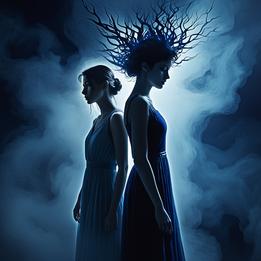
Anima Shadow
The unconscious feminine aspect within a man's psyche, representing repressed emotions and unintegrated personality traits.
Anima Shadow Dream Meaning
The unconscious feminine aspect within a man's psyche, representing repressed emotions and unintegrated personality traits.
Interpretive Themes
Mythological Resonance
Psyche
GreekThe mortal woman who must perform impossible tasks to reunite with Eros, representing the soul's journey to integrate love and the unconscious feminine.
Coniunctio
AlchemicalThe sacred marriage of masculine and feminine principles within the psyche, symbolizing the integration of opposites into wholeness.
Cultural Lenses
Jungian Perspective
View Context →Central to analytical psychology as the feminine archetype within male psyche, representing connection to unconscious, creativity, and soul. Integration leads to individuation and psychological wholeness.
Freudian Perspective
View Context →Viewed through psychosexual development and Oedipal complex, representing repressed maternal attachments and unresolved childhood conflicts manifesting in adult relationships and neuroses.
Gestalt Perspective
View Context →Seen as unfinished psychological business requiring awareness and integration through present-moment experience. The dream figure represents disowned aspects needing reclamation for completeness.
Cognitive Perspective
View Context →Interpreted as cognitive schema representing gender expectations and emotional processing patterns. Dreams about anima reflect mental models needing adjustment for better psychological functioning.
Evolutionary Perspective
View Context →Viewed as adaptive mechanism for social bonding and mate selection. The anima represents evolved psychological systems for recognizing complementary traits in potential partners.
East Asian Perspective
View Context →Similar to yin-yang balance, representing necessary feminine energy (yin) within masculine (yang) for harmony. Historical Daoist practices cultivated this integration for spiritual attainment.
South Asian Perspective
View Context →Connected to Shakti energy within masculine consciousness in Hindu philosophy. Tantric practices historically sought union of Shiva (masculine) and Shakti (feminine) within individual psyche.
Middle Eastern Perspective
View Context →In Sufi mysticism, represents the divine feminine (Nafs) needing purification. Historical practices involved spiritual exercises to integrate this aspect for closeness to divine.
European Perspective
View Context →Appears in alchemical symbolism as conjunctio (sacred marriage) and in fairy tales as feminine guides. Historical hermetic traditions sought this integration for spiritual transformation.
African Perspective
View Context →In many traditions, represents ancestral feminine wisdom and community connection. Rituals often invoke balancing masculine and feminine energies for individual and communal harmony.
North American Perspective
View Context →In Indigenous traditions, often appears as feminine spirit guides in vision quests. Modern interpretations blend psychological concepts with traditional teachings about balance.
Modern Western Perspective
View Context →Reinterpreted through gender theory and queer perspectives, challenging binary notions. Contemporary discussions focus on fluid identity and emotional intelligence beyond traditional gender roles.
Historical Authorities
Want a deeper analysis?
Get a personalized interpretation of your entire dream including this symbol.
Interpret My DreamThe Oracle's Prediction
Combine multiple symbolsA significant relationship will deepen or transform through increased emotional honesty and vulnerability.
Timeframe
Seasonal (~3 Months)
Intensity
Deep
A surge of creative inspiration or intuitive insight will arise from previously blocked emotions.
Timeframe
Immediate (Next 48h)
Intensity
Deep
Common Appearances & Contexts
| Context | Emotion | Interpretation |
|---|---|---|
| Context Meeting a stranger | Emotion Curiosity | Interpretation Exploring unknown self. |
| Context Chasing figure | Emotion Frustration | Interpretation Avoiding integration. |
| Context Merging with shadow | Emotion Euphoria | Interpretation Accepting wholeness. |
| Context Fighting feminine presence | Emotion Anger | Interpretation Resisting inner aspects. |
| Context Guiding figure | Emotion Trust | Interpretation Accepting unconscious wisdom. |
| Context Mirror reflection | Emotion Shock | Interpretation Seeing hidden self. |
| Context Transforming appearance | Emotion Confusion | Interpretation Identity fluidity. |
| Context Lost in forest | Emotion Anxiety | Interpretation Unconscious exploration. |
| Context Creative inspiration | Emotion Joy | Interpretation Unconscious gifts. |
| Context Relationship conflict | Emotion Sadness | Interpretation Projecting inner conflict. |
| Context Ritual ceremony | Emotion Awe | Interpretation Sacred integration. |
| Context Voice whispering | Emotion Fear | Interpretation Unconscious messages. |
Interpret Your Full Dream
Beyond this symbol, every dream carries a unique story. Share your dream for a personalized AI-powered interpretation.