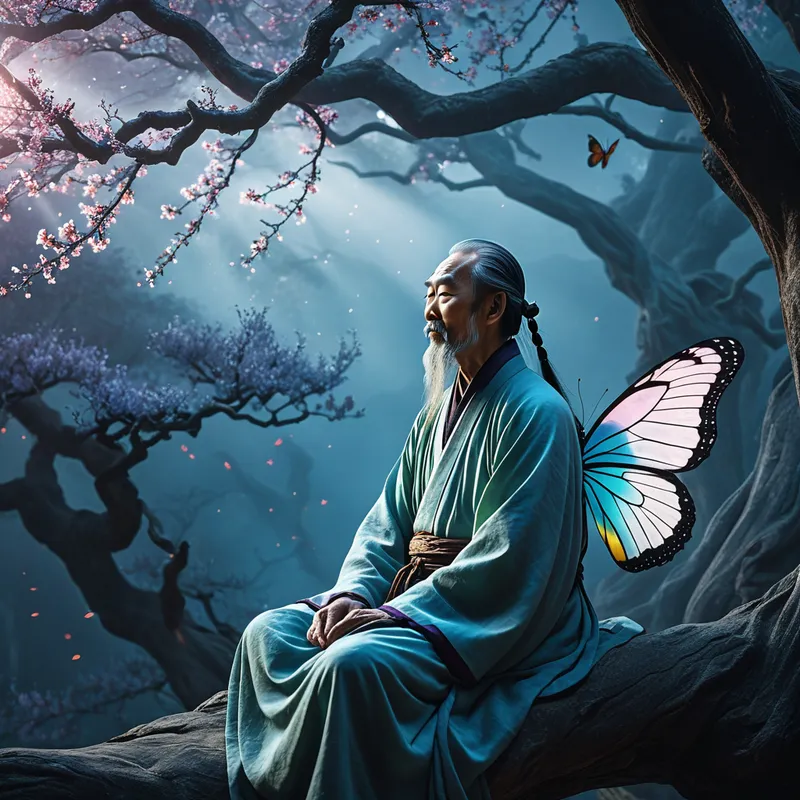
Zhuangzi's Butterfly Dream Myth Meaning & Symbolism
A sage dreams he is a butterfly, then awakens, left to wonder if he is a man who dreamed a butterfly, or a butterfly now dreaming he is a man.
The Tale of Zhuangzi’s Butterfly Dream
Once, in the time of the Warring States, when [the world](/myths/the-world “Myth from Tarot culture.”/) was a cacophony of ambition and steel, there was a man who sought wisdom not in palaces, but in the rustling of reeds and the flight of birds. His name was [Zhuangzi](/myths/zhuangzi “Myth from Chinese culture.”/). He was a keeper of mysteries, a man for whom the boundary between waking and sleeping was as thin as a cicada’s wing.
On an afternoon heavy with the scent of blooming lotuses and damp earth, Zhuangzi laid himself down in the dappled shade of a great tree. The hum of the world—the distant cries of hawkers, the worries of kings—fell away from him like a discarded cloak. His breath slowed, becoming one with the gentle sigh of [the wind](/myths/the-wind “Myth from Various culture.”/) through the leaves. Consciousness, that diligent scribe, set down its brush and slept.
And he dreamed.
He did not dream of mountains or rivers, nor of ancestors or forgotten battles. He dreamed he was a butterfly. Not that he saw a butterfly, but that his very essence, the “I” that was Zhuangzi, dissolved and was reconstituted into the fragile, glorious being of a butterfly. He felt the lightness of it! The world was a garden of exquisite sensation. He flitted from flower to flower on wings of sunbeam and painted silk, drunk on nectar and the sheer joy of motion. He knew, with absolute certainty, the butterfly’s knowledge: the map of the breeze, the geometry of petals, the pure, unselfconscious purpose of being. He was the butterfly, and the butterfly was him. There was no Zhuangzi. There was only this floating, fluttering life, utterly free and completely itself.
Then, a tremor passed through the dream-garden. A sensation of weight, of density, of being pulled downward. The fragrance of blossoms faded, replaced by the smell of grass and his own sleeping form. The boundless sky contracted to the canopy of a tree.
He awoke.
He was Zhuangzi again, lying on his mat, the solid bones of a man beneath him. But the awakening was not a simple return. It was a rupture, a profound disorientation. He sat up, the memory of wings still tingling in his shoulders. He looked at his own human hands, turning them over as if seeing them for the first time. A deep, wondering confusion settled in his heart.
The man who awoke was not the same man who slept. For now, he was haunted by a question that would echo for millennia: Who is dreaming whom?
Did Zhuangzi of Qi just dream he was a butterfly, a vivid fancy now past? Or is this—this solid world, this body, this name—the ongoing dream of a butterfly somewhere, a butterfly that is, at this very moment, dreaming vividly that it is a man named Zhuangzi?
The tale ends not with an answer, but with this exquisite, unresolvable doubt. The boundary between reality and illusion, between self and other, between the waking ego and the boundless soul, is shown to be not a wall, but a shimmering veil.

Cultural Origins & Context
This parable emerges from the text bearing his name, the Zhuangzi, a cornerstone of Daoist philosophy compiled around the 4th century BCE. Unlike the rigid hierarchies and moral strictures of Confucian thought that dominated the era, the Zhuangzi championed spontaneity, relativity, and freedom. It is a text of poetry, paradox, and profound skepticism of conventional knowledge.
The story of [the butterfly dream](/myths/the-butterfly-dream “Myth from Chinese culture.”/) is not presented as a religious revelation or a historical account, but as a philosophical anecdote, a “teaching tale” meant to jar the listener out of cognitive complacency. It was passed down among scholars, monks, and artists, a secret key to a different way of perceiving. Its societal function was subversive: to question the very foundations of identity and authority. If one cannot be sure of the reality of one’s own self, how can one be arrogantly certain of anything else? It served as an antidote to dogma, a reminder that the universe operates on principles far more fluid and mysterious than human categories can contain.
Symbolic Architecture
The myth’s power lies in its elegant, binary [symbolism](/symbols/symbolism “Symbol: The use of symbols to represent ideas or qualities, often conveying deeper meanings beyond literal interpretation. In dreams, it’s the language of the unconscious.”/). Zhuangzi represents the ego, the constructed self with a name, a [history](/symbols/history “Symbol: History in dreams often represents the dreamer’s past experiences, lessons learned, or unresolved issues that continue to influence their present.”/), and a place in society. He is order, [weight](/symbols/weight “Symbol: Weight symbolizes burdens, responsibilities, and emotional loads one carries in life.”/), and defined form. The [butterfly](/symbols/butterfly “Symbol: Symbolizes transformation, beauty, and the ephemeral nature of life.”/) symbolizes the Self (in the Jungian sense) or the Dao in its particular, fleeting manifestation. It is [chaos](/symbols/chaos “Symbol: In Arts & Music, chaos represents raw creative potential, uncontrolled expression, and the breakdown of order to forge new artistic forms.”/), [lightness](/symbols/lightness “Symbol: A sensation of weightlessness or buoyancy in the body, often linked to emotional release, spiritual elevation, or freedom from burdens.”/), transformation, and unselfconscious being.
The dream is not an escape from reality, but an entry into a broader one.
The pivotal [moment](/symbols/moment “Symbol: The symbol of a ‘moment’ embodies the significance of transient experiences that encapsulate emotional depth or pivotal transformations in life.”/) is not the dream, but the awakening—the liminal [crisis](/symbols/crisis “Symbol: A crisis symbolizes turmoil, urgent challenges, and the need for immediate resolution or change.”/). This is the psychological crux. [The ego](/myths/the-ego “Myth from Jungian culture.”/) (Zhuangzi) has been immersed in, and fully identified with, the unconscious (the butterfly). Upon re-emerging into [consciousness](/symbols/consciousness “Symbol: Consciousness represents the state of awareness and perception, encompassing thoughts, feelings, and experiences.”/), it carries the [memory](/symbols/memory “Symbol: Memory symbolizes the past, lessons learned, and the narratives we construct about our identities.”/) of that state, which destabilizes its claim to sole sovereignty. The myth dramatizes [the ego](/myths/the-ego “Myth from Jungian culture.”/)’s shocking, humbling realization that it is not the author of the [psyche](/myths/psyche “Myth from Greek culture.”/), but a [character](/symbols/character “Symbol: Characters in dreams often signify different aspects of the dreamer’s personality or influences in their life.”/) in a much larger [story](/symbols/story “Symbol: The symbol of ‘Story’ represents the narrative woven through our lives, embodying experiences, lessons, and emotions that shape our identities.”/).
The question “Am I a man who dreamed a butterfly, or a butterfly dreaming I am a man?” is the ultimate [symbol](/symbols/symbol “Symbol: A symbol can represent an idea, concept, or belief, serving as a powerful tool for communication and understanding.”/) of relativized consciousness. It dismantles [the hierarchy](/symbols/the-hierarchy “Symbol: A structured system of ranking, power, and social order, often representing authority, status, and one’s position within a group or society.”/) where waking [life](/symbols/life “Symbol: The symbol of ‘Life’ represents a journey of growth, interconnectedness, and existential meaning, encompassing both the joys and challenges that define human experience.”/) is “real” and dream life is “false.” Instead, it proposes a [continuum](/symbols/continuum “Symbol: A philosophical concept representing an unbroken sequence or progression where all points are connected without gaps, often symbolizing the flow of time, existence, or consciousness.”/) of being, a flowing exchange between different states of [awareness](/symbols/awareness “Symbol: Conscious perception of self, surroundings, or internal states. Often signifies awakening, insight, or heightened sensitivity.”/), each with its own validity and [reality](/symbols/reality “Symbol: Reality signifies the state of existence and perception, often reflecting one’s understanding of truth and life experiences.”/).
The Dreamer’s Resonance
When this myth pattern stirs in a modern dream, it signals a profound encounter with the nature of identity. One might dream of being an animal and feeling more “real” or free in that form, or of shifting between genders, ages, or even species. Upon waking, the dreamer is left with a lingering, somatic echo—a feeling of wings where shoulders are, or a different rhythm of breath.
Psychologically, this indicates a process of ego-dissolution and reconfiguration. The rigid, habitual sense of “I” is being softened, challenged by contents from the deeper, more fluid layers of the psyche. It is often experienced during life transitions, deep therapy, or spiritual inquiry, when the old identity feels insufficient or false. The dream is the psyche’s way of demonstrating that [the self](/myths/the-self “Myth from Jungian culture.”/) is not a fixed monument, but a dynamic process—a constant, dreaming becoming.

Alchemical Translation
The alchemical work modeled here is the transmutation of certainty into wonder, and of fixed identity into fluid being. The modern individual’s path of individuation often begins with a strong, defended ego-structure. [The first stage](/myths/the-first-stage “Myth from Alchemical culture.”/) (Zhuangzi sleeping) is a necessary surrender, a letting go of conscious control to engage with the unconscious.
The goal is not to choose between man or butterfly, but to hold the question, to live in the fertile paradox.
The immersion in the butterfly state is the [nigredo](/myths/nigredo “Myth from Alchemical culture.”/)—the dissolution of the old self. The confusion upon awakening is the albedo, the dawning of a new, more complex awareness. The [triumph](/myths/triumph “Myth from Roman culture.”/) is not in answering the riddle, but in integrating its tension.
The individuated individual, the modern sage, is one who can move between states—engaged in the world of human affairs (the man) yet perpetually informed by the soul’s perspective (the butterfly). They carry within them the knowledge that their conscious identity is a temporary, useful dream within the vast, dreaming reality of the psyche. This realization brings not insanity, but a profound liberation: the freedom to play one’s part without being trapped by it, to wear [the mask](/myths/the-mask “Myth from Various culture.”/) of personality without mistaking it for one’s true face. One becomes, in essence, a conscious participant in one’s own endless transformation.
Associated Symbols
Explore related symbols from the CaleaDream lexicon: