Zhar-Ptitsa Myth Meaning & Symbolism
A luminous, elusive bird of fire whose capture demands a perilous quest, embodying the soul's yearning for the divine and the transformative price of its pursuit.
The Tale of Zhar-Ptitsa
Listen, and let the old tale settle in your bones. In a time when the world was thick with magic, where the dark forest whispered secrets and the tsar’s word was law, there existed a wonder. It was not a wonder of stone or steel, but of light and air. The Zhar-Ptitsa.
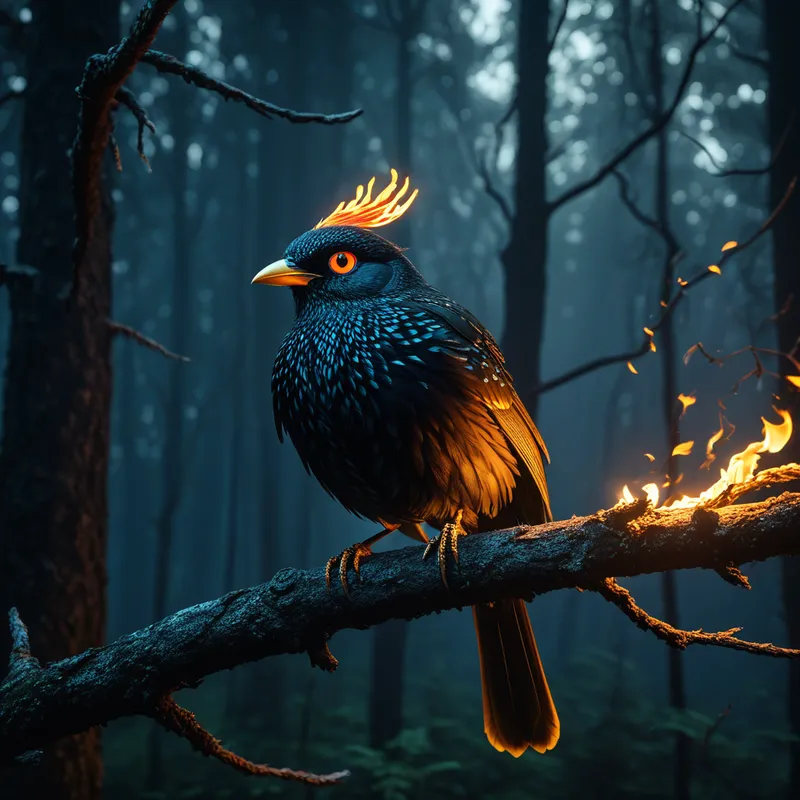
It came on nights when the moon hid its face, a streak of impossible dawn against the starless vault. It moved not like a bird, but like a falling star given will, its plumage not feathers but captive sunbeams and tongues of living flame. Where it alighted—on the branch of a gnarled apple tree heavy with fruit of solid gold—the night ceased to be. Shadows fled. The very air grew warm and sweet, humming with a power that was neither good nor evil, but simply other. It would pluck a single golden apple with its beak of polished jet, and in that moment, the garden of the tsar was no longer part of the earth. It was a piece of heaven, borrowed.
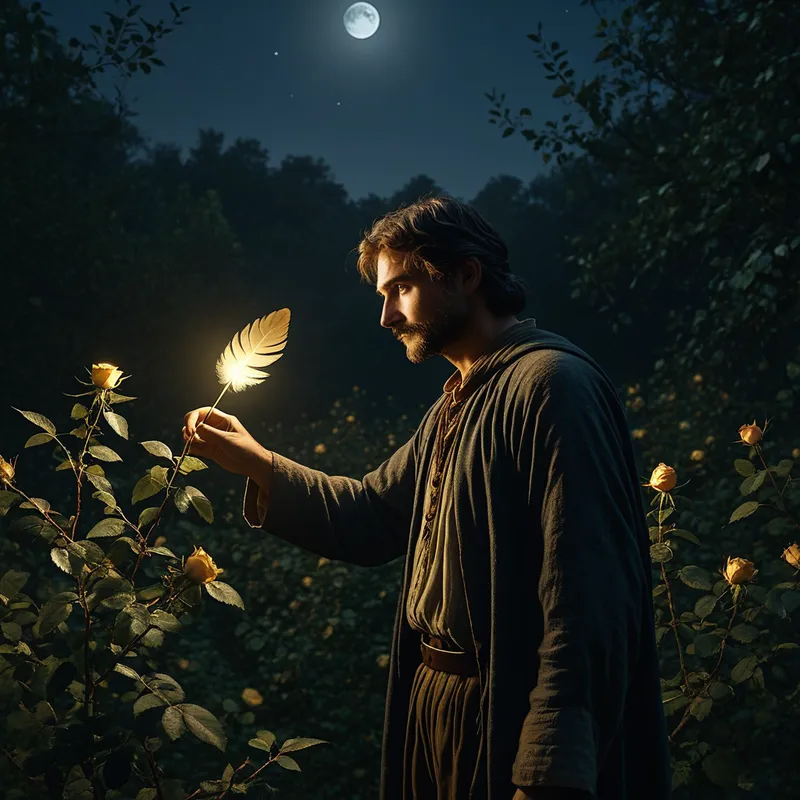
And then it would be gone. The darkness rushed back, colder and deeper than before. All that remained was a scent of ozone and summer lightning, and, sometimes, a single feather. Not a feather as you know it, but a shaft of light made solid, warm to the touch, glowing with a soft, persistent radiance that no lamp could mimic and no shadow could quench.
The tsar, in his hall of greed, saw not beauty, but possession. He saw a prize. To his three sons he issued a decree that was also a sentence: “Bring me the bird. He who succeeds shall have half my kingdom now, and all of it upon my death. He who fails… let him not return at all.”
The two elder sons, clad in pride and polished armor, rode out with boasting words. They sought the bird in taverns and royal courts, believing such a treasure must be guarded by other kings. They found only wine and empty boasts. The youngest, Ivan Tsarevich, simple of heart but clear of purpose, listened to the wind. It told him to enter the forest, where the paths are made by wolves and the maps are drawn by fools.
His journey was a descent into the world’s dream. He met a great Grey Wolf who spoke with a human voice, offering both threat and covenant. He passed through lands where the water gave visions and the stones remembered sorrow. He learned that [the Firebird](/myths/the-firebird “Myth from Slavic culture.”/) was kept in a garden even more remote than the tsar’s, by a tsar even more powerful, guarded not by walls but by a celestial, silent awareness.
The capture was not an act of force, but of sacred theft, a negotiation with fate itself. In the silent, radiant garden, under the watchful gaze of a thousand golden apples, Ivan moved not as a hunter, but as a supplicant. He did not seize; he received. The bird, blinding in its glory, did not fight. It allowed itself to be taken, its light dimming to a manageable glow, its fire banked to warmth. But this was not a victory. It was the beginning of a longer, more terrible road home—a road paved with betrayal by his brothers, with death and miraculous revival, with the aid of the Wolf and the wisdom of Koshchei the Deathless. The return was the true quest, a forging of the soul in the fires of treachery and loss, until at last, the radiant, captive wonder was presented not as a trophy, but as a testament to a journey that had incinerated the boy and forged a man in his place.
Cultural Origins & Context
The tale of the Zhar-Ptitsa is a jewel in the vast, oral tapestry of East Slavic folklore, most famously codified in the 19th-century collections of Alexander Afanasyev. It belongs not to a fixed scripture, but to the living breath of the skaziteli. Told during the long, dark winters, its light was both entertainment and instruction. The Firebird was not merely a fantastical creature; it was a narrative vessel for profound cosmological and social ideas.
In the pre-Christian, animistic worldview of the Slavs, the bird was a potent psychopomp, a creature bridging the earthly realm (Yav) and the celestial or divine realm (Prav). The Zhar-Ptitsa, with its solar attributes, likely carried echoes of solar deities. Its theft and subsequent trials reflect a deep cultural understanding: contact with the divine is perilous. It disrupts the established order (the tsar’s garden, the tsar’s command) and demands a complete transformation of the one who seeks it. The story served as a societal blueprint, reinforcing the value of humility (the youngest son), perseverance, and the acceptance of guidance from the non-human world (the Wolf), while warning of the corrupting power of envy and greed embodied by the elder brothers.
Symbolic Architecture
The Zhar-Ptitsa is the ultimate [symbol](/symbols/symbol “Symbol: A symbol can represent an idea, concept, or belief, serving as a powerful tool for communication and understanding.”/) of the unattainable yet irresistibly compelling goal of the [soul](/symbols/soul “Symbol: The soul represents the essence of a person, encompassing their spirit, identity, and connection to the universe.”/). It is not a mere physical [treasure](/symbols/treasure “Symbol: A hidden or valuable object representing spiritual wealth, inner potential, or divine reward.”/), but the incarnation of a transcendental value—[beauty](/symbols/beauty “Symbol: This symbol embodies aesthetics, harmony, and the appreciation of life’s finer qualities.”/), [truth](/symbols/truth “Symbol: Truth represents authenticity, honesty, and the quest for knowledge beyond mere appearances.”/), divine essence, or the fully realized Self.
The Firebird does not wish to be owned; it wishes to be followed. Its capture is not an end, but the violent beginning of an initiation.
The [bird](/symbols/bird “Symbol: Birds symbolize freedom, perspective, and the connection between the earthly and spiritual realms, often representing the soul’s aspirations or personal growth.”/)’s [radiance](/symbols/radiance “Symbol: A powerful symbol of illumination, divine presence, and inner awakening, often representing clarity, truth, and spiritual energy.”/) represents [consciousness](/symbols/consciousness “Symbol: Consciousness represents the state of awareness and perception, encompassing thoughts, feelings, and experiences.”/) itself—a light so profound it transforms everything it touches (golden apples) but cannot be directly gazed upon or easily held. Ivan’s [quest](/symbols/quest “Symbol: A quest symbolizes a journey or search for purpose, fulfillment, or knowledge, often representing life’s challenges and adventures.”/) is the ego’s [journey](/symbols/journey “Symbol: A journey in dreams typically signifies adventure, growth, or a significant life transition.”/) toward this higher consciousness. The initial, often foolish desire (the tsar’s greed, Ivan’s filial duty) is merely the catalyst; the true [purpose](/symbols/purpose “Symbol: Purpose signifies direction, meaning, and intention in life, often reflecting personal ambitions and core values.”/) is revealed only through the ordeal. The Grey [Wolf](/symbols/wolf “Symbol: Wolves in dreams symbolize instinct, intelligence, freedom, and a deep connection to the wilderness and primal instincts.”/) symbolizes the instinctual, guiding wisdom of the unconscious, which the conscious mind (Ivan) must learn to trust and cooperate with, often against its own rational judgment.
The pivotal [moment](/symbols/moment “Symbol: The symbol of a ‘moment’ embodies the significance of transient experiences that encapsulate emotional depth or pivotal transformations in life.”/) is never the final [presentation](/symbols/presentation “Symbol: A presentation in a dream can symbolize the act of revealing or showcasing one’s ideas, emotions, or status, reflecting the dreamer’s current life circumstances or relationships.”/) of the bird, but the finding of the single, glowing [feather](/symbols/feather “Symbol: A feather represents spiritual elevation, lightness, and the freedom of the spirit. It often symbolizes messages from the divine and connection to ancient wisdom.”/). This is the first [glimpse](/symbols/glimpse “Symbol: A fleeting, partial view or moment of insight that suggests more lies beyond immediate perception, often hinting at hidden truths or future possibilities.”/) of the numinous, the undeniable sign that the quest is valid and the goal is real. It is the dream [image](/symbols/image “Symbol: An image represents perception, memories, and the visual narratives we create in our minds.”/) that haunts, the [moment](/symbols/moment “Symbol: The symbol of a ‘moment’ embodies the significance of transient experiences that encapsulate emotional depth or pivotal transformations in life.”/) of inspiration that will not let go, the [symptom](/symbols/symptom “Symbol: A physical or emotional sign indicating an underlying imbalance, distress, or message from the unconscious mind.”/) that points toward a deeper truth.

The Dreamer’s Resonance
To dream of pursuing or glimpsing the Zhar-Ptitsa is to experience the psyche announcing a call to individuation. The dreamer is in a state of profound, often painful, longing. This is not a mundane desire, but a Sehnsucht—a soul-hunger for something beyond the current configuration of life.
Somatically, this may manifest as a restless energy, a feeling of being “not at home” in one’s own skin or circumstances, or a peculiar warmth or quickening in the chest when contemplating a new, risky path. Psychologically, it is the recognition of the “golden apple”—some area of life (a relationship, a creative project, a spiritual practice) that has begun to glow with unusual significance, hinting at a greater potential. The dream often highlights the obstacles: the dark forest of confusion, the treacherous brothers (aspects of one’s own cynicism or fear), or the paralyzing awe before the bird itself. The dream is a map of the internal resistance that must be faced. The feeling upon waking is crucial: a sense of awe and melancholy indicates the touch of the numinous; a sense of frustration may point to the ego’s refusal to heed the call or begin the humble, perilous work.

Alchemical Translation
The myth of the Firebird is a perfect allegory for the alchemical Magnum Opus. The process begins with the nigredo, the blackening: the tsar’s garden plunged into deeper darkness after the bird’s visit, representing the initial dissatisfaction and sense of lack that launches the quest. Ivan’s journey into the unknown forest is the solutio, a dissolution of old identities and certainties.
The capture of the bird is the albedo, the whitening—not a triumph, but the securing of the volatile, radiant spirit. It is the moment the unconscious content is made conscious, raw and blinding.
The subsequent trials—betrayal, death, dismemberment—are the fierce rubedo, the reddening or suffering. This is where the captured spirit is not merely possessed, but integrated. The ego is crucified by circumstance, forcing a reliance on a power greater than itself (the Wolf, a symbol of the Self). The final return and presentation of the bird is the citrinitas, the yellowing or illumination, and the achievement of the gold. The transformed hero does not keep the treasure for private glory; he presents it, having himself become a vessel for its light. The kingdom he inherits is the integrated psyche, where the radiant, once-elusive Self now has a dwelling place. The quest for the outer object reveals itself to have always been the forging of an inner subject, capable of bearing its own fire.
Associated Symbols
Explore related symbols from the CaleaDream lexicon:
- Bird — The Zhar-Ptitsa itself, representing the transcendent spirit, the soul’s aspiration, and a messenger between the earthly and divine realms.
- Fire — The essential element of the Firebird, symbolizing transformative energy, purifying destruction, consciousness, passion, and the unquenchable spark of life.
- Forest — The dark, enchanted woods Ivan must enter, representing the unknown depths of the unconscious, the realm of mystery, danger, and instinctual wisdom.
- Journey — The core structure of the myth, embodying the process of individuation, the necessary passage through trials to achieve psychological wholeness.
- Gold — The color and substance of the bird’s feathers and the apples it seeks, symbolizing the ultimate value, the perfected Self, and solar divinity.
- Wolf — The Grey Wolf as guide and helper, representing the intelligent instinct of the unconscious, a fierce protector and teacher on the perilous path.
- Light — The radiant emanation of the Firebird, representing enlightenment, awareness, hope, and the illuminating power of truth that dispels shadow.
- Sacrifice — The repeated losses Ivan endures—safety, trust, even life—which are necessary offerings for the attainment of the transcendent goal.
- Apple — The golden fruit in the garden, representing temptation, immortality, sacred knowledge, and the initial, tangible proof of the divine presence.
- Hero — Ivan Tsarevich, the archetypal figure who answers the call, faces the darkness, and is utterly transformed by the quest for the sublime.
- Shadow — Embodied by the treacherous elder brothers and the general peril of the quest, representing the personal and collective darkness that must be confronted and integrated.
- Dream — The entire quest operates in a dream-logic landscape, and the feather is a dream-object that haunts waking life, pulling the individual toward their destiny.