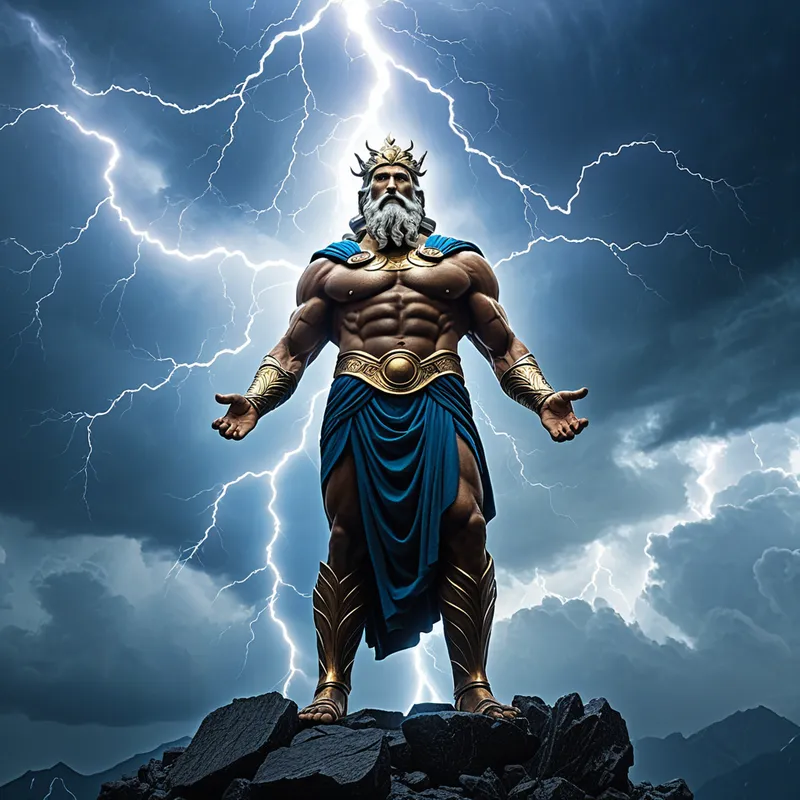
Zeus's Thunderbolt Myth Meaning & Symbolism
The weapon forged by the Cyclopes, symbolizing ultimate sovereignty, divine justice, and the terrifying, creative power that structures reality from primal disorder.
The Tale of Zeus’s Thunderbolt
Before there was order, there was a scream. It was the scream of [the earth](/myths/the-earth “Myth from Hindu culture.”/), Gaia, as she was crushed under the weight of her own children, the Titans, who ruled with a chaos of stone and brute force. Their king, [Kronos](/myths/kronos “Myth from Greek culture.”/), had swallowed [the sky](/myths/the-sky “Myth from Persian culture.”/) and the future, devouring his own offspring to keep his throne secure. In the hidden, damp caves of Crete, a single cry went unanswered by [the Titans](/myths/the-titans “Myth from Greek culture.”/). It was the cry of the last-born son, Zeus, saved by his mother’s cunning. He grew not on milk, but on the honey of prophecy and the roar of she-goats, his blood singing with a destiny of storm.
His time came. He emerged, not as a babe, but as a force of will. He journeyed to the deepest pit of the cosmos, to [Tartarus](/myths/tartarus “Myth from Greek culture.”/), a place of groans and shifting darkness. There, he freed the monstrous, one-eyed Cyclopes, beings of pure, unrefined craft, imprisoned by the fearful Titans. In gratitude, and with the fury of those long captive, the Cyclopes took the raw elements of [the underworld](/myths/the-underworld “Myth from Greek culture.”/)—the searing heat of the earth’s core, the flash of primal fear, the unbreakable law of cause—and forged them in a furnace stoked with stars. What they crafted was not a mere weapon. It was a pronouncement. A jagged, three-forked spear of pure, crackling energy: the Thunderbolt.
The air itself tasted of ozone and impending verdict. On the plains of battle, the Titans hurled mountains. Zeus raised the bolt. It was not thrown; it was unleashed. A sound tore the fabric of [the world](/myths/the-world “Myth from Tarot culture.”/)—a crack that was also a command. Light, not of the sun, but of absolute clarity, bleached the battlefield. Where it struck, primordial stone vaporized into order. The chaos of the Titans met the structuring law of the bolt. The war, the Titanomachy, was not won by strength alone, but by the introduction of a new principle into the universe: focused, sovereign power. The thunderbolt was the gavel of a new court. With it, Zeus cast the Titans into Tartarus, and from the peak of [Mount Olympus](/myths/mount-olympus “Myth from Global/Universal culture.”/), he established a cosmos ruled not by raw consumption, but by law, oath, and tempered might. The bolt rested by his throne, a silent, ever-present reminder: from chaos, order is born in a flash of terrifying, creative violence.
Cultural Origins & Context
This myth is the foundational political and cosmological story of ancient Greece, primarily conveyed through the epic poetry of Hesiod’s Theogony and echoed in Homeric hymns. It was not mere entertainment; it was a sacred narrative explaining the origin of the current world order (kosmos) and legitimizing the authority of the Olympian [pantheon](/myths/pantheon “Myth from Roman culture.”/). Performed at religious festivals and symposia, the tale of the thunderbolt served a critical societal function: it illustrated the transition from a primordial, monstrous, and familial tyranny (the Titans) to a divinely sanctioned, hierarchical kingship (Zeus’s rule).
The thunderbolt itself became the ultimate symbol of Zeus’s sovereignty and the guarantor of [justice](/myths/justice “Myth from Tarot culture.”/) (Dike) and oath-keeping (Horkos). To swear an oath by Zeus’s thunderbolt was to invoke the most potent and terrifying divine retribution. The myth thus provided a metaphysical backbone for social order, teaching that legitimate power, however awe-inspiring and fearsome, is preferable to the anarchic, devouring chaos that preceded it. It was a story told to justify kingship, law, and the sometimes terrifying price of civilization.
Symbolic Architecture
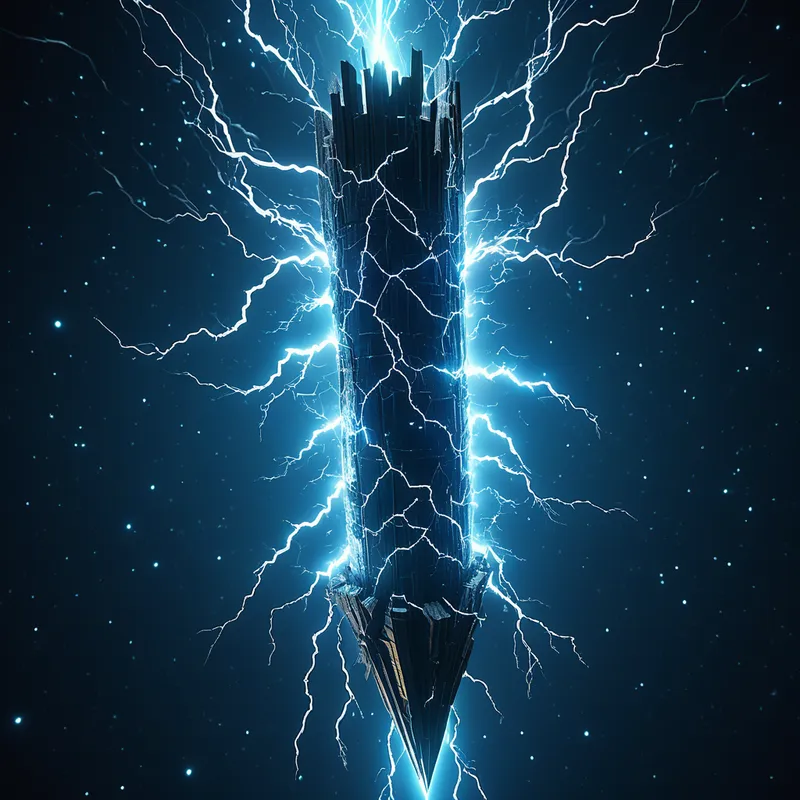
The thunderbolt is far more than a [weapon](/symbols/weapon “Symbol: A weapon in dreams often symbolizes power, aggression, and the need for protection or defense.”/); it is a supreme [symbol](/symbols/symbol “Symbol: A symbol can represent an idea, concept, or belief, serving as a powerful tool for communication and understanding.”/) of transformative, structuring [consciousness](/symbols/consciousness “Symbol: Consciousness represents the state of awareness and perception, encompassing thoughts, feelings, and experiences.”/). It represents the sudden, illuminating [insight](/symbols/insight “Symbol: A sudden, deep understanding of a complex situation or truth, often arriving unexpectedly and illuminating hidden connections.”/) that forever separates one state of being from another.
The thunderbolt is the instantaneous moment of differentiation—the flash that cleaves chaos from cosmos, unconsciousness from awareness, potential from act.
Psychologically, the Titans symbolize the undifferentiated, archaic contents of the [psyche](/myths/psyche “Myth from Greek culture.”/): overwhelming instincts, parental complexes, and the chaotic “[family](/symbols/family “Symbol: The symbol of ‘family’ represents foundational relationships and emotional connections that shape an individual’s identity and personal development.”/) tyranny” of inherited patterns. Zeus represents the emerging ego-consciousness, the psychic entity that must differentiate itself from this primal [swamp](/symbols/swamp “Symbol: Represents the subconscious mind, emotions, and the complexities of personal issues.”/). The forging in Tartarus signifies that the tool for this [differentiation](/symbols/differentiation “Symbol: The process of distinguishing or separating parts of the self, emotions, or identity from a whole, often marking a developmental or psychological milestone.”/)—conscious insight, will, or judgment—is born from engaging with the deepest, most repressed parts of [the self](/myths/the-self “Myth from Jungian culture.”/) (the [underworld](/symbols/underworld “Symbol: A symbolic journey into the unconscious, representing exploration of hidden aspects of self, transformation, or confronting repressed material.”/)). The Cyclopes, as master craftsmen, represent the focused, instinctual genius that can shape raw psychic [energy](/symbols/energy “Symbol: Energy symbolizes vitality, motivation, and the drive that fuels actions and ambitions.”/) into a usable tool.
The bolt’s three prongs are profoundly significant. They mirror the three realms over which Zeus and his brothers drew lots: sky, sea, and [underworld](/myths/underworld “Myth from Greek culture.”/). Thus, the bolt is an [instrument](/symbols/instrument “Symbol: An instrument symbolizes creativity, communication, and the means by which one expresses oneself or influences the world.”/) of triune sovereignty, a symbol of the power to integrate and rule over the totality of experience—the [heights](/symbols/heights “Symbol: Represents ambition, fear, or spiritual elevation. Often symbolizes life challenges or a desire for perspective.”/) of [spirit](/symbols/spirit “Symbol: Spirit symbolizes the essence of life, vitality, and the spiritual journey of the individual.”/), the [depths](/symbols/depths “Symbol: Represents the subconscious, hidden emotions, or foundational aspects of the self, often linked to primal fears or profound truths.”/) of the unconscious, and the fluid [realm](/symbols/realm “Symbol: The symbol of ‘Realm’ often signifies the boundaries of one’s consciousness, experiences, or emotional states, suggesting aspects of reality that are either explored or ignored.”/) of [emotion](/symbols/emotion “Symbol: Emotion symbolizes our inner feelings and responses to experiences, often guiding our actions and choices.”/) and [soul](/symbols/soul “Symbol: The soul represents the essence of a person, encompassing their spirit, identity, and connection to the universe.”/).
The Dreamer’s Resonance
When the motif of Zeus’s thunderbolt erupts in a modern dream, it rarely appears as a classical mythic scene. Instead, it manifests as the experience of the bolt’s essence. The dreamer may be in a landscape of profound confusion or stuck in a stifling, archaic situation (a Titan-esque job, relationship, or internal state). Suddenly, there is a catastrophic, brilliant event: a tree split by lightning outside a window, a power surge blowing out all the lights, or being struck by a beam of silent, white energy.
Somatically, this can correlate with a jolt awake, a sudden insight upon waking, or a feeling of being “electrified.” Psychologically, this dream pattern signals a forceful, perhaps disruptive, moment of psychic reorganization. The old, monolithic structure of a complex is being shattered by a bolt of consciousness. It is often experienced as a crisis—terrifying, awe-inspiring, and destructive to the status quo. The dreamer is in the process of claiming their own inner sovereignty, using a burst of lucidity to break free from a consuming, “titanic” pattern that has held them captive. The chaos that follows in the dream is not an end, but the necessary raw material for a new, more conscious order.
Alchemical Translation
The myth models the alchemical process of [separatio](/myths/separatio “Myth from Alchemical culture.”/) and the creation of the [lapis philosophorum](/myths/lapis-philosophorum “Myth from Alchemical culture.”/) ([the philosopher’s stone](/myths/the-philosophers-stone “Myth from Alchemical culture.”/))—the achieved, integrated Self. The initial state is the massa confusa, the chaotic, undifferentiated Titanomachy within the psyche. The alchemical fire is the heat of conflict and suffering (the war, the imprisonment in Tartarus).
Zeus’s journey to free the Cyclopes is [the ego](/myths/the-ego “Myth from Jungian culture.”/)‘s courageous descent into the unconscious (nekyia) to retrieve the latent, specialized capabilities needed for transformation. The forging of the bolt is the coniunctio of opposites—raw instinct (Cyclopes) with strategic purpose (Zeus)—to create a new, transcendent function: discriminating consciousness.
Individuation is not a gentle sunrise but often a lightning strike—a violent, clarifying moment that forever divides the person you were from the person you must become.
For the modern individual, the “alchemical translation” of this myth is the forging of personal sovereignty. It is the process of confronting the internal “Titans”—the overwhelming parental voices, the archaic fears, the consuming habits—and, through a painful but necessary engagement with one’s own depths (Tartarus), crafting a tool of personal authority. This “thunderbolt” is one’s own ethical conviction, a piercing insight, or a moment of unwavering decision that structures a life of chaos into a life of purpose. The bolt is not wielded to destroy others, but to disintegrate inner tyranny, establishing an inner Olympus where consciousness, not chaos, rules. The goal is not to become a tyrannical Zeus, but to integrate his capacity for order, justice, and the legitimate, awe-inspiring power of a conscious life.
Associated Symbols
Explore related symbols from the CaleaDream lexicon: