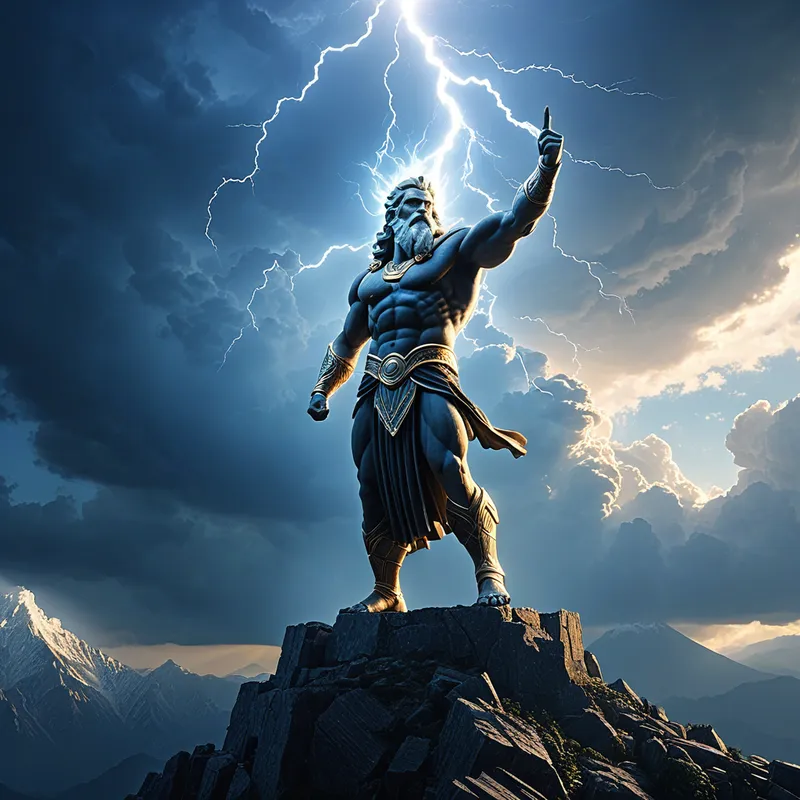
Zeus' Thunderbolt Myth Meaning & Symbolism
The story of the ultimate weapon, forged in the heart of rebellion, that established cosmic order and symbolizes the terrifying power of conscious authority.
The Tale of Zeus’ Thunderbolt
Before [the world](/myths/the-world “Myth from Tarot culture.”/) knew order, there was only chaos and a war of titans. The air was thick with the screams of the Titans and the groans of [the earth](/myths/the-earth “Myth from Hindu culture.”/). [Kronos](/myths/kronos “Myth from Greek culture.”/), who had swallowed his children to secure his reign, ruled with a fearful, stagnant grip. But in a hidden cave on Crete, a child grew, nourished by a divine goat and protected by the dancing of armored youths. His name was Zeus.
When he came of age, his thunder was not in his hands but in his belly—a roaring need for [justice](/myths/justice “Myth from Tarot culture.”/), for a new age. He tricked his father, forcing him to disgorge his swallowed siblings: [Hestia](/myths/hestia “Myth from Global/Universal culture.”/)</ab title>, Demeter, [Hades](/myths/hades “Myth from Greek culture.”/), [Poseidon](/myths/poseidon “Myth from Greek culture.”/), and Hera. They emerged, whole and furious, and the great war, the Titanomachy, began.
For ten years, the cosmos shook. The Olympians fought from Olympus, [the Titans](/myths/the-titans “Myth from Greek culture.”/) from Othrys. Mountains were hurled like stones, and seas boiled. Yet, the conflict was a stalemate, a brutal exchange of raw, elemental fury. Zeus knew this war of brute force would rage forever. He needed a weapon not of the old earth, but of the new sky. A decisive force.
He descended into the deepest, most fiery chasms of the earth, to the grim fortress of [Tartarus](/myths/tartarus “Myth from Greek culture.”/). There, he freed the forgotten ones: the Cyclopes and the Hekatoncheires. The Cyclopes, masters of the primal forge, looked upon Zeus and saw not a titan, but a principle. In gratitude, and with the fury of their long imprisonment, they set to work. From the heart of a volcanic fire, from the essence of storm and sky, they hammered and shaped. Not a sword, not a spear, but a concentrated point of celestial law.
They presented three gifts: to Hades, a helmet of darkness; to Poseidon, a trident to shake the earth; and to Zeus… the Keraunos. It was not merely a bolt of lightning. It was the solidified will of [the sky](/myths/the-sky “Myth from Persian culture.”/), a jagged fork of pure, terrifying authority. It hummed with a sound that was both the first crack of creation and the final word of judgment.
With the hundred-handed ones hurling mountains as a barrage and Zeus ascending to the highest peak, the final act commenced. He raised the thunderbolt. The world held its breath. Then, he cast it not at a Titan, but at the heart of the rebellion itself. The bolt tore through the chaos, a line of brilliant, violent order. It struck with the sound of a universe being defined. The Titans were not just defeated; they were overthrown by a new paradigm. The age of brute, chthonic force was ended. The reign of Olympian law, symbolized by that crackling, unforgiving light in Zeus’s fist, had begun.
Cultural Origins & Context
This myth is the foundational political and cosmological story of ancient Greece, primarily codified in Hesiod’s Theogony in the 8th or 7th century BCE. It was not mere entertainment; it was a sacred narrative explaining the origin of the current world order (Cosmos) from primal chaos (Chaos). Performed by bards and rhapsodes, it served a critical societal function: legitimizing the concept of a centralized, patriarchal authority (Zeus as king) over older, more chaotic, and perhaps matrilineal or tribal power structures (the Titans).
The thunderbolt itself became the ultimate symbol of this legitimacy. It was Zeus’s scepter, his executive power. To swear an oath by it was to invoke the highest possible authority. The myth taught that true sovereignty—whether of a god, a king, or a city-state—required more than strength; it required the strategic intelligence to secure the tools of authority (freeing the Cyclopes) and the will to wield them decisively to establish and maintain order.
Symbolic Architecture
The Thunderbolt is the ultimate [symbol](/symbols/symbol “Symbol: A symbol can represent an idea, concept, or belief, serving as a powerful tool for communication and understanding.”/) of differentiated [consciousness](/symbols/consciousness “Symbol: Consciousness represents the state of awareness and perception, encompassing thoughts, feelings, and experiences.”/) imposing order on undifferentiated unconscious force.
The bolt is the flash of insight that separates one thing from another, creating distinction, law, and meaning from a formless mass.
Psychologically, the Titans represent the raw, archaic, and often overwhelming drives of the unconscious—the “titanic” emotions, instincts, and complexes that can swallow the developing ego (as Kronos swallowed his children). Zeus represents the emerging principle of conscious order, [the ego](/myths/the-ego “Myth from Jungian culture.”/) that must differentiate itself from this primal soup. The war is the necessary, brutal struggle of the [psyche](/myths/psyche “Myth from Greek culture.”/) to gain sovereignty over its own inner [chaos](/symbols/chaos “Symbol: In Arts & Music, chaos represents raw creative potential, uncontrolled expression, and the breakdown of order to forge new artistic forms.”/).
The forging of the bolt by the Cyclopes is crucial. They are subterranean, “one-eyed” beings, symbolizing a focused, intuitive [insight](/symbols/insight “Symbol: A sudden, deep understanding of a complex situation or truth, often arriving unexpectedly and illuminating hidden connections.”/) born from the [depths](/symbols/depths “Symbol: Represents the subconscious, hidden emotions, or foundational aspects of the self, often linked to primal fears or profound truths.”/). The [weapon](/symbols/weapon “Symbol: A weapon in dreams often symbolizes power, aggression, and the need for protection or defense.”/) is not found; it is crafted through an [alliance](/symbols/alliance “Symbol: A formal or informal union between individuals or groups for mutual benefit, support, or protection.”/) with the very powers of the deep (the unconscious). This signifies that [the authority](/symbols/the-authority “Symbol: A figure representing power, control, and societal structure, often embodying rules, leadership, or external judgment.”/) of consciousness (Zeus) is not innate; it is constructed by integrating specialized, potent aspects of the psyche that were previously imprisoned or ignored.
The Dreamer’s Resonance
When this mythic pattern stirs in the modern dreamer, it often manifests as dreams of immense, uncontrollable electrical storms; of being given or wielding a dangerous, powerful tool; or of a final, decisive confrontation with a monstrous, overwhelming figure or situation. Somatically, this can correlate with a feeling of pent-up energy, anxiety before a major life decision, or the adrenaline surge of confronting a deep-seated fear.
The psyche is enacting its own Titanomachy. The dreamer is in a state of internal stalemate, where older patterns (Titans)—perhaps a long-held resentment, a paralyzing fear, or a compulsive behavior—are at war with the desire for a new, more conscious way of being (the Olympians). The dream signals that the conflict has reached its peak and requires a revolutionary, integrative act—the forging and wielding of one’s own “thunderbolt.” This is the moment of claiming personal authority.
Alchemical Translation
The alchemical process mirrored here is the coagulatio—the fixing of the volatile spirit into a solid, operative form. The volatile spirit is the chaotic, potential energy of the unconscious (the Titans, the storm). The thunderbolt is the lapis, [the philosopher’s stone](/myths/the-philosophers-stone “Myth from Alchemical culture.”/) of the psyche: a concentrated, potent, and durable symbol of the integrated Self.
Individuation is not the eradication of the Titans, but their defeat and imprisonment in Tartarus—the conscious acknowledgment and binding of chaotic impulses into the service of a greater psychic order.
For the modern individual, the “alchemical translation” involves several stages. First, one must “free the Cyclopes”—that is, descend into one’s own depths to recover forgotten talents, intuitive wisdom, or creative powers that have been suppressed. Second, one must use these recovered faculties to forge a new principle of personal authority (the bolt). This is not brute willpower, but a refined, focused intention born of insight. Finally, one must wield it. This is the terrifying, necessary act of setting a definitive boundary, making a life-altering choice, or asserting one’s truth in a way that shatters an old, stagnant order within the soul. The bolt does not negotiate; it defines. In doing so, it establishes the inner cosmos where the conscious ego, like Zeus, can reign not as a tyrant, but as the legitimate ruler of a now-ordered psychic universe.
Associated Symbols
Explore related symbols from the CaleaDream lexicon: