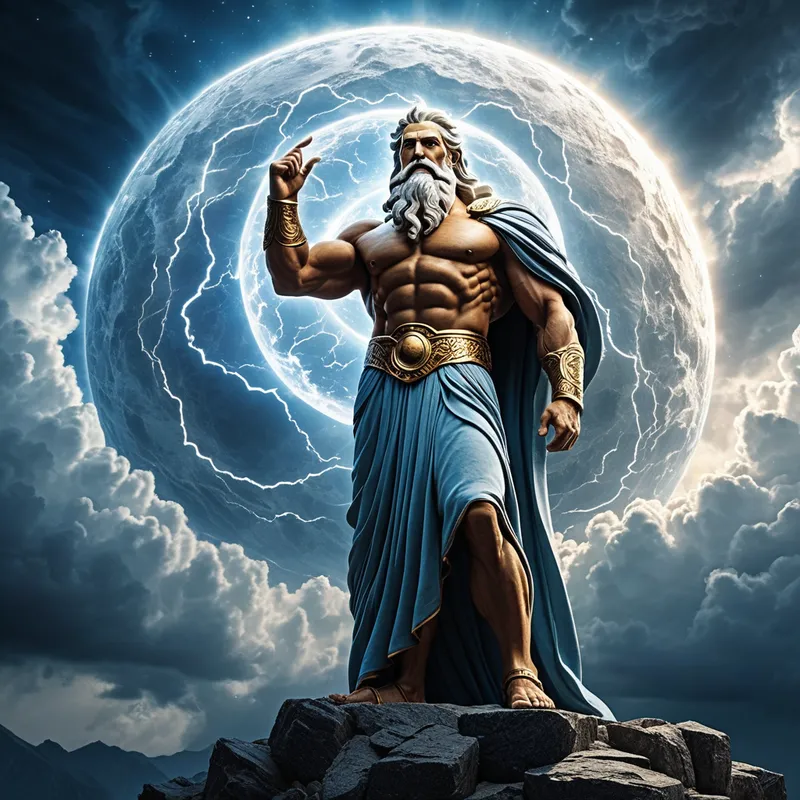
Zeus- The king of god Myth Meaning & Symbolism
The myth of the sky-father who overthrows chaos to establish cosmic order, embodying the archetypal struggle for sovereignty over the inner and outer worlds.
The Tale of Zeus- The king of god
Listen, and hear the tale of the birth of order from [the womb](/myths/the-womb “Myth from Various culture.”/) of endless strife. In the beginning was Chaos, and from it came [the Earth](/myths/the-earth “Myth from Hindu culture.”/), Gaia, and [the Sky](/myths/the-sky “Myth from Persian culture.”/), [Ouranos](/myths/ouranos “Myth from Global/Universal culture.”/). Their union birthed [the Titans](/myths/the-titans “Myth from Greek culture.”/), ancient and terrible. But [Ouranos](/myths/ouranos “Myth from Global/Universal culture.”/), fearing his children, forced them back into Gaia’s dark depths. In agony, Gaia forged a sickle of adamant and gave it to her youngest Titan, [Kronos](/myths/kronos “Myth from Greek culture.”/). He lay in wait, and when [Ouranos](/myths/ouranos “Myth from Global/Universal culture.”/) descended to embrace [the Earth](/myths/the-earth “Myth from Hindu culture.”/), [Kronos](/myths/kronos “Myth from Greek culture.”/) struck, severing [the Sky](/myths/the-sky “Myth from Persian culture.”/) from the Earth forever. From the blood that fell upon the land, [the Furies](/myths/the-furies “Myth from Greek culture.”/) and the Giants were born. Thus began the reign of [the Titans](/myths/the-titans “Myth from Greek culture.”/).
But Kronos, having learned fear from his father, swallowed a prophecy whole: that he too would be overthrown by his own child. So, when his sister-queen Rhea bore him children—[Hestia](/myths/hestia “Myth from Global/Universal culture.”/), Demeter, Hera, [Hades](/myths/hades “Myth from Greek culture.”/), [Poseidon](/myths/poseidon “Myth from Greek culture.”/)—he opened his maw and consumed them, each one, trapping the new generation within his eternal belly.
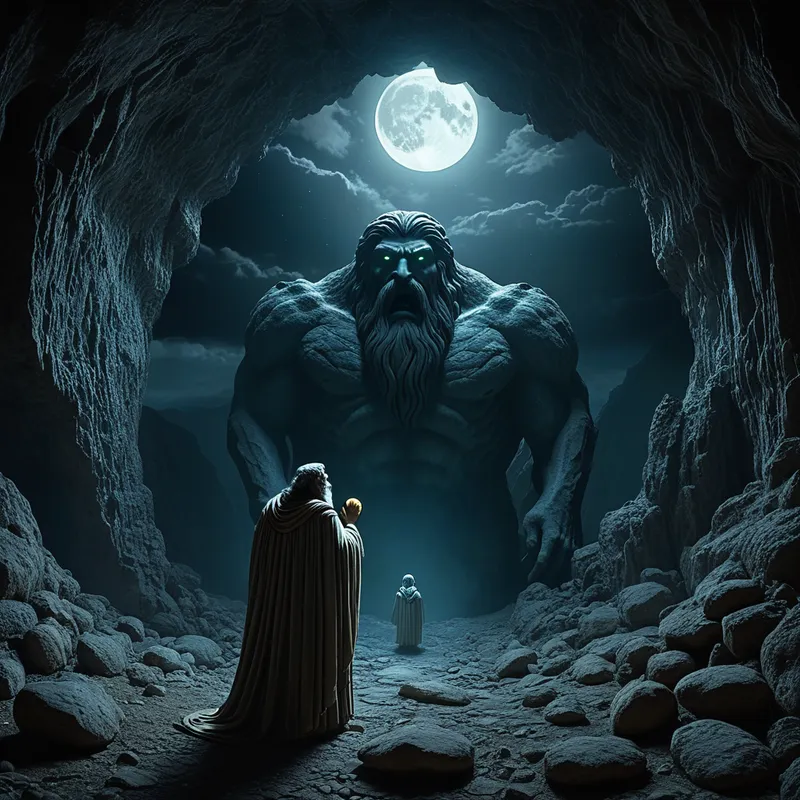
Rhea, her heart a cavern of grief, sought her mother Gaia. When her time came for the sixth child, she fled to a Cretan cave, where the earth opened to receive her. There, amidst the sound of clashing shields danced by the Kouretes to mask his cries, she bore a son. She named him Zeus. And she wrapped a stone in swaddling clothes, and with a mother’s terrible resolve, presented it to Kronos. The Titan, unsuspecting, swallowed the stone, believing his line secure.
The infant Zeus grew strong in the hidden cave, nourished by the goat Amaltheia. He learned the taste of honey and the power of thunder. When he came of age, guided by the Titaness [Metis](/myths/metis “Myth from Greek culture.”/), he disguised himself as a cupbearer and served his father a potent draught. Kronos drank, and his gut convulsed. One by one, he disgorged the stone first, then his children, whole and grown, erupting into the light. The war that followed—the Titanomachy—shook the foundations of the cosmos. Zeus freed the Cyclopes and the Hekatoncheires from [Tartarus](/myths/tartarus “Myth from Greek culture.”/), and with their help, the Olympians hurled lightning and mountains. The Titans were cast down, imprisoned in [the abyss](/myths/the-abyss “Myth from Kabbalistic culture.”/).
Victorious, the three brothers drew lots. Hades won the unseen realm below, Poseidon the shifting seas, and Zeus, the winner of the sky and the seat of authority over all. He ascended to the peak of [Mount Olympus](/myths/mount-olympus “Myth from Global/Universal culture.”/), where he established his throne. From there, he wielded the thunderbolt, balanced the scales of Dike, and presided over [the pantheon](/myths/the-pantheon “Myth from Greek culture.”/), a king not born of peace, but forged in the cataclysm between generations.
Cultural Origins & Context
The myth of Zeus is the foundational narrative of the Hellenic world, evolving from prehistoric Indo-European sky-god traditions. He was known as Zeus Pater (Father Zeus), a direct linguistic cousin to the Roman Jupiter and the Vedic Dyaus Pita. His stories were not scripture, but a living, oral tradition performed by bards like [Homer](/myths/homer “Myth from Greek culture.”/) and Hesiod, who systematized the divine genealogies in the 8th century BCE. These epics served as the national poetry of the Greeks, providing a shared cosmology, ethical framework, and explanation for the natural world—thunder was his voice, lightning his weapon, the clear sky his benevolence.
The myth functioned as a charter for patriarchal, kingly authority and the [triumph](/myths/triumph “Myth from Roman culture.”/) of cosmos (order) over chaos. It justified the political structure of the city-state (polis), where the king or ruling council was seen as Zeus’s earthly counterpart, responsible for [justice](/myths/justice “Myth from Tarot culture.”/) (dike) and hospitality ([xenia](/myths/xenia “Myth from Greek culture.”/)). The rituals performed at his major sanctuaries, like Olympia, were acts of communal alignment with this cosmic order, seeking his favor for stability, victory, and civic harmony.
Symbolic Architecture
Zeus represents the archetypal principle of the sovereign [consciousness](/symbols/consciousness “Symbol: Consciousness represents the state of awareness and perception, encompassing thoughts, feelings, and experiences.”/). He is not brute force, but the authorized force that structures [reality](/symbols/reality “Symbol: Reality signifies the state of existence and perception, often reflecting one’s understanding of truth and life experiences.”/). His victory is the [psyche](/myths/psyche “Myth from Greek culture.”/)’s necessary [movement](/symbols/movement “Symbol: Movement symbolizes change, progress, and the dynamics of personal growth, reflecting an individual’s desire or need to transform their circumstances.”/) from a state dominated by the Kronos complex—a time-bound, paranoid, consuming [pattern](/symbols/pattern “Symbol: A ‘Pattern’ in dreams often signifies the underlying structure of experiences and thoughts, representing both order and the repetitiveness of life’s situations.”/) that ingests potential and new [life](/symbols/life “Symbol: The symbol of ‘Life’ represents a journey of growth, interconnectedness, and existential meaning, encompassing both the joys and challenges that define human experience.”/)—to one of differentiated order.
The thunderbolt is not merely destruction; it is the sudden, illuminating insight that clears the psychic atmosphere, the moment of decisive judgment that ends inner civil war.
His swallowing of Metis (cunning intelligence) before she can give [birth](/symbols/birth “Symbol: Birth symbolizes new beginnings, transformation, and the potential for growth and development.”/) to a rival signifies the [integration](/symbols/integration “Symbol: The process of unifying disparate parts of the self or experience into a cohesive whole, often representing psychological wholeness or resolution of internal conflict.”/) of wisdom into the seat of power itself, making counsel internal rather than external. His numerous liaisons, often problematic from a modern ethical view, symbolically represent the sovereign ego’s encounter with and [assimilation](/symbols/assimilation “Symbol: The process of integrating new experiences, identities, or knowledge into one’s existing self, often involving adaptation and transformation.”/) of various divine attributes ([beauty](/symbols/beauty “Symbol: This symbol embodies aesthetics, harmony, and the appreciation of life’s finer qualities.”/), [memory](/symbols/memory “Symbol: Memory symbolizes the past, lessons learned, and the narratives we construct about our identities.”/), justice, etc.) from the broader field of the unconscious. The [Aegis](/symbols/aegis “Symbol: A divine shield or protective mantle, often associated with Zeus or Athena in Greek mythology, representing supernatural protection, authority, and divine power.”/) represents the terrifying, petrifying power of raw, undiluted sovereignty that can freeze [chaos](/symbols/chaos “Symbol: In Arts & Music, chaos represents raw creative potential, uncontrolled expression, and the breakdown of order to forge new artistic forms.”/) in its tracks.
The Dreamer’s Resonance
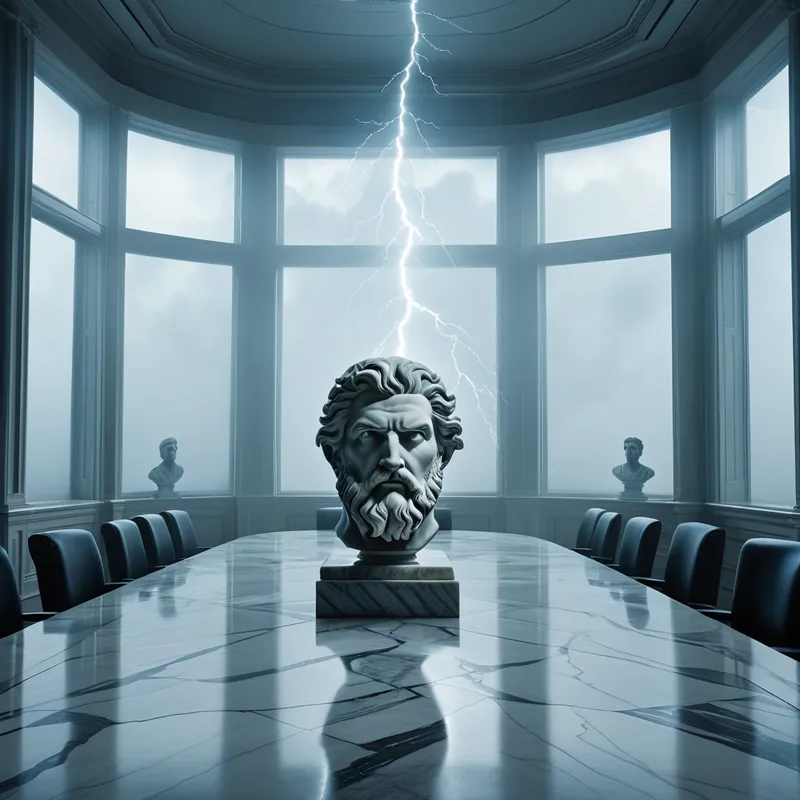
To dream of Zeus is to dream of a confrontation with the inner authority principle. It may manifest as a powerful, bearded figure issuing commands; a sudden, awe-inspiring storm; or the discovery of a majestic, elevated throne room within a familiar place.
Somatically, this can correlate with a feeling of expansion in the chest, a tightening of the jaw, or a surge of adrenaline—the body preparing to “hold the line.” Psychologically, the dreamer is likely grappling with a crisis of leadership, either externally in their world or internally among conflicting drives. The dream may be pushing the dreamer to claim legitimate authority, to make a decisive break from a “devouring” past pattern (a job, relationship, or internal critic), or to integrate disparate parts of [the self](/myths/the-self “Myth from Jungian culture.”/) under a conscious, unifying aim. It can also warn of the inflation and hubris of the uninitiated ruler—[the ego](/myths/the-ego “Myth from Jungian culture.”/) identifying solely with the power, not the responsibility.
Alchemical Translation
The myth of Zeus models the alchemical opus of Individuation—the creation of a stable, authoritative [Lapis Philosophorum](/myths/lapis-philosophorum “Myth from Alchemical culture.”/) from [the prima materia](/myths/the-prima-materia “Myth from Alchemical culture.”/) of ancestral chaos. The process begins in the [nigredo](/myths/nigredo “Myth from Alchemical culture.”/): the darkness of Kronos’s belly, the state of being unconsciously identified with familial or cultural complexes that consume one’s potential.
The stone swallowed in place of the Self is the necessary deception, the protective crust of persona that allows the true king to grow in secret.
The albedo is the purification and emergence on Crete, the development of one’s unique strength and resourcefulness away from the dominant complex. The citrinitas is the strategic cunning (Metis) and the forging of alliances (freeing the Cyclopes)—the development of the tools and relationships needed for revolution. The final [rubedo](/myths/rubedo “Myth from Alchemical culture.”/) is the Titanomachy itself: the fiery, cataclysmic inner battle where the old, monolithic order of the psyche is overthrown. The drawing of lots represents the final stage: the conscious ordering of the psychic realms ([the underworld](/myths/the-underworld “Myth from Greek culture.”/) of memory and shadow to Hades, the fluid realm of emotion and the unconscious to Poseidon, and the realm of conscious spirit and principle to the ego, now in service to the Self as Zeus).
For the modern individual, this is not about becoming a tyrannical god, but about undertaking the difficult, violent, and ultimately ordering work of deposing internalized “devouring” authorities to establish a personal sovereignty capable of holding the tension of opposites, wielding discernment (the thunderbolt), and dispensing justice within one’s own soul.
Associated Symbols
Explore related symbols from the CaleaDream lexicon: