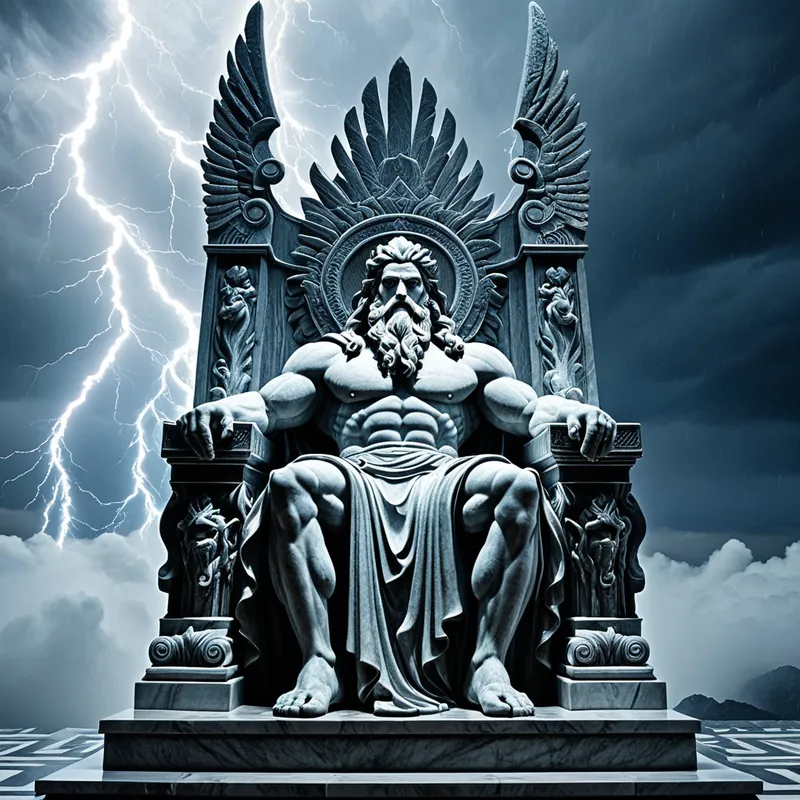
Zeus Myth Meaning & Symbolism
The sky-father who overthrew chaos to establish cosmic law, embodying the archetypal struggle for sovereignty, authority, and the integration of power.
The Tale of Zeus
In the beginning, there was only a yawning, formless dark. From this abyss, Gaia heaved herself into being, solid and vast, and from her, without sweet union, came Ouranos, the starry sky. He lay upon her, a smothering blanket, and would not let her children—the Titans, the Cyclopes, the Hundred-Handed Ones—see the light. The world was a prison, a groaning weight of potential trapped in eternal night.
Gaia’s rage forged a sickle of adamant. She whispered to her youngest Titan son, Kronos, who held a simmering ambition in his heart. When Ouranos descended to embrace the Earth once more, Kronos struck. A terrible, echoing scream rent the cosmos as the sky was castrated and thrown back, forever separated from the earth. Blood fell like rain, and from it sprang the Furies and the Giants. Order was born from a brutal, necessary crime.
But Kronos, having swallowed chaos, became its new vessel. Warned that his own child would overthrow him, he devoured each babe his sister-wife Rhea bore him: Hestia, Demeter, Hera, Hades, Poseidon. Their divine light vanished into his fathomless belly. Grief-stricken and furious, Rhea, when her sixth child quickened, fled to a hidden cave in Crete. There, amidst the dancing of shield-clashing Kouretes, she gave birth to a son. She named him Zeus.
She wrapped a stone in swaddling clothes and gave it to Kronos, who swallowed it without a glance. Meanwhile, the infant Zeus drank from the goat Amaltheia, his cries masked by the clashing bronze. He grew not by years, but by power. His first act of sovereignty was to free his siblings. With a potion of mustard and wine, given to Kronos by the cunning Metis, the Titan king wretched, and the undigested gods erupted forth, whole and blazing with wrath.
Then began the war that shook the foundations of the world: the Titanomachy. For ten years, Olympus and Othrys hurled mountains and rivers at each other. The cosmos trembled. Zeus, remembering his grandmother’s counsel, descended into the abyss of Tartarus and freed the Cyclopes and the Hundred-Handed Ones. In gratitude, the Cyclopes forged for him the master weapon: the thunderbolt. With that crackling, world-splitting power in his fist, and the hundred arms of his allies hurling three hundred stones at once, the tide turned. The Titans were cast down, bound, and imprisoned in Tartarus, guarded by their own monstrous brothers.
A new age dawned. The victors drew lots: Hades won the unseen realms, Poseidon the restless seas, and Zeus the high sky and the right to preside. He established his court on Mount Olympus, a realm above the clouds. But creation was not yet secure. The monster Typhon, last son of Gaia, rose to challenge the new order. In a cataclysm that nearly unmade reality, Zeus faced him alone, his thunderbolts flashing like the heartbeat of the world, until he buried the beast under a mountain. Only then was the sovereignty of the Olympian Cosmos sealed. The rule of law, prophecy, and the precarious balance of fate began, with the Sky-Father as its often-mercurial, always-potent king.
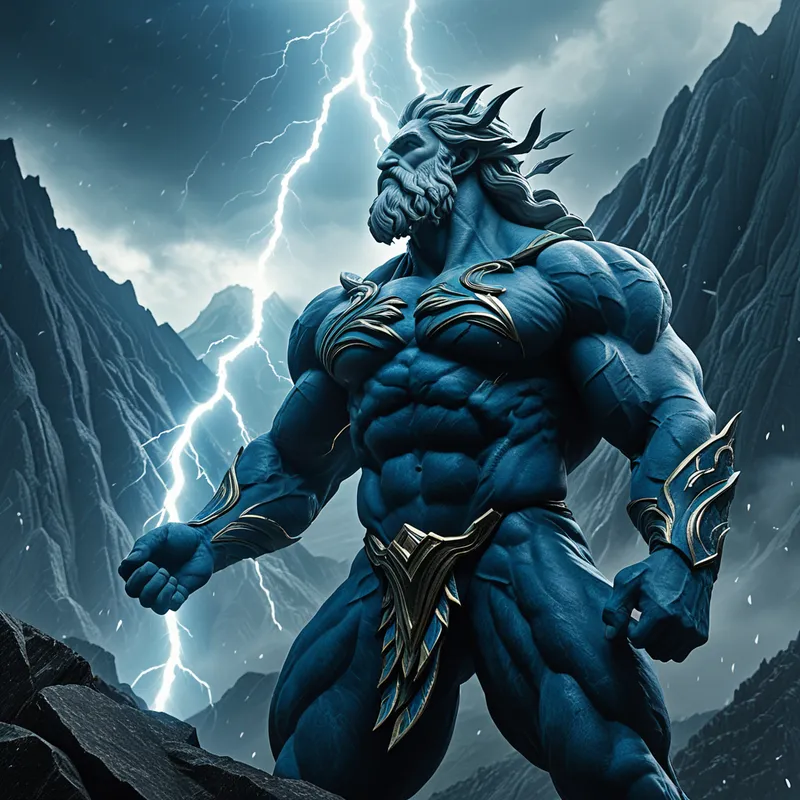
Cultural Origins & Context
The figure of Zeus, as the Indo-European Dyēus ph₂tēr (Sky Father), is one of humanity’s most ancient and widespread theological concepts. His myth, as we know it, was crystallized in the oral traditions of the Greek world, most famously in the epic poetry of Hesiod’s Theogony and woven throughout the Homeric hymns and epics. These were not mere stories for entertainment; they were the sacred narrative of the cosmos, recited by bards and rhapsodes at religious festivals and aristocratic gatherings. They served a foundational societal function: to explain the origin of the world (cosmogony), the establishment of the current divine order (theogony), and, crucially, to legitimize a patriarchal, hierarchical social structure. Zeus’s victory over the chaotic, older forces of the Titans and monsters provided a divine blueprint for the triumph of cosmos (order) over chaos, of civilization over barbarism, and of sanctioned kingly authority over tyrannical or anarchic rule. His numerous liaisons, often problematic through a modern lens, were also etiological, explaining the origins of cities, lineages, and natural phenomena, weaving the divine directly into the fabric of human geography and genealogy.
Symbolic Architecture
Zeus is not merely a powerful god; he is the archetypal principle of the sovereign function. His myth charts the painful, violent, and necessary transition from one order to another.
The thunderbolt is not just a weapon; it is the instantaneous, illuminating force of decisive consciousness that clears psychic chaos.
He represents the differentiated ego emerging from the undifferentiated, devouring unconscious (Kronos). His journey is one of liberation—first of himself, then of his siblings (other potential aspects of the psyche), and finally of the monstrous, creative, yet imprisoned potentials (the Cyclopes). His reign is not one of peaceful stasis but of constant maintenance. The battles against Titans, Giants, and Typhon symbolize the perpetual psychic work required to uphold consciousness, structure, and moral law against the perpetual regressive pull of the unconscious, of brute instinct, and of undifferentiated rage (Gaia’s vengeance). His many relationships signify the ruler’s attempt to integrate diverse aspects of life—wisdom (Metis), marriage and relationship (Hera), justice (Themis)—into his domain, though not always successfully or harmoniously.
The Dreamer’s Resonance
When the pattern of Zeus erupts in the modern dreamscape, it signals a profound crisis or opportunity related to authority and personal sovereignty. Dreaming of a mighty but distant storm, a towering but empty throne, or a powerful, charismatic yet intimidating father figure can point to the dreamer’s struggle with their own inner authority. Are they still in the belly of Kronos—suppressed, unseen, their potential “eaten” by a job, a relationship, or an internalized critical parent? Or are they in the phase of forging their thunderbolt—discovering their unique, potent skill or voice that can change their life’s landscape?
Somatically, this might manifest as tension in the shoulders and chest (carrying a burden of responsibility), or a feeling of expansive energy and clarity in the head (the realm of the sky-father). Psychologically, it is the process of confronting the “Titans” within: outdated personal rules, overwhelming emotions, or a tyrannical inner critic that must be dethroned to allow a new, more conscious self to govern.
Alchemical Translation
The alchemical journey mirrored in Zeus’s myth is the individuation process of claiming one’s rightful kingdom—the integrated Self. The prima materia is the chaotic, unconscious state (the reign of Ouranos, the devouring of Kronos). The separation is the brutal but necessary act of differentiation: the individual must, like young Zeus, retreat to a “cave” of introspection to nurture their latent power away from the consuming influences of family or society.
To become sovereign is not to become a tyrant, but to hold the tension between the lightning of will and the vessel of law.
The conjunction is the gathering of allies—freeing the siblings (acknowledging other subpersonalities) and the Cyclopes (integrating one’s profound, perhaps neglected, creative and strengths). The forging of the thunderbolt is the coagulatio: the crystallization of one’s unique authority, a personal principle or capability that is unmistakably and powerfully one’s own. Finally, the battles and the establishment of rule on Olympus represent the rubedo, the red stage of conscious living. Here, the individual does not eliminate the unconscious (the Titans remain in Tartarus), but consciously contains and manages it, establishing an inner polis where different aspects (the Olympian gods) have their domain under the presiding awareness of a central, ruling consciousness. The goal is not a sterile peace, but a dynamic, responsible sovereignty where one can finally say, with the weight of both power and justice, “I reign.”
Associated Symbols
Explore related symbols from the CaleaDream lexicon:
- Father
- Weather
- Government
- Superior
- Beard
- Powerful
- Authorities
- Thunderstorm
- Nurturing Rain
- Electric Storm
- Thunder Clap
- Meteorological Phenomenon
- Lightning
- Monsoon
- Severe Weather Alert
- Helicopter View
- Thunderstorm Sky
- Celestial Storm
- Storm Cloud
- Dazzling Aurora
- Clouds Parting
- Thunderhead
- Smart Home Hub
- Distant Thunder
- Thunderstorm Clouds
- Eagle’s Nest
- Thunderstorm Over Lake
- Torrent of Rain
- Echoing Thunder
- Thunderstorm Gathering
- Electric Shock
- Thunder
- Rainfall
- The Authority
- Authority
- Flashing
- Voltage
- Thunderclap
- Dominance