Zechariah Myth Meaning & Symbolism
A priest struck mute for questioning an angel's promise, who regains his voice only upon naming his miraculous son, John the Baptist.
The Tale of Zechariah
The air in the Holy of Holies was thick, a palpable presence of centuries-old prayer and the sweet, cloying scent of incense that clung to the robes of the old priest. Zechariah was alone, as alone as a man can be in the house of God. His lot had been cast, and by the ancient custom, it was his turn to offer the incense at the golden altar. His heart, a drumbeat of solemn duty and quiet yearning, echoed in the vast, silent chamber. He and his wife, Elizabeth, were righteous, walking blamelessly in all the commandments, yet their home was a quiet one, marked by the unspoken sorrow of barrenness. Their prayers for a child had long since settled into the dust of resignation.
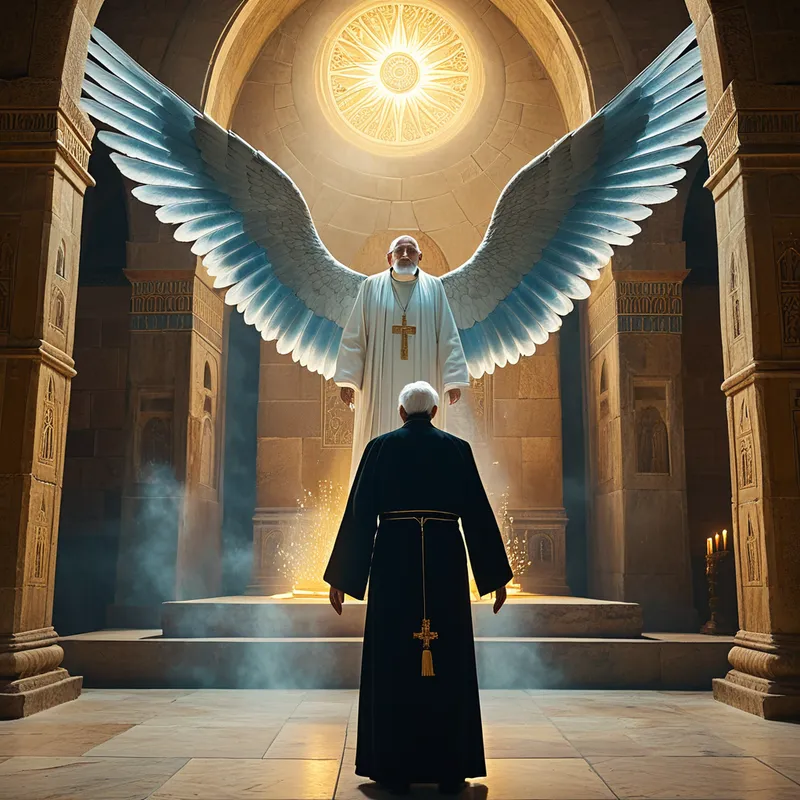
As the smoke of the offering began to curl heavenward in a grey-blue spiral, a light appeared—not a light from the lampstand, but a light that was. It coalesced into a form of terrifying majesty, standing to the right of the altar of incense. Zechariah’s breath caught, his blood turning to ice water. It was the archangel Gabriel.
“Do not be afraid, Zechariah,” the being spoke, and the words were not sound but a vibration in the very stone. “Your prayer has been heard. Your wife Elizabeth will bear you a son, and you are to call him John. He will be a joy and a delight to you, and many will rejoice because of him. For he will be great in the sight of the Lord… He will go on before the Lord, in the spirit and power of Elijah.”
The promise was immense, world-altering. It spoke to the deepest, most abandoned hope of his heart. Yet, Zechariah, the priest of the law, the man of measured ritual, looked upon the impossible. His reason, his knowledge of years and barren wombs, rose up like a wall. “How can I be sure of this?” he heard himself say, the words a dry rasp. “I am an old man, and my wife is well along in years.”
The angel’s gaze, which had been luminous, seemed to deepen into a well of ancient knowing. “I am Gabriel. I stand in the presence of God, and I have been sent to speak to you and to tell you this good news. And now you will be silent and not able to speak until the day this happens, because you did not believe my words, which will come true at their appointed time.”
The light did not fade; it was simply gone. And with it went Zechariah’s voice. A great stillness filled him, a hollow where his question had been. He stumbled out to the waiting crowd, who saw his ashen face and understood he had seen a vision. He could only gesture, a man suddenly entombed in his own silence.
Months passed in that profound quiet. Elizabeth conceived, as the angel had said, and hid herself for five months, a secret joy flowering in the desert of their age. Zechariah lived the promise in mute witness, the growing life in his wife’s womb a daily, wordless sermon to his doubt.
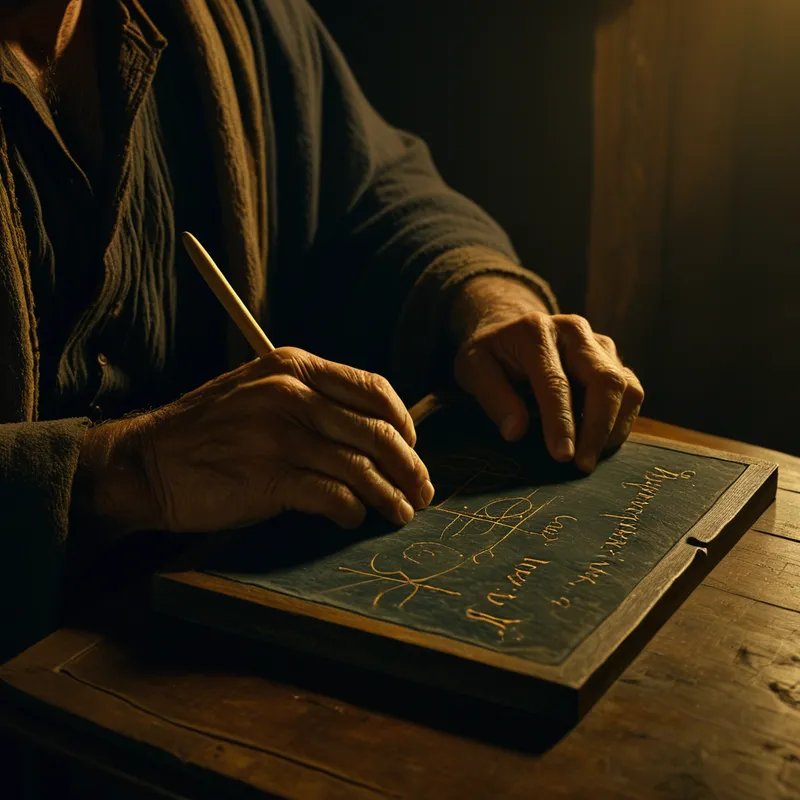
When the child was born, on the eighth day at his circumcision, the family assumed he would be named Zechariah, after his father. Elizabeth, with a certainty that had grown in the soil of silence, said, “No! He is to be called John.” They protested, turning to the mute father. Zechariah asked for a writing tablet. In the hush of the room, the scratch of the stylus was the only sound. He wrote, “His name is John.” And immediately, as the final letter was formed, his tongue was loosed. His first act was not to complain of his long silence, but to open his mouth and pour forth a torrent of praise, a prophecy that sang of God’s redemption and the destiny of this child, who would be called John the Baptist.
Cultural Origins & Context
The myth of Zechariah is found in the opening chapter of the Gospel of Luke, a text composed in the latter half of the first century CE. Unlike the other gospels, Luke begins with a formal, historical prologue, situating the story within the reign of Herod the Great and the priestly order of Abijah. This anchors the tale not in abstract cosmology, but in a specific religious and social milieu: Second Temple Judaism.
The story functions as a bridge between the old covenant and the new. Zechariah is a representative of the established, temple-based priesthood, a system bound by law, ritual, and lineage. His encounter in the Temple, the very heart of that system, signifies that the divine initiative is breaking into the established order from within. The story was passed down within early Christian communities as a foundational narrative explaining the origins of John the Baptist, a pivotal figure who prepared the way for Jesus. Societally, it served to legitimize John’s prophetic authority by rooting it in a miraculous, priestly origin story, demonstrating that the new movement was a fulfillment, not a rejection, of ancient promises. It was a story told to inspire awe and to illustrate the pattern of faithful waiting, sudden interruption, and transformative fulfillment.
Symbolic Architecture
At its core, the myth of Zechariah is a profound map of the psyche’s encounter with the numinous—the overwhelming, transformative power of the Self. Zechariah, the ego identified with tradition, duty, and rational order, is confronted in his most secure sanctuary by the archetypal messenger, Gabriel. The angel represents a direct influx from the unconscious, a call to a new and impossible life that shatters the ego’s comfortable worldview.
The doubt of the sage is not a rejection of truth, but the ego’s last, necessary defense before it surrenders to a reality larger than its comprehension.
His question, “How can I be sure?” is the rational mind’s legitimate, yet ultimately inadequate, response to the archetypal. The resulting muteness is not merely a punishment, but a profound symbolic necessity. His voice, the instrument of his priestly office and personal identity, is suspended. He is plunged into the liminal space of silence, where the old certainties cannot be spoken and the new reality has not yet been born. This enforced silence is a gestation period. He must contain the promise without being able to articulate it, to live the mystery rather than explain it. The birth of John—whose name means “God is gracious”—is the manifestation of that contained promise. Zechariah’s voice returns only when he actively aligns with the divine will by writing “John,” symbolizing the ego’s conscious assent to and cooperation with the Self’s purpose. His first liberated speech is prophecy, showing that the voice that returns is not the old, questioning voice, but a new one, integrated with and serving the transpersonal reality.
The Dreamer’s Resonance
When this mythic pattern stirs in the modern dreamer, it often manifests as dreams of being mute, having a blocked throat, or desperately trying to speak or shout without sound. Somatic sensations may accompany this—a tightness in the jaw, a lump in the throat, a feeling of breath constricted. Psychologically, this signals a profound moment of incubation.
The dreamer is in a “Zechariah phase.” They have received an intuitive prompt, a call to a new way of being—perhaps a creative idea, a relational possibility, or a vocational shift—that feels both miraculous and impossible. The ego, terrified of the disruption, has responded with rational doubt (“How can I do this? It’s not practical. I’m too old. It’s too late.”). The muteness in the dream reflects the psyche’s wise enforcement of a necessary silence. It is saying, “You are not yet ready to speak of this. You must first hold it, gestate it, let it grow in the dark of your unconscious without trying to control it with your conscious plans and pronouncements.” The dream invites the dreamer to endure this fertile silence, to watch for the “Elizabeth” aspect—the inner container of faith that quietly believes and nurtures the promise—and to wait for the moment of naming, the act of conscious commitment that will release a new, authentic voice into the world.

Alchemical Translation
The alchemical journey modeled by Zechariah is that of mortificatio followed by illuminatio. The initial stage is the nigredo, the blackening: the dazzling, terrifying encounter with the angel in the sacred space. This is the dissolution of the old conscious attitude (the priestly ego). His doubt is the final reaction of the prima materia before it submits to transformation.
The enforced silence is the central alchemical vessel, the vas hermeticum. In this sealed space, the opposites are held: doubt and promise, age and new life, silence and prophecy. This is the long, patient work of albedo, the whitening, where the contents are purified through containment. Zechariah does nothing but witness and serve the process occurring in Elizabeth. He learns to “write” instead of “speak”—a more deliberate, grounded form of expression that comes from the hand, not the reactive tongue.
The voice that is lost in doubt is returned only through the hand that writes the true name.
The climax is the rubedo, the reddening or culmination. The act of writing “John” is the final, conscious coniunctio—the marriage of the human will (Zechariah’s hand) with the divine intent (the name given by the angel). This act of alignment breaks the seal. The liberated voice that erupts is no longer the personal voice of Zechariah the doubter, but the transpersonal voice of Zechariah the prophet. It is a voice that now sings the song of the Self, having been tempered and reborn in the vessel of silence. For the modern individual, the myth instructs: when a call from the deep psyche renders you speechless with its enormity, do not despair the silence. See it as the necessary alchemical vessel. Tend to the quiet, growing thing within. Your true voice—authentic, creative, and prophetic—will return only when you are ready to inscribe its true name upon your life.
Associated Symbols
Explore related symbols from the CaleaDream lexicon: