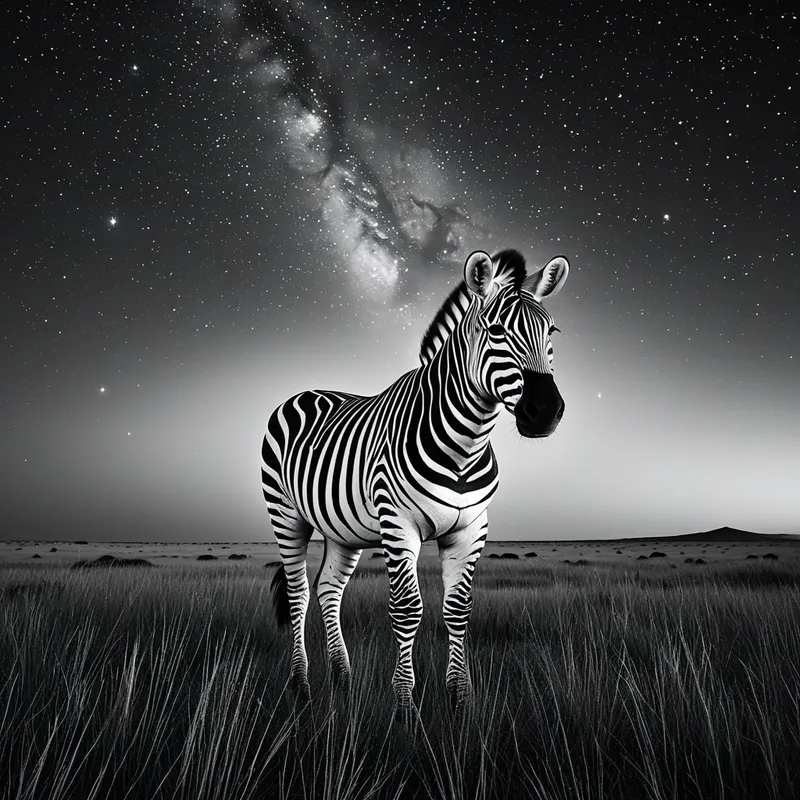
Zebra Myth Meaning & Symbolism
A San creation myth where Zebra, the first animal, sacrifices its pristine hide to bring color, pattern, and the duality of life to the world.
The Tale of Zebra
In the time before time, when [the world](/myths/the-world “Myth from Tarot culture.”/) was a breath held in the throat of the dawn, there was only the great, silent expanse. [The sky](/myths/the-sky “Myth from Persian culture.”/) was a bowl of unbroken blue, and [the earth](/myths/the-earth “Myth from Hindu culture.”/) was a canvas of endless, pale dust. All things were one color, one tone, a world waiting in a dream of potential. And in this dream walked the first of all creatures, Zebra. Its hide was as smooth and unblemished as a [moonstone](/myths/moonstone “Myth from Various culture.”/), a creature of pure, radiant white, moving like a ghost through the monochrome land.
The [Great Spirit](/myths/great-spirit “Myth from Native American culture.”/), who shaped the hills with a sigh and filled the dry riverbeds with a thought, looked upon this perfect, colorless world and felt a longing. It was a world of peace, but it was a world without story, without contrast, without the dance of difference. The Spirit called Zebra to the foot of the great Koppie. “You are the first,” the voice echoed, not in sound, but in the shiver of the grass. “And in your form, all forms will find their echo. But the world cannot remain in this single note.”
Zebra stood, trembling, its white hide glowing in the starlight. The Great Spirit knelt, and from the ashes of the first fire—a fire that held memories of suns yet unborn—the Spirit gathered dark, powdery soot. From the bed of an ancient, dry lake, the Spirit scooped pure white clay. With fingers that held the heat of creation and the cool of [the void](/myths/the-void “Myth from Buddhist culture.”/), the Spirit began to paint.
The touch was not gentle. It was the searing brand of destiny. Where the ash-stained finger traced, a stripe of profound, velvety black burned into Zebra’s hide. Where the clay-smudged finger followed, a stripe of brilliant white was sealed. Zebra cried out, a sound that became the first wind, as its pristine unity was shattered into a rhythm of opposites. It was an agony of becoming, a violent baptism into complexity. The Spirit painted on, stripe after stripe, until Zebra’s body was a living tapestry of dark and light, a map of a new, dualistic reality.
When it was done, Zebra stood transformed, panting, its sides heaving. It looked at its reflection in a newly formed pool and saw a stranger—a being of breathtaking, terrifying pattern. Then, it turned and bolted. And as it ran across the plain, a miracle unfolded. Where its black hooves struck the earth, green shoots pushed through the dust. Where its shadow fell, flowers of yellow and red unfurled. The very air seemed to split into the blue of day and the indigo of twilight. Zebra, in its sacrifice of primal unity, had not just received pattern—it had become the catalyst for all pattern, for color, for the very interplay of shadow and light that gives the world its depth and its story.
Cultural Origins & Context
This profound narrative finds its roots in the oral traditions of the San peoples, indigenous hunter-gatherers of Southern Africa, particularly in the Kalahari region. It is not a singular, canonical text, but a living story passed down through generations around evening fires, told by elders and shamans to explain the origins of natural beauty and existential truth. The myth served a crucial societal function beyond mere explanation. In a culture deeply attuned to tracking, observation, and survival in a harsh landscape, the story of Zebra encoded a fundamental philosophical principle: that life is constituted by essential contrasts. It taught that what appears as a flaw or a mark—the stripes that make Zebra visible—is, in fact, the source of its sacred power and the world’s vibrancy. The myth was a cognitive tool, preparing the mind to see the world not as a collection of things, but as a dynamic relationship between opposites: day and night, hunger and plenty, safety and danger, community and solitude.
Symbolic Architecture
At its core, the Zebra myth is a masterclass in the [symbolism](/symbols/symbolism “Symbol: The use of symbols to represent ideas or qualities, often conveying deeper meanings beyond literal interpretation. In dreams, it’s the language of the unconscious.”/) of primordial sacrifice and the [birth](/symbols/birth “Symbol: Birth symbolizes new beginnings, transformation, and the potential for growth and development.”/) of [consciousness](/symbols/consciousness “Symbol: Consciousness represents the state of awareness and perception, encompassing thoughts, feelings, and experiences.”/) through [differentiation](/symbols/differentiation “Symbol: The process of distinguishing or separating parts of the self, emotions, or identity from a whole, often marking a developmental or psychological milestone.”/). The unmarked, white Zebra represents the primal unity, the unconscious [pleroma](/symbols/pleroma “Symbol: In Gnostic cosmology, the Pleroma is the divine fullness or totality of spiritual powers, representing the realm of perfection beyond the material world.”/) where all potentials exist but [none](/symbols/none “Symbol: The absence represented by ‘none’ can signify emptiness, potential, or a yearning for substance.”/) are realized. It is [innocence](/symbols/innocence “Symbol: A state of purity, naivety, and freedom from guilt or corruption, often associated with childhood and moral simplicity.”/), but it is also stagnation. The act of painting by the Great [Spirit](/symbols/spirit “Symbol: Spirit symbolizes the essence of life, vitality, and the spiritual journey of the individual.”/) is the initial, often traumatic, act of discrimination that creates the known world.
The first wound is the first distinction, and from that cleavage, all creation flows.
The [stripes](/symbols/stripes “Symbol: Stripes represent duality, boundaries, and movement, often symbolizing order versus chaos or societal roles versus individuality.”/) are not merely decoration; they are the fundamental binary code of [reality](/symbols/reality “Symbol: Reality signifies the state of existence and perception, often reflecting one’s understanding of truth and life experiences.”/). Black and white, in this context, are not moral absolutes of good and evil, but complementary forces: [presence](/symbols/presence “Symbol: Presence in dreams often signifies awareness or acknowledgment of something significant in one’s life.”/) and [absence](/symbols/absence “Symbol: The state of something missing, void, or not present. Often signifies loss, potential, or existential questioning.”/), substance and [space](/symbols/space “Symbol: Dreaming of ‘Space’ often symbolizes the vastness of potential, personal freedom, or feelings of isolation and exploration in one’s life.”/), known and unknown, self and other. Zebra becomes the archetypal coincidentia oppositorum. Its enduring psychological power lies in its modeling of a sacred [paradox](/symbols/paradox “Symbol: A contradictory yet true concept that challenges logic and perception, often representing unresolved tensions or profound truths.”/): to become truly whole, one must first be willing to be divided, to bear the marks of experience. The myth suggests that our individual “[stripes](/symbols/stripes “Symbol: Stripes represent duality, boundaries, and movement, often symbolizing order versus chaos or societal roles versus individuality.”/)“—our scars, our unique talents, our flaws, our personal [history](/symbols/history “Symbol: History in dreams often represents the dreamer’s past experiences, lessons learned, or unresolved issues that continue to influence their present.”/)—are not accidents, but the very patterns that allow us to participate in and contribute to the colorful complexity of existence.
The Dreamer’s Resonance
When this myth stirs in the modern [psyche](/myths/psyche “Myth from Greek culture.”/), it often surfaces in dreams of stark contrast, marked bodies, or sudden, transformative visibility. To dream of a zebra, particularly one that is being painted, marked, or is losing/gaining its stripes, signals a profound somatic and psychological process underway: the individuation of [the self](/myths/the-self “Myth from Jungian culture.”/) from the mass.
The dreamer may be experiencing the “painting” phase—a felt sense of being acted upon by a larger, impersonal force (the Self, fate, a life crisis) that is indelibly changing their identity. This can feel violent, like a burning brand, as old, monolithic ways of being (the pure white hide) are broken down. The somatic resonance might be anxiety, a feeling of exposure, or hypersensitivity, as if one’s psychological skin is newly raw and patterned. Alternatively, dreaming of confidently being the striped zebra, running and causing life to bloom in one’s wake, indicates the integration of this process. The dreamer is moving from resisting their unique composition of light and dark traits to embodying it, discovering that their specific pattern of strengths and weaknesses is precisely what makes them effective and generative in the world.
Alchemical Translation
The alchemical journey mirrored in the Zebra myth is the opus of individuation, specifically the stage of [separatio](/myths/separatio “Myth from Alchemical culture.”/) and subsequent coniunctio. The initial, unified massa confusa (the white Zebra) must undergo a necessary and painful separation. The ash and clay represent the [nigredo](/myths/nigredo “Myth from Alchemical culture.”/) and albedo—the blackening and whitening—not as sequential stages, but as simultaneous, interwoven principles that must be applied to the soul’s substance.
The goal is not to return to blank unity, but to achieve a higher synthesis: a patterned whole where the opposites are held in conscious, dynamic tension.
For the modern individual, this translates to the courage of self-definition. It is the willingness to step away from the comfort of amorphous belonging (the unmarked herd) and allow life’s experiences—both the searing ashes of failure, grief, or shadow-work (the black stripes) and the clarifying clay of insight, discipline, and conscious choice (the white stripes)—to mark us. The [triumph](/myths/triumph “Myth from Roman culture.”/) is not in avoiding the paint, but in realizing that the act of being painted is the act of being created. Our task is to stop fleeing from our own patterned nature, to cease seeing our contrasts as flaws, and instead to run with them. In doing so, like Zebra, we do not just accept our own duality; we become agents who, by embodying our resolved conflicts, bring color, life, and new possibilities into the world around us. We become creators of our own landscape, not merely inhabitants of a monochrome one.
Associated Symbols
Explore related symbols from the CaleaDream lexicon: