
Yuzu-yu Myth Meaning & Symbolism
A sacred ritual bath infused with winter yuzu, believed to cleanse the spirit and connect bathers to ancestral wisdom and the year's turning.
The Tale of Yuzu-yu
Listen, and let the steam carry the tale. In the deep heart of winter, when the sun is a pale memory and the world holds its breath in the longest night, the people would gather. Not in temples of stone, but in humble bathhouses of cedar and pine, where the air was thick with the ghost of a thousand past winters. The water was drawn not from any well, but from the deep, silent earth, heated over fires that crackled with the bones of old trees.
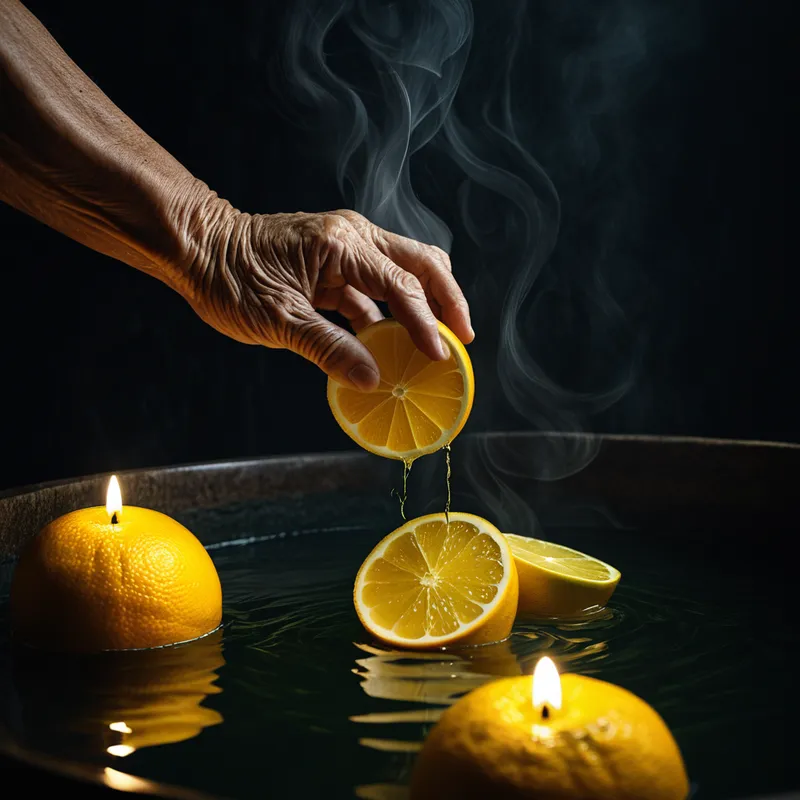
Into this vessel of liquid warmth, the elders would bring the treasure of the fading year: the yuzu. Golden as captured sunlight, wrinkled with the wisdom of the cold, each fruit was a world unto itself. With reverence, they would slice them open, or set them whole to bob upon the surface like little, fragrant suns. The moment the peel met the heat, the air would change. A sharp, clean scent would burst forth—not sweet, but bright and bracing, a scent that cut through the drowsy steam like a memory of summer.
They called this the Yuzu-yu. To enter the water was not merely to bathe. It was to step into a river of time. The heat seeped into weary bones, the citrus oil kissed the skin, and as the bather closed their eyes in the communal dark, the stories would rise with the steam. Whispers of ancestors who had performed this same rite, hopes for the returning sun, confessions of the year’s burdens released into the fragrant water. It was said that to bathe in the Yuzu-yu was to be washed clean not of dirt, but of the year’s spiritual grime. It warded off colds, yes, but more importantly, it warded off ill fortune. It promised a winter of health and a spring of renewal. The ritual was simple: to immerse, to inhale, to remember, and to emerge reborn into the crisp winter air, skin glowing, spirit light, carrying the scent of the golden fruit as a personal talisman against the dark.
Cultural Origins & Context
The practice of Yuzu-yu is rooted in the deep, animistic fabric of Japanese folk tradition, intersecting with the practical wisdom of Kampo and the annual rhythm of agricultural life. Its most common association is with Toji, the shortest day and longest night of the year. This solar event was a pivotal moment of cosmic transition, a time when the veil between worlds was considered thin and the forces of Yang (light, warmth) were at their weakest, soon to be reborn.
The ritual was not centralized in priestly liturgy but lived in the domestic and communal sphere—passed down through generations of mothers, grandmothers, and village elders. It functioned as a form of communal magic and preventative medicine. The yuzu, ripening in late autumn, was seen as a concentrated essence of vitality, its bright color and strong scent symbolically repelling misfortune and illness (often personified as malicious spirits or yakubyougami). By partaking in the bath, individuals aligned themselves with the turning year, actively participating in the cosmic struggle to ensure the sun’s return and the community’s survival through the harsh season. It was a somatic prayer, a collective sigh of resilience.
Symbolic Architecture
At its core, Yuzu-yu is an alchemical vessel where the elemental opposites of the year are reconciled. The cold winter (Yin) meets the warm bath (Yang). The darkness of the solstice is penetrated by the golden, sun-like fruit. The communal water dissolves the isolated individual. This is not a myth of a lone hero, but of the collective soul performing an act of psychic hygiene.
The bath is the womb of the year, where the accumulated past is dissolved so the future may be born unburdened.
The yuzu itself is the key symbol. Its thick, rugged peel protects a fragrant, acidic interior—a perfect metaphor for the resilient self that guards a vibrant, sometimes sharp, inner life. Releasing its essence into the hot water symbolizes the voluntary surrender of one’s defensive boundaries for a greater purpose: communal healing and renewal. The act is one of offering. The steam carrying the scent represents the transformation of the personal into the atmospheric, the individual contribution to the shared spiritual environment.
The Dreamer’s Resonance
When the pattern of Yuzu-yu arises in modern dreams, it seldom appears as a literal bathhouse. Instead, the dreamer may find themselves in a place of immersive transition—a pool, a misty forest, a room filling with a particular scent. The somatic feeling is crucial: the enveloping warmth, the sensation of floating, the sharp, clean aroma that brings clarity.
Psychologically, this signals a process of active purification and integration. The “water” is the unconscious itself. The “yuzu” represents a core aspect of the dreamer’s experience—often a memory, a talent, or a piece of hard-won wisdom (symbolized by the fruit’s late ripening)—that needs to be consciously “sliced open” and offered up to be processed. The dream may occur during life transitions, after periods of stress, or when ancestral patterns or old emotional “grime” need to be cleansed. It is the psyche’s ritual, creating its own Yuzu-yu to facilitate healing. The presence of shadowy or ancestral figures in such dreams aligns with the myth’s function of connecting to the familial and cultural unconscious.

Alchemical Translation
For the modern individual navigating the “long winters” of the soul—periods of depression, stagnation, grief, or existential cold—the Yuzu-yu offers a profound model for psychic transmutation. The individuation process requires these periodic, voluntary descents into the warming waters of self-reflection.
First, one must draw the water: create a vessel of attention and introspection. Second, gather the yuzu: identify that precious, resilient resource within—a core value, a creative spark, a painful but important truth. Third, perform the ritual: consciously immerse oneself in the process, allowing the heat of focused emotion and the sharp scent of that truth to permeate one’s entire being. This is the dissolution of the ego’s rigid defenses.
The goal is not to emerge “clean” in a sterile sense, but to emerge scented—carrying the indelible, fortifying essence of the process itself into the world.
Finally, one steps out into the cold air. This is the integration. The transformed individual re-enters their life not as a victim of the winter, but as an embodied symbol of the returning light, carrying within them the fragrant proof of their own resilience. The myth teaches that renewal is not a passive waiting for spring, but an active, ritualized collaboration with the darkness, using the very fruits that the ending cycle has provided.
Associated Symbols
Explore related symbols from the CaleaDream lexicon: