Yuga Cycle Myth Meaning & Symbolism
A vast cosmic cycle of four descending ages, where dharma wanes and consciousness dims, culminating in dissolution before a golden dawn is reborn.
The Tale of Yuga Cycle
Listen. Before the first word was spoken, before the first mountain rose from the primal waters, there was the Breath. And with that Breath, the great Brahma exhales a universe into being. This is not a single story, but the story of all stories—the great Wheel of Time, the Yuga Cycle.
It begins in a light so pure it has no shadow. This is the Satya Yuga. [The earth](/myths/the-earth “Myth from Hindu culture.”/) is soft as butter, yielding wish-fulfilling trees. The air hums with the primordial syllable Om. Humanity is not as we know it; they are giants of spirit, their bodies luminous, their lifespans stretching for thousands of years. Dharma stands firm on all four legs, like a steadfast bull. There is no mine or thine, only the One. Truth is the very substance of reality, and the divine is as present as the ground beneath one’s feet.
But the Wheel turns. The light thickens, casting the first, faint silhouette. The Treta Yuga dawns. Dharma now stands on three legs. A subtle chill enters [the world](/myths/the-world “Myth from Tarot culture.”/). The earth hardens; effort is born. Sacrifice appears—the great Rama must string a mighty bow, fight demons, and suffer exile to uphold the cosmic order. The scent of ritual fire, havan, fills the air, a fragrant bridge to a heaven that is beginning to feel distant. The divine is glimpsed in the perfect king, the flawless hero.
The turn continues, the light dimming to a bronze twilight. This is the Dvapara Yuga. Dharma trembles, balanced on only two legs. The world is divided—good and evil, love and hatred, knowledge and ignorance. Great wars are fought not just on battlefields like Kurukshetra, but within every heart. The divine is heard in the profound song, the Bhagavad Gita, whispered on a chariot between two armies, a desperate teaching for a confused age. The air tastes of iron and doubt.
And then, the final turn into deep shadow: the [Kali Yuga](/myths/kali-yuga “Myth from Hindu culture.”/). Dharma stands precariously on a single leg. The world is iron and stone. Lifespans shorten, minds contract. Truth is replaced by falsehood, wisdom by cleverness, generosity by greed. The air is thick with the smoke of industry and strife. The divine seems utterly hidden, accessible only through fervent devotion or the complete abandonment of [the self](/myths/the-self “Myth from Jungian culture.”/). It is an age where [the sacred thread](/myths/the-sacred-thread “Myth from Hindu culture.”/) is worn but the heart is hollow, where rulers are not protectors but exploiters, and the soul feels exiled in a marketplace of illusions.
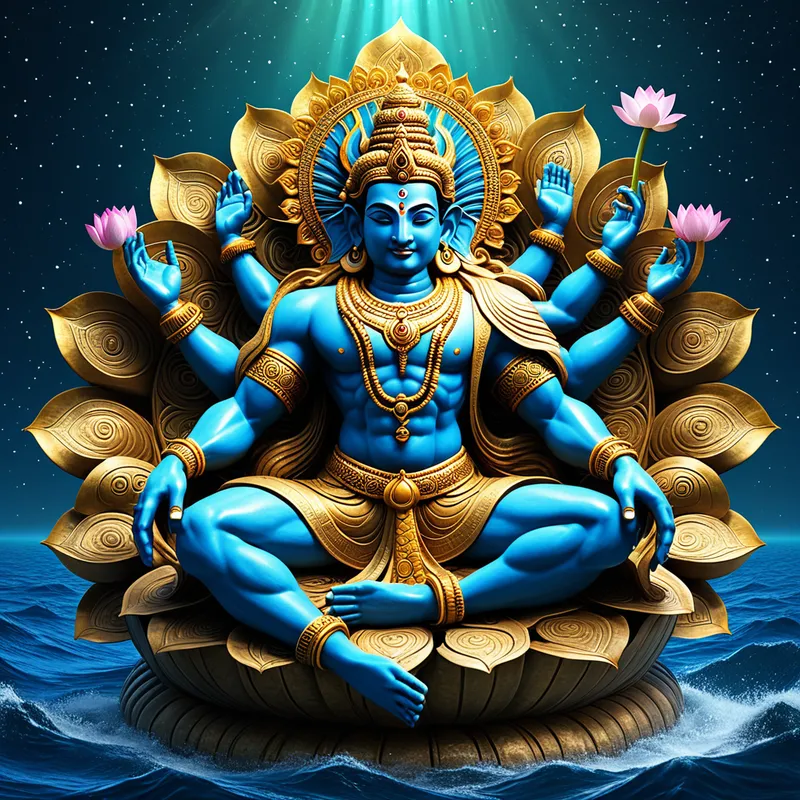
This is the descent. But the story does not end in eternal night. For when the weight of adharma, of disorder, becomes too great to bear, the great preserver, [Vishnu](/myths/vishnu “Myth from Hindu culture.”/), incarnates. He arrives not as a gentle teacher, but as [Kalki](/myths/kalki “Myth from Hindu culture.”/), a fierce warrior on a white horse, wielding a blazing sword that is not of metal but of divine discernment. With that sword, he severs the tangled roots of the corrupted age. The cosmos, weary and spent, dissolves back into the causal ocean from whence it came. There is a great, silent pause—the [pralaya](/myths/pralaya “Myth from Hindu culture.”/), the dissolution. And in that holy void, on the endless coils of the serpent Ananta [Shesha](/myths/shesha “Myth from Hindu culture.”/), [Vishnu](/myths/vishnu “Myth from Hindu culture.”/) rests. He dreams. And from his dream, from [the lotus](/myths/the-lotus “Myth from Hindu culture.”/) of his navel, Brahma is born again. The golden Satya Yuga dawns once more. The Wheel has turned full circle. The Breath is drawn in, and then exhaled anew.
Cultural Origins & Context
The architecture of the Yuga Cycle is woven into the very fabric of Hindu cosmology, primarily articulated in texts like the Puranas, the Mahabharata, and the Manusmriti. It was not a mere calendar but a metaphysical map of reality, passed down by sages (rishis) and storytellers (sutas) to kings and commoners alike. Its function was profound: to provide a cosmic context for human life. It answered the existential “why”—why virtue seems so difficult, why the world seems to decay, why suffering accumulates. It placed the tribulations of an individual life, and even of a civilization, within a vast, purposeful rhythm. It was a narrative that fostered patience (titiksha) and righteous action (dharma), even in a dark age, by assuring that the darkness itself was part of a grand, cyclical order presided over by the divine. It was a myth that managed both despair and hope, grounding society in a timeline so immense it relativized all earthly power and ambition.
Symbolic Architecture
The Yuga Cycle is not a [linear](/symbols/linear “Symbol: Represents order, predictability, and a direct, step-by-step progression. It symbolizes a clear path from cause to effect.”/) [history](/symbols/history “Symbol: History in dreams often represents the dreamer’s past experiences, lessons learned, or unresolved issues that continue to influence their present.”/) but a profound symbolic map of [consciousness](/symbols/consciousness “Symbol: Consciousness represents the state of awareness and perception, encompassing thoughts, feelings, and experiences.”/) itself. The four [Yugas](/myths/yugas “Myth from Hindu culture.”/) represent the gradual exteriorization and densification of [spirit](/symbols/spirit “Symbol: Spirit symbolizes the essence of life, vitality, and the spiritual journey of the individual.”/) into matter, and the corresponding [interior](/symbols/interior “Symbol: The interior symbolizes one’s inner self, thoughts, and emotions, often reflecting personal growth, vulnerabilities, and secrets.”/) [journey](/symbols/journey “Symbol: A journey in dreams typically signifies adventure, growth, or a significant life transition.”/) of the [soul](/symbols/soul “Symbol: The soul represents the essence of a person, encompassing their spirit, identity, and connection to the universe.”/) from unity to [separation](/symbols/separation “Symbol: A spiritual or mythic division between realms, states of being, or consciousness, often marking a transition or loss of connection.”/) and back again.
The descent of the ages is the soul’s journey into the labyrinth of experience; the dissolution is the moment it remembers it holds the thread.
The Satya Yuga symbolizes the state of pure, undifferentiated consciousness—the Self before [the ego](/myths/the-ego “Myth from Jungian culture.”/)‘s [birth](/symbols/birth “Symbol: Birth symbolizes new beginnings, transformation, and the potential for growth and development.”/). Here, the inner and outer worlds are one. The Treta Yuga marks the birth of [the ego](/myths/the-ego “Myth from Jungian culture.”/) and [the principle](/symbols/the-principle “Symbol: A fundamental truth, law, or doctrine that serves as a foundation for a system of belief, behavior, or reasoning, often representing moral or ethical standards.”/) of sacrifice—the conscious [effort](/symbols/effort “Symbol: Effort signifies the physical, mental, and emotional energy invested toward achieving goals and personal growth.”/) ([tapas](/myths/tapas “Myth from Hindu culture.”/)) required to maintain [connection](/symbols/connection “Symbol: Connection symbolizes relationships, communication, and bonds among individuals.”/) with the whole. The Dvapara Yuga represents the full flowering of duality and conflict, the battlefield of the [psyche](/myths/psyche “Myth from Greek culture.”/) where opposing forces (the Pandavas and Kauravas) must be integrated. The Kali Yuga is the state of maximum identification with the [persona](/symbols/persona “Symbol: The social mask or outward identity one presents to the world, often concealing the true self.”/) and the [material](/symbols/material “Symbol: Material signifies the tangible aspects of life, often representing physical resources, desires, and the physical world’s influence on our existence.”/) world—[the ego](/myths/the-ego “Myth from Jungian culture.”/) lost in its own [projection](/symbols/projection “Symbol: The unconscious act of attributing one’s own internal qualities, emotions, or shadow aspects onto external entities, people, or situations.”/), where the inner divine is almost completely obscured by [shadow](/symbols/shadow “Symbol: The ‘shadow’ embodies the unconscious, repressed aspects of the self and often represents fears or hidden emotions.”/).
The [bull](/symbols/bull “Symbol: The bull often symbolizes strength, power, and determination in many cultures.”/) of Dharma losing its [legs](/symbols/legs “Symbol: Legs in dreams often symbolize movement, freedom, and the ability to progress in life, representing both physical and emotional support.”/) is the steady [erosion](/symbols/erosion “Symbol: Erosion in dreams represents gradual decay, loss of structure, or the wearing away of foundations over time through persistent forces.”/) of inner integrity and wholeness. The [avatar](/symbols/avatar “Symbol: The Avatar represents identity, self-expression, and the exploration of different aspects of the self.”/) Kalki is not an external [savior](/symbols/savior “Symbol: A figure representing rescue, redemption, or deliverance from crisis, often embodying hope and external intervention in times of need.”/) but the [archetype](/symbols/archetype “Symbol: A universal, primordial pattern or prototype in the collective unconscious that shapes human experience, behavior, and creative expression.”/) of the awakened consciousness within the individual—the fierce sword of discrimination (viveka) that cuts through illusion (maya). The [dissolution](/symbols/dissolution “Symbol: The process of breaking down, dispersing, or losing form, often representing transformation, release, or the end of a state of being.”/) (pralaya) is the necessary [death](/symbols/death “Symbol: Symbolizes transformation, endings, and new beginnings; often associated with fear of the unknown.”/) of the old, rigid psychic structures, making way for renewal.
The Dreamer’s Resonance
When this myth stirs in the modern dreamer, it often manifests not as a literal story, but as profound somatic and emotional landscapes. One may dream of living in a crumbling, corrupt city (Kali Yuga), feeling a deep, moral nausea and a longing for clean air and open space. Another may dream of a forgotten, golden temple submerged in murky [water](/myths/water “Myth from Chinese culture.”/) (Satya Yuga buried by time), representing a lost connection to the sacred Self.
Common motifs include: The Decaying Clock or Wheel, symbolizing the felt pressure of time and entropy on the psyche. The Single, Dying Tree in a wasteland, representing the one-legged Dharma—a core value or truth the dreamer clings to against all odds. The Feeling of Being in the “Wrong Age,” a deep sense of anachronism and spiritual loneliness. These dreams signal a critical juncture: the psyche is experiencing the full weight of its own “Kali Yuga”—a period of alienation, materialism, and inner conflict—and is initiating a process of collapse and purification. The despair in the dream is the first sign of the soul’s refusal to continue the false narrative.
Alchemical Translation
For the modern individual, the Yuga Cycle models the entire alchemical process of individuation—the journey from the unconscious [golden age](/myths/golden-age “Myth from Universal culture.”/) of childhood (Satya), through the struggles of adaptation and formation of the [persona](/myths/persona “Myth from Greek culture.”/) (Treta, Dvapara), into the inevitable crisis of mid-life or spiritual awakening where the persona proves false and empty (Kali).
The end of your personal Kali Yuga arrives not with a cosmic horseman, but with the quiet, devastating question: “Is this all there is?”
This crisis is the necessary Kalki moment. The “white horse” is the mounting energy of a purified will, and the “sword” is the ruthless, loving application of self-honesty. One must “destroy the world”—that is, deconstruct the false identity, the compulsive behaviors, and the outdated beliefs that constitute one’s personal, corrupted age. This feels like a dissolution, a pralaya: depression, loss of meaning, the death of an old life.
But this dissolution is the prerequisite for the Satya Yuga of the true Self. The individual does not return to childish innocence, but achieves a second naivety—a conscious, hard-won integration where the divine is no longer projected onto external gods or ideals, but recognized as the very ground of one’s being. The cycle then continues at a higher octave; having integrated the lessons of one great turn of the wheel, the individual is prepared to engage with the next level of complexity, not as a victim of time, but as a conscious participant in its eternal rhythm. The myth teaches that darkness is not a permanent state, but a phase in the soul’s respiration. Our task is not to halt the wheel, but to learn to turn with it, consciously, from the still center.
Associated Symbols
Explore related symbols from the CaleaDream lexicon: