Yue Lao Myth Meaning & Symbolism
The myth of Yue Lao, the Old Man of the Moon, who binds destined lovers with an invisible red thread, revealing the hidden architecture of fate and connection.
The Tale of Yue Lao
The night was not merely dark; it was a velvet shroud, pierced only by the cold, silver eye of the moon. Wei Gu, a young scholar whose heart was heavy with loneliness, walked the empty streets of Songcheng. His footsteps echoed against the silent walls, a solitary rhythm in a sleeping world. He was a man adrift, seeking a harbor he could not name.
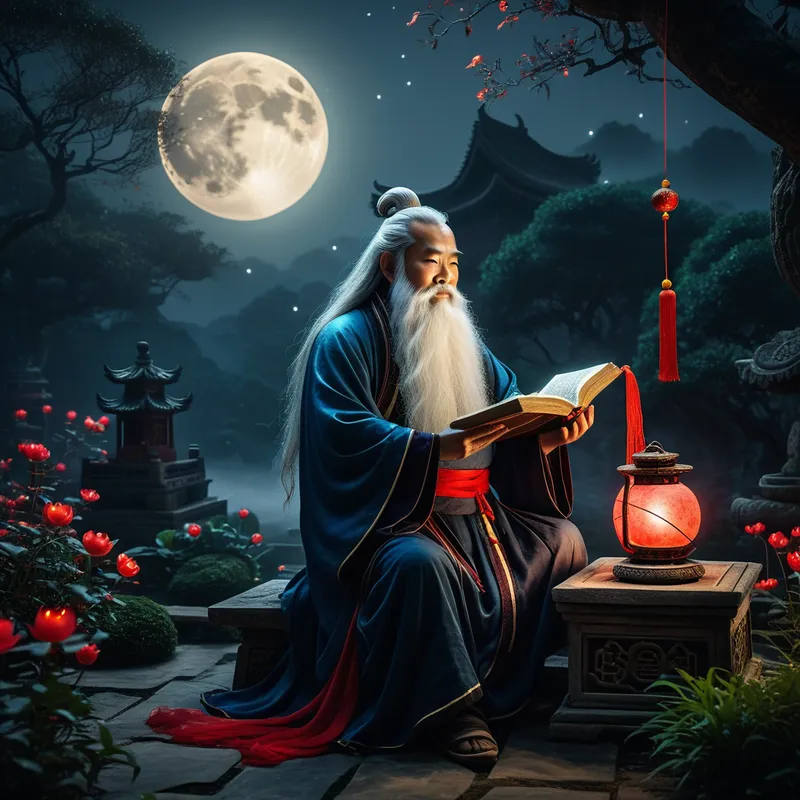
His path led him to the steps of the city’s great temple. There, in a pool of moonlight so bright it seemed liquid, sat an old man. His beard was the white of winter’s first snow, his robes simple yet imbued with a stillness that felt older than the stones beneath them. On his lap lay a massive, leather-bound book, its pages open to no script Wei Gu could decipher. Beside him, a single sack bulged with… something.
But it was not the book or the sack that arrested Wei Gu’s gaze. It was the thread. A coil of crimson silk, glowing with a faint, inner luminescence, rested in the old man’s hands. With infinite patience, the ancient one was tying one end of the thread around the ankle of a wailing infant, a girl-child left swaddled in the temple’s shadow. The other end of the thread vanished into the moonlit gloom, stretching toward an unknowable horizon.
“Old father,” Wei Gu ventured, his voice a whisper against the immense quiet. “What is this you do?”
The old man did not look up. His fingers, gnarled like ancient roots, continued their work. “I tie the thread,” he said, his voice the soft rustle of pages turning in an eternal library. “This is the thread of marriage. From the moment of birth, I bind a man and a woman with this cord. Though they be born of families at war, though continents and calamities lie between them, this thread will not break. It will shorten, it will pull, it will guide their steps until they stand face to face. Their feet are destined to become entangled. There is no escape.”
A cold thrill, part terror and part awe, shot through Wei Gu. Destiny, given form as a simple red string. “Then… tell me, I beg you,” he stammered. “Who is destined for me? Where is the other end of my thread?”
The Old Man of the Moon, Yue Lao, finally lifted his eyes. They held the depth of the night sky. Without a word, he gestured to the squalling infant. “Her,” he said.
Wei Gu’s world shattered. This? This beggar’s child, this mewling scrap of humanity, was to be his wife? Rage and disbelief, hot and bitter, flooded him. This was not the poetic union of his dreams. This was a cruel joke of the heavens. In a blind fury, he called for his servant. “Dispose of it,” he hissed, pointing at the child. The servant, terrified yet obedient, drew a dagger and lunged. The blade struck, but only grazed the infant’s brow before the servant fled, leaving the child bleeding but alive in the dark.
Years flowed like a river. Wei Gu rose, married another, built a life. Yet a phantom thread seemed to tug at his soul, a persistent, unanswered question. Then, he was sent to a distant province, where he met a governor of great repute. The governor had a daughter, of surpassing beauty and grace, who had captured the heart of every eligible man in the region. Yet, she always wore a singular ornament: a delicate pearl hairpin, placed with care over a small, crescent-shaped scar on her forehead.
At a banquet, drawn by a force he could not name, Wei Gu asked her the story of the scar. Her voice was soft as she recounted the tale told to her by her adoptive father, the governor. How she had been found as an infant on temple steps, left for dead with a knife wound on her brow. How he had taken her in and raised her as his own.
The room spun. The moonlight through the window seemed to laugh silently. The phantom thread in his soul pulled taut, a searing line of connection that led directly to the scar beneath her pearl pin. The Old Man’s words echoed in the chamber of his memory: “Their feet are destined to become entangled. There is no escape.” He had tried to cut the thread with a blade of arrogance, and had only succeeded in marking its beginning. The story of his life was not his own to write; it was a sentence already spoken, a knot already tied under the watchful eye of the moon.
Cultural Origins & Context
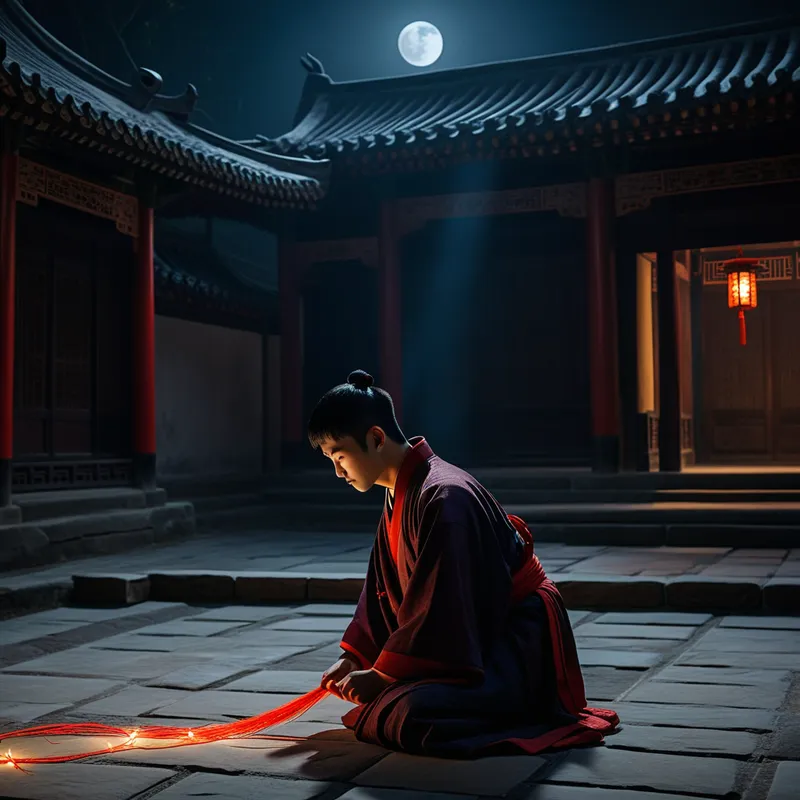
The myth of Yue Lao finds its earliest recorded form in the Gan Bao’s Records of an Inquest into the Spirit Realm (Soushen Ji) from the Tang Dynasty. It is a classic example of a zhiguai tale—a “record of the strange”—which served not merely as entertainment, but as a vehicle for exploring the permeable boundaries between the human and spiritual worlds, and for imparting moral and cosmological truths.
The story was passed down through oral tradition and literary collections, told by parents to children, by scholars to students, and by matchmakers to hopeful families. Its societal function was profound. In a culture where marriages were often arranged for social, economic, or political alliance, the myth of Yue Lao provided a powerful, comforting narrative of cosmic intentionality. It transformed a social contract into a sacred destiny. It assured individuals that their partner was not a random choice, but a soul pre-ordained by a celestial bureaucrat who kept the grand ledger of human hearts. This belief softened the edges of pragmatism with the gold leaf of fate, offering a romantic and spiritual justification for the union of strangers.
Symbolic Architecture
At its core, the myth of Yue Lao is a profound meditation on the nature of connection and the architecture of the unseen world that governs human relationships.
The red thread is not a chain of bondage, but the nervous system of the cosmos, a living filament through which the pulse of destiny is transmitted.
The Old Man of the Moon himself is an archetypal figure of the cosmic record-keeper, the divine administrator of the heart. His book is the Yuanfen Ce, the ledger of predestined affinity (yuanfen). He does not create love; he officiates a connection that already exists in the invisible order of things. His action is one of recognition and formalization, not invention.
The red thread is the central symbol. It is invisible yet unbreakable, delicate yet stronger than time or human will. It represents the intangible bonds of yuanfen—that complex, ineffable combination of destiny, chance, and shared karma that draws souls together. It is the physical manifestation of an emotional and spiritual tether. Wei Gu’s violent reaction symbolizes the ego’s rebellion against a fate it deems unworthy, its attempt to sever through force what can only be fulfilled through surrender and recognition.
The moonlit setting is crucial. The moon, in Chinese symbolism, is yin, feminine, reflective, and connected to the world of intuition, dreams, and the unconscious. Yue Lao operates in this liminal, silver light, indicating that the laws of connection are not of the rational, sunlit world, but are rooted in the deeper, intuitive, and often mysterious layers of existence.
The Dreamer’s Resonance
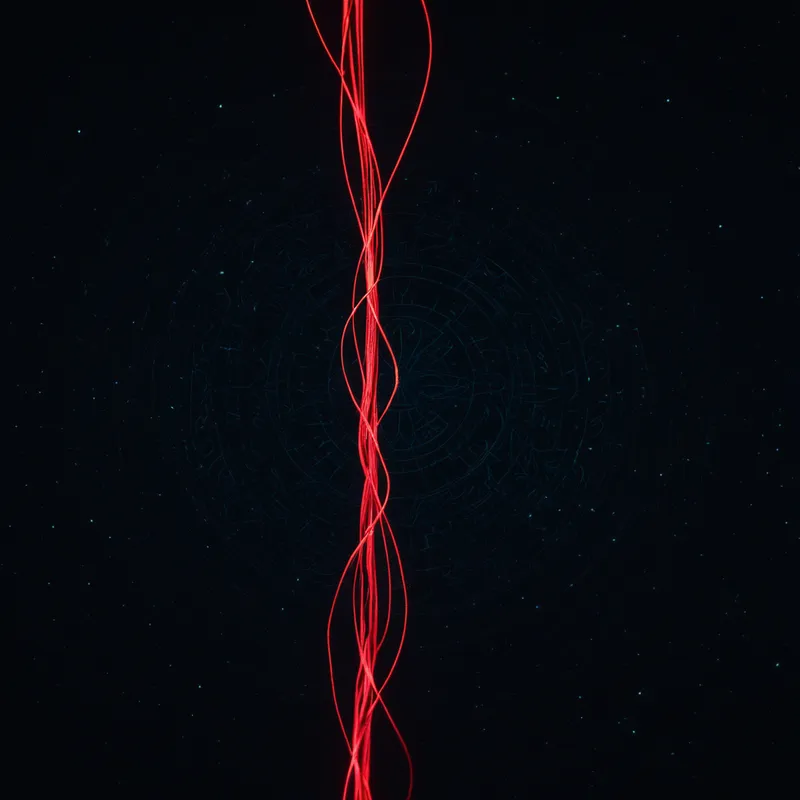
When the pattern of the Yue Lao myth stirs in the modern dreamer, it signals a profound somatic and psychological engagement with the archetype of destined connection. To dream of a red thread—tying your ankle, tangling in your hands, stretching into a fog, or connecting you to a distant, shadowy figure—is to feel the pull of the yuanfen in your life.
This is not necessarily romantic. It can manifest as dreams of an unseen tether to a lost friend, a destined career path, a place you feel inexplicably called to, or even a part of your own psyche from which you feel estranged. The somatic sensation is often one of a gentle, insistent tugging in the chest or solar plexus, a feeling of being guided or drawn. Psychologically, the dreamer is navigating the tension between conscious choice and unconscious calling. They may be resisting a relationship or a life direction that feels fated, wrestling with the Wei Gu inside them that wants to cut the thread with the dagger of logic, fear, or arrogance. The dream invites an acknowledgment of the invisible architecture that supports their life, urging them to trust the pull, even when its destination is obscured.

Alchemical Translation
The journey of Wei Gu is a perfect map of the alchemical process of psychic transmutation, specifically the integration of the anima (his destined feminine counterpart) and the surrender of the ego to the Self.
Individuation is the process of following the red thread back to the part of your own soul you tried to abandon, and recognizing it as your completion.
Initially, Wei Gu is in a state of nigredo, the blackening. He is alone, seeking externally for what he lacks. His encounter with Yue Lao is the first revelation of the lapis philosophorum, the philosopher’s stone—the hidden, perfect pattern of his soul. But his ego, in its inflated state, rejects this pattern because it does not conform to its idealized image. His command to kill the infant is the ultimate act of psychic murder, an attempt to destroy the nascent, vulnerable connection to his own wholeness.
The years that pass represent the long, slow work of albedo, the whitening—the purification through life experience. His marriage to another is a conscious, perhaps satisfactory, but ultimately incomplete union. The scar on the governor’s daughter’s forehead is the indelible mark of his earlier rejection, the wound he inflicted now returned to him as the identifying mark of his destiny. This is the moment of rubedo, the reddening. The thread becomes visible in the light of conscious recognition. The scar is not a flaw, but a sacred sigil, the proof of the thread’s endurance.
His final, stunned realization is the coniunctio, the sacred marriage. It is not merely a union with another person, but the integration of his shadow—his capacity for violence and rejection—and his anima, the feminine principle of connection and destiny. He surrenders to the pattern. The myth teaches that the alchemical gold, the achieved Self, is not found by writing our own story from scratch, but by deciphering the story that has already been written in the ledger of our deepest nature, and having the courage to live it. The red thread does not rob us of freedom; it is the very line that leads us home to our most authentic, and connected, self.
Associated Symbols
Explore related symbols from the CaleaDream lexicon: