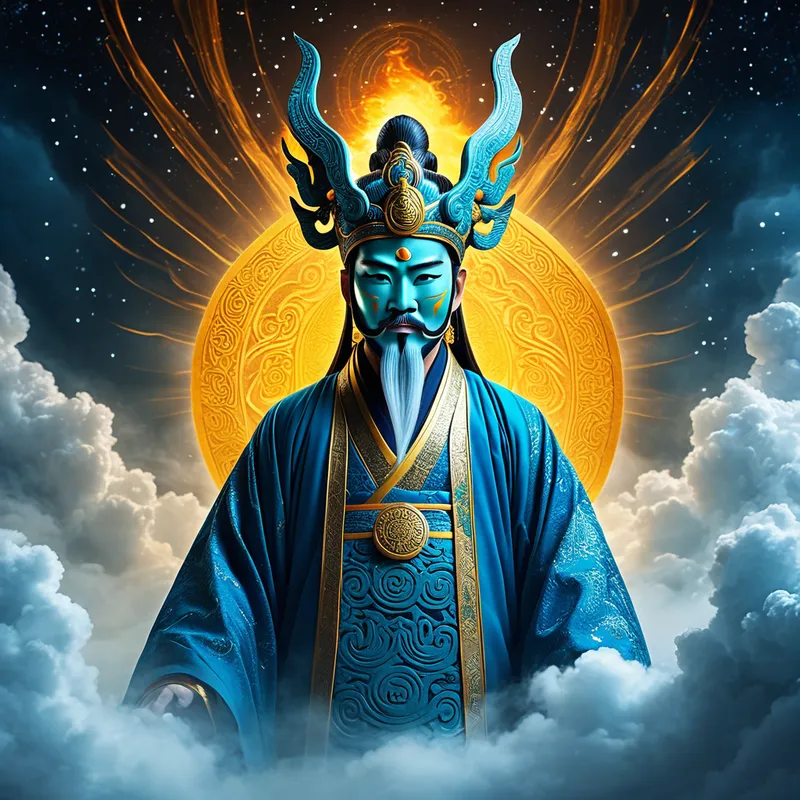
Yuanxiao Festival Myth Meaning & Symbolism
A tale of a celestial maiden, a grieving emperor, and a wise advisor who used lantern light and sweet rice balls to avert divine wrath and restore cosmic harmony.
The Tale of Yuanxiao Festival
Hear now the tale of a time when [the sky](/myths/the-sky “Myth from Persian culture.”/) wept fire and [the earth](/myths/the-earth “Myth from Hindu culture.”/) trembled in shadow. In the celestial courts of the [Jade Emperor](/myths/jade-emperor “Myth from Chinese culture.”/), a favored daughter, a maiden of the stars, grew weary of the eternal, perfect order of the heavens. Her heart, curious and warm, turned its gaze downward, to the vibrant, chaotic tapestry of the mortal world. One fateful day, disguised in mortal raiment, she slipped past the gates of heaven and descended to walk among the green fields and bustling villages.
There, she met a humble cowherd, a man whose songs were for the earth and whose hands knew the weight of honest toil. In his eyes, she saw a reflection not of distant stars, but of a simple, burning hearth—a warmth the cold palaces of heaven lacked. They fell in love, a union of celestial and terrestrial, and for a time, lived in blissful obscurity.
But the heavens are not so easily forsaken. The Jade Emperor, discovering his daughter’s absence and her mortal union, was consumed by a fury as cold and vast as [the void](/myths/the-void “Myth from Buddhist culture.”/). This was not merely disobedience; it was a cosmic transgression, a blurring of sacred boundaries. In his wrath, he commanded his celestial armies to retrieve her. The sky darkened with divine soldiers. The maiden was seized, torn from her mortal love’s arms, and dragged back to the high, lonely palaces, leaving the cowherd bereft on a suddenly grey and silent earth.
Yet, the Emperor’s fury was not spent. The mortal world, he decreed, had seduced and corrupted his heavenly kin. It must be purified. On the fifteenth day of the first lunar month, he would send a legion of fire dragons to breathe celestial flame across the land, reducing every village, every field, every memory of his daughter’s joy to ash and cinder. The decree echoed through the cosmos, and a dreadful silence fell upon [the world](/myths/the-world “Myth from Tarot culture.”/), a silence thick with the scent of coming smoke.
In the mortal capital, the Emperor of Han learned of this impending doom. Panic gripped his court. How does one plead with a god bent on annihilation? Among his advisors was a man named Dongfang Shuo, a scholar whose wisdom was as deep as the oldest well. He did not counsel armies or sacrifices. Instead, he walked the city, his mind turning like the slow grind of a millstone, seeking not force, but cunning.
His plan was born of empathy and trickery. He knew the heart of a father, even a celestial one. He sought out the household where the celestial maiden had served in disguise, a family named Yuan. There, he found a girl named Yuanxiao, who pined for her family, separated by duty. A spark ignited in the wise man’s mind. He instructed the Emperor to command every household, on the night of the destined doom, to hang red lanterns at their doors, set bonfires in the streets, and set afloat thousands of glowing lanterns on every river. The capital must become a sea of fire—but a fire of celebration, not destruction.
Furthermore, every family was to make and eat small, round dumplings of glutinous rice, filled with sweet paste. These were to be called yuanxiao. The Emperor’s daughter, the wise man whispered, would be tasked with preparing this “special heavenly dish” for her father.
On the appointed night, the Jade Emperor looked down from his throne. Instead of a dark, cowering world, he saw a breathtaking spectacle. The entire mortal realm was ablaze with countless points of light—crimson lanterns swaying like fiery blossoms, rivers of flame flowing through the streets, and constellations of light drifting on the dark waters. It appeared as if his celestial fire had already arrived, and the world was joyfully embracing its own destruction. And then, his daughter presented him with the sweet, round dumplings. As he tasted their comforting sweetness, his heart softened. The display, he was told by a clever messenger, was the world offering itself in joyful sacrifice, and the dumplings were named for the girl who missed her home. In that moment of perceived reverence and paternal sweetness, his wrath dissolved. The fire dragons were recalled. The world was saved not by battle, but by light, sweetness, and the clever mirroring of a father’s love.
Cultural Origins & Context
This myth, woven around the Lantern Festival, is a folk narrative that crystallized during the Han Dynasty (206 BCE – 220 CE). It was not a scripture of the state cult, but a story told by the people, for the people. It functioned as an etiological myth, a poetic “origin story” for the festival’s key rituals: the hanging of red lanterns, the lighting of bonfires, and the eating of glutinous rice balls. Passed down orally and later recorded in miscellaneous zhiguai (tales of the strange) and local chronicles, its primary tellers were likely community elders and festival storytellers.
Societally, it served multiple functions. It reinforced the cosmological order of Heaven and Earth while offering a narrative where that order could be negotiated through human wit and ritual. It transformed a mid-winter festival (likely with ancient roots in sun worship and driving away evil spirits with light and fire) into a deeply human drama about family separation and reunion, mirroring the real-life reunions that occurred after the New Year period. The myth provided a sacred reason for the communal joy, binding the community together in a shared performance of a story that averted cosmic disaster.
Symbolic Architecture
At its core, the myth is a profound [allegory](/symbols/allegory “Symbol: A narrative device where characters, events, or settings represent abstract ideas or moral qualities, conveying deeper meanings through symbolic storytelling.”/) of mediation and the reconciliation of opposites. The [celestial maiden](/symbols/celestial-maiden “Symbol: A divine feminine figure associated with the heavens, representing purity, guidance, and spiritual connection beyond earthly realms.”/) represents the [soul](/symbols/soul “Symbol: The soul represents the essence of a person, encompassing their spirit, identity, and connection to the universe.”/)‘s descent—[the divine spark](/myths/the-divine-spark “Myth from Gnostic culture.”/) that seeks experience in the messy, beautiful [realm](/symbols/realm “Symbol: The symbol of ‘Realm’ often signifies the boundaries of one’s consciousness, experiences, or emotional states, suggesting aspects of reality that are either explored or ignored.”/) of matter (the mortal world). Her forced return to [heaven](/symbols/heaven “Symbol: A symbolic journey toward ultimate fulfillment, spiritual transcendence, or connection with the divine, often representing life’s highest aspirations.”/) symbolizes the painful [tension](/symbols/tension “Symbol: A state of mental or emotional strain, often manifesting physically as tightness, pressure, or unease, signaling unresolved conflict or anticipation.”/) between [spirit](/symbols/spirit “Symbol: Spirit symbolizes the essence of life, vitality, and the spiritual journey of the individual.”/) ([heaven](/symbols/heaven “Symbol: A symbolic journey toward ultimate fulfillment, spiritual transcendence, or connection with the divine, often representing life’s highest aspirations.”/)) and instinct, [body](/symbols/body “Symbol: The body in dreams often symbolizes the dreamer’s self-identity, personal health, and the relationship they have with their physical existence.”/), and [relationship](/symbols/relationship “Symbol: A representation of connections we have with others in our lives, often reflecting our emotional state.”/) ([earth](/symbols/earth “Symbol: The symbol of Earth often represents grounding, stability, and the physical realm, embodying a connection to nature and the innate support it provides.”/)).
The lantern is not merely a light in the darkness; it is the conscious ego, a fragile vessel holding the flame of awareness, raised aloft to communicate across the great divide.
The [Jade](/symbols/jade “Symbol: A precious stone symbolizing purity, protection, and spiritual connection, often associated with wisdom, longevity, and harmony.”/) Emperor embodies the archetypal principle of absolute, rigid order. His [wrath](/symbols/wrath “Symbol: Intense, often destructive anger representing repressed emotions, moral outrage, or survival instincts.”/) is the [fury](/symbols/fury “Symbol: An intense, overwhelming rage that consumes the dreamer, often representing suppressed anger or a primal emotional eruption.”/) of a [system](/symbols/system “Symbol: A system represents structure, organization, and interrelated components functioning together, often reflecting personal or social order.”/) threatened by the [ambiguity](/symbols/ambiguity “Symbol: A state of uncertainty or multiple possible meanings, often found in abstract art and atonal music where clear interpretation is intentionally elusive.”/) of love and [choice](/symbols/choice “Symbol: The concept of choice often embodies decision-making, freedom, and the multitude of paths available in life.”/). Dongfang Shuo, the advisor, is the [archetype](/symbols/archetype “Symbol: A universal, primordial pattern or prototype in the collective unconscious that shapes human experience, behavior, and creative expression.”/) of the [Trickster](/symbols/trickster “Symbol: A boundary-crossing archetype representing chaos, transformation, and the subversion of norms through cunning and humor.”/)-Sage. He does not confront power directly but outwits it through symbolic [reflection](/symbols/reflection “Symbol: Reflection signifies self-examination, awareness, and the search for truth within oneself.”/). He understands that to change a god’s mind, you must speak in the god’s own [language](/symbols/language “Symbol: Language symbolizes communication, understanding, and the complexities of expressing thoughts and emotions.”/): spectacle and [symbol](/symbols/symbol “Symbol: A symbol can represent an idea, concept, or belief, serving as a powerful tool for communication and understanding.”/).
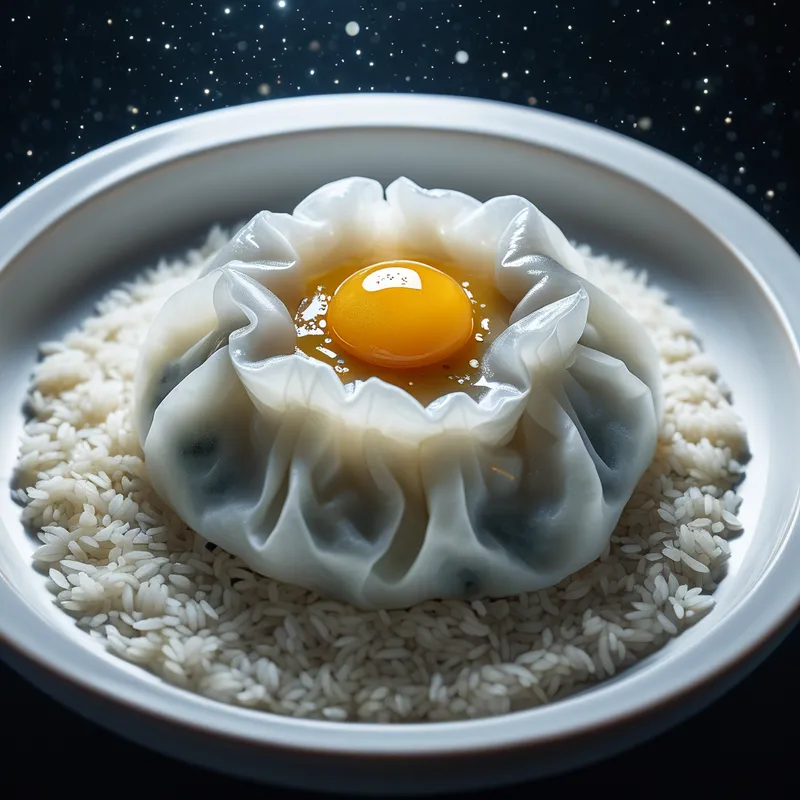
The yuanxiao dumpling is a perfect [mandala](/symbols/mandala “Symbol: A sacred geometric circle representing wholeness, the cosmos, and the journey toward spiritual integration.”/). Its round shape symbolizes wholeness and [reunion](/symbols/reunion “Symbol: A reunion symbolizes reconnection, healing, and the revival of past relationships and experiences.”/). The sweet filling hidden within the plain, glutinous exterior represents the hidden joy, the core of [sweetness](/symbols/sweetness “Symbol: Represents pleasure, reward, and positive experiences, often linked to emotional satisfaction and life’s enjoyable moments.”/) (the reunited [family](/symbols/family “Symbol: The symbol of ‘family’ represents foundational relationships and emotional connections that shape an individual’s identity and personal development.”/), the saved world) contained within the struggles of [life](/symbols/life “Symbol: The symbol of ‘Life’ represents a journey of growth, interconnectedness, and existential meaning, encompassing both the joys and challenges that define human experience.”/). The communal making and eating is an act of incorporating this wholeness.
The Dreamer’s Resonance
When this myth pattern stirs in the modern [psyche](/myths/psyche “Myth from Greek culture.”/), it often manifests in dreams of profound separation anxiety coupled with ingenious solutions. One might dream of a loved one trapped in a high tower (the celestial palace) while the dreamer frantically tries to send signals—flashing lights, ringing bells, or creating a vast, beautiful pattern on the ground visible from above. There is a somatic feeling of urgency in the chest, a creative desperation.
This dream state indicates a psychological process where a vital part of [the self](/myths/the-self “Myth from Jungian culture.”/)—one’s creativity, passion, or capacity for simple joy (the celestial maiden)—has been “recalled” by an inner tyrant, perhaps the critical superego or the demands of impersonal duty (the Jade Emperor). The psyche feels under threat of being “burned” by its own repressed ideals or rigid self-judgment. The dreamer is in the role of Dongfang Shuo, tasked not with direct rebellion, but with the clever, symbolic negotiation of this internal conflict. The dream is the psyche’s workshop for crafting its own “lanterns” and “yuanxiao”—symbolic acts or insights that can appease the inner tyrant and allow the lost part to return.

Alchemical Translation
The myth models the individuation process as one of symbolic transmutation. The initial state is one of painful dichotomy: spirit vs. matter, order vs. chaos, father vs. lover. The impending “celestial fire” represents the neurosis or psychic explosion that occurs when these opposites are held in unreconciled tension.
Individuation is not the victory of one principle over another, but the ritual that convinces the ruling consciousness to accept the previously rejected other.
The alchemical work is performed by [the ego](/myths/the-ego “Myth from Jungian culture.”/) (the mortal emperor and his advisor) in service of the Self (the need for wholeness). The advisor’s genius is his refusal to fight fire with force, but with its mirror image: celebratory fire. This is the key to psychic transmutation. One does not battle a complex (like the rigid, wrathful father-god) head-on; one meets it with its own energy, but redirected into a creative, symbolic form. Hanging a lantern is an act of saying to the unconscious, “I see your destructive potential, and I choose to shape it into a guiding light.”
Making and consuming the yuanxiao is the final, integrative stage. It is the internalization of the reconciled state. The round dumpling is the [lapis philosophorum](/myths/lapis-philosophorum “Myth from Alchemical culture.”/), [the philosopher’s stone](/myths/the-philosophers-stone “Myth from Alchemical culture.”/) of this myth. By consciously engaging in acts that create inner and outer harmony (the rituals), the modern individual performs their own psychic festival. They learn to illuminate the darkness not to banish it, but to show its shape; to sweeten life’s burdens by finding the hidden core of meaning within them; and ultimately, to reunite the celestial aspirations of the spirit with the earthly, heartfelt joys of being human.
Associated Symbols
Explore related symbols from the CaleaDream lexicon: