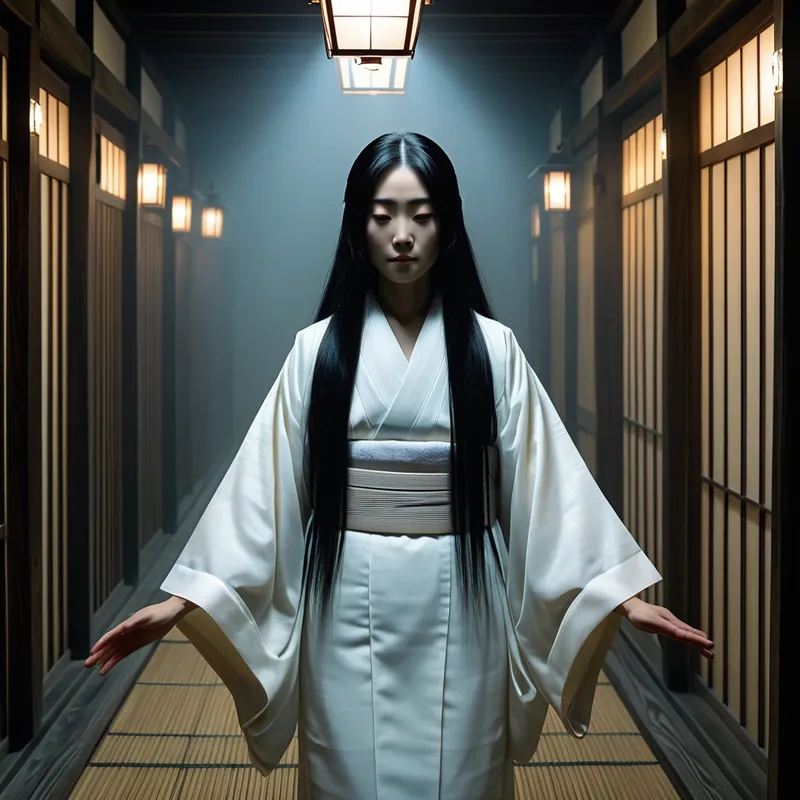
Yūrei Myth Meaning & Symbolism
The tale of a soul trapped between worlds by unresolved grief, rage, or injustice, seeking release through remembrance and ritual.
The Tale of Yūrei
Listen, and let the evening shadows grow long. This is not a story for the bright sun, but for the hour when the world holds its breath between day and night, the tasogare-doki. In a house of wood and paper, a silence settles, deeper than sleep. The air grows cold, a chill that seeps from the floorboards themselves. A faint scent of damp earth and fading incense arrives unbidden.
Then, a sound. Not a footfall, but the whisper of heavy silk dragging across polished wood. From the deepest dark of the hallway, a form emerges. It is a woman, yet not. She is clad in the white kimono of the dead, the kyōkatabira. Her feet do not touch the floor. Her long, black hair hangs like a curtain, obscuring a face you feel is turned toward you, heavy with an emotion so potent it has weight. Her hands are pale, limp, and tipped with shadows. This is a yūrei.
She does not speak, but her presence is a scream. The room fills with the memory of her story—a love betrayed, a life stolen, a promise broken, a grief so vast it could not be contained by the grave. She is bound here, to this place, this moment of her anguish. She floats, a testament to a knot in the fabric of life that was never untied. Her purpose is singular: to be seen, to have her pain acknowledged. She may reach out a hand, not to harm, but to connect across the impossible gulf. She may weep tears that are cold as winter rain. She is waiting. For an answer. For a name. For the performance of the forgotten rite, the offering of the missing senkō. Her story is a loop of suffering, playing eternally until the thread is cut, not by force, but by the sacred act of remembrance and release.
Cultural Origins & Context
The yūrei is not merely a ghost story; it is a profound expression of Japanese spiritual cosmology and social order. Its roots are deep in the syncretic soil of Shinto and Bukkyō. In Shinto, all things possess a spirit, a kami, and the human soul, or tama, is particularly potent. Buddhism introduced complex ideas of karma, attachment, and the cycles of rebirth. The yūrei exists at the dangerous intersection of these beliefs: a spirit unable to move on to the peaceful ancestor state or the next rebirth because it is held fast by powerful human emotions—onnen, shūnen, or a demand for justice.
These narratives were honed during the Edo period, told in whispered kaidan in flickering lantern light, and immortalized in woodblock prints by artists like Maruyama Ōkyo and in Kabuki theater. They served a crucial societal function. In a culture with strict codes of honor, familial duty (kō), and social obligation (giri), the yūrei was the ultimate consequence of their violation. It was the voice of the wronged, the forgotten, and the silenced, returning to rebalance the moral ledger where earthly justice had failed. The rituals to pacify them—proper funeral rites, memorial services (kuyō), and consistent offerings at the butsudan—were not superstition, but essential maintenance of the delicate harmony between the living and the dead.
Symbolic Architecture
Psychologically, the yūrei is the archetypal symbol of the unprocessed psyche. It is a complex of emotion—trauma, rage, heartbreak, injustice—that was not given its due, was buried alive in the unconscious, and now returns, autonomously, to haunt the halls of the self.
The ghost is not the memory of the past, but the past itself, alive and unassimilated, demanding payment on a debt of attention.
The white kimono symbolizes the shroud, the frozen state of the trauma. The long, unbound black hair represents the wild, uncontrolled nature of the repressed content, obscuring the “face” or true identity of the wound. The ghost’s typical lack of feet shows its disconnection from grounded reality and purposeful movement. It is stuck in a moment, a literal embodiment of being “haunted by the past.” Its specific form often reveals the nature of the complex: a drowned ghost (funayūrei) may speak of emotional overwhelm; one with a bandaged head, of unacknowledged mental anguish or shame.

The Dreamer’s Resonance
When a yūrei pattern manifests in modern dreams, the dreamer is encountering an active complex—a “ghost in the machine” of their own psyche. You do not dream of a yūrei; you dream the yūrei that you host. The somatic experience is key: the chilling air, the sense of oppressive dread, the paralysis, the feeling of being watched by an unseen presence in your own home (the psyche).
This is the psyche’s attempt at integration. The complex, previously dormant or ignored, has gathered enough energy to manifest. It appears not to harm, but to communicate. The haunting is a call for ritual attention. The dreamer is being shown the part of themselves that is bound, unresolved, and weeping in the shadows of memory. The specific setting of the dream—a childhood home, a former workplace, a dark alley—often holds the clue to the complex’s origin. The emotional tone of the ghost (sorrow, anger, accusation) is the very emotion the dreamer has disowned or failed to fully mourn.

Alchemical Translation
The journey with the yūrei is a profound alchemy of the soul, a model for individuation. The ghost is the prima materia, the leaden, heavy weight of unmetabolized experience. The process is not exorcism, but sacred hospitality.
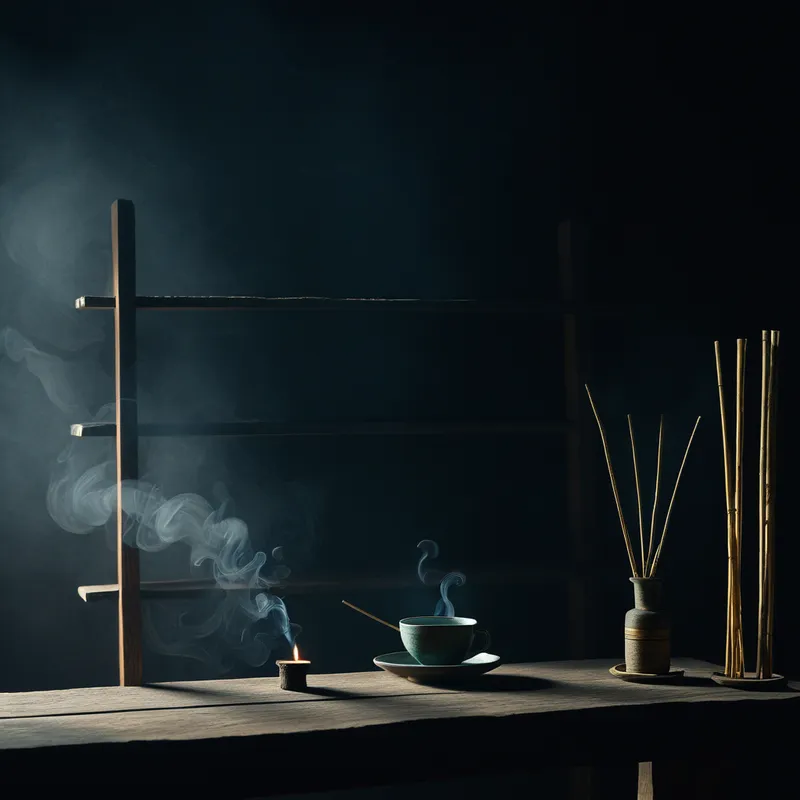
The work is not to banish the ghost, but to invite it to tea, to finally listen to the story it has been trying to tell for a lifetime.
First, one must turn and face the apparition, overcoming the instinct to flee. This is conscious acknowledgment of the wound. Then, one must listen. What injustice does it cry? What love does it mourn? What name does it seek? This is the stage of confrontation and understanding, giving language to the wordless pain. Finally, one performs the ritual of release. In the inner world, this may be the act of writing the unsent letter, of finally weeping the withheld tears, of symbolically offering respect and closure to a memory.
This completes the circuit. The energy bound in obsessive repetition (innen) is transformed. The ghost, having been witnessed and its truth honored, loses its form. The white kimono dissolves. The cold air warms. The complex is integrated, its energy now available to the conscious personality not as a haunting, but as wisdom, depth, and compassion. The soul is no longer fractured, but made more whole by having reclaimed its lost pieces. The silence that follows is not empty, but peaceful—the nirvana of a conflict resolved, a story finally laid to rest.
Associated Symbols
Explore related symbols from the CaleaDream lexicon: