Yowie Myth Meaning & Symbolism
A powerful ancestral being, the Yowie embodies the untamed wilderness, serving as a guardian of sacred boundaries and a reflection of our own primal, shadowed nature.
The Tale of Yowie
Listen. The land is not silent. It breathes with the stories of the First People, and in the deep places—the gullies choked with lawyer vine, [the mist](/myths/the-mist “Myth from Celtic culture.”/)-wrapped ranges where the rock meets [the sky](/myths/the-sky “Myth from Persian culture.”/)—something older than memory watches.
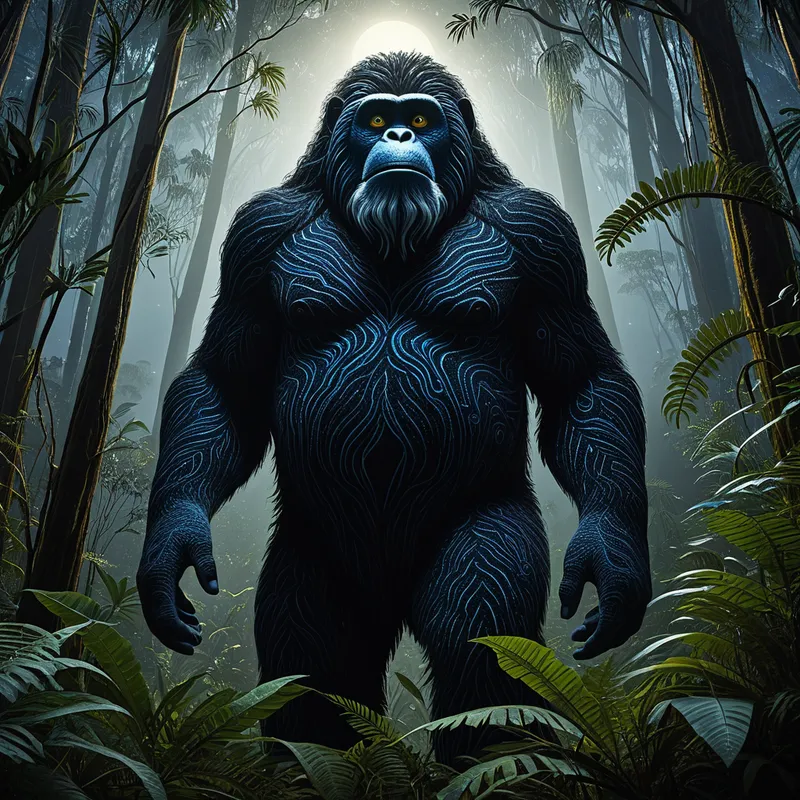
Before the first campfire was lit, when [the world](/myths/the-world “Myth from Tarot culture.”/) was still being sung into being, the Ancestors walked. Among them were beings of immense power, shaped from the very substance of the land. From the red earth and the ironbark, from [the shadow](/myths/the-shadow “Myth from Jungian culture.”/) of the towering karri and the silence of the stone, the Yowie was formed. It was not a man, nor was it a beast. It was a spirit of place, a living part of the country, as permanent and as formidable as the mountains themselves.
It moved through the world with a sound like boulders grinding deep underground. Its fur was the color of wet earth and shadow. Its eyes held the cold fire of distant stars, seeing not just the physical form of a hunter tracking a emu, but the intention in his heart, the respect—or lack of it—in his step. The Yowie did not hunt for food as men do. It was the guardian of the thresholds, the keeper of the lines between the sacred and the profane, the known camp and the forbidden places.
There was a man, a skilled hunter of the Gundungurra people. His name is lost to [the wind](/myths/the-wind “Myth from Various culture.”/), but his story remains. He was proud, and his success made him bold. He ventured further than the elders advised, chasing a prize beyond the marked trees, into a steep valley where the sun barely touched the floor. The air grew cold. The birds fell silent. He felt a presence, a weight of observation that pressed on his neck like a physical hand.
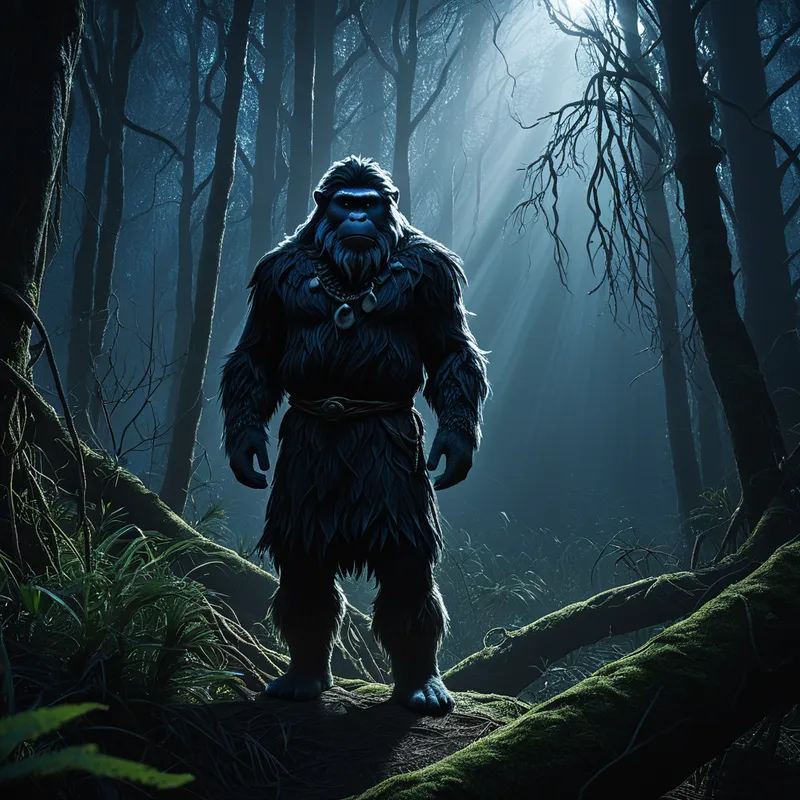
He turned. There, between two massive, moss-covered stones, stood the Yowie. It did not roar. It did not charge. It simply was—an embodiment of [the wilderness](/myths/the-wilderness “Myth from Biblical culture.”/) itself, regarding him. [The hunter](/myths/the-hunter “Myth from African culture.”/)’s spear felt like a twig in his hand. All his skill, his pride, drained into [the earth](/myths/the-earth “Myth from Hindu culture.”/). In that endless moment, he understood not with his mind, but with his bones: he was the intruder here. This was not a territory to conquer, but a presence to acknowledge.
The Yowie took one slow step forward, not in threat, but in declaration. Then, it melted back into the tapestry of shadow and stone, leaving only the crushing silence and the scent of crushed leaves. The hunter returned to his people, empty-handed. He was a changed man. He spoke little of what he saw, but his eyes held a new depth, a reverence for the line he had crossed and the guardian that enforced it. He had met [the law](/myths/the-law “Myth from Biblical culture.”/) of the land, and it had a face.
Cultural Origins & Context
The stories of the Yowie are woven into the fabric of numerous Aboriginal language groups across eastern Australia, from the rainforests of the north to the rugged ranges of the south. It is not a singular, monolithic myth, but a constellation of related narratives that speak to a shared understanding of the world. These are not campfire tales of mere monsters to frighten children; they are integral parts of Lore.
The Yowie belongs to the Dreaming. It is an ancestral being, a creator or shaper from that primordial time. Its stories are Songline, mapping both physical geography and moral law. Elders and knowledge keepers passed these narratives down through precise oral tradition, often in connection with specific sites—a particular rock formation, a hidden waterhole, a dense patch of forest. The telling of the Yowie story functioned as a vital cultural mechanism: it encoded environmental knowledge, demarcated territorial boundaries, and instilled a profound ethic of respect. It taught that the wilderness is not empty, but full of conscious, powerful presences that demand recognition and reciprocity.
Symbolic Architecture
At its core, the Yowie is the archetypal [spirit](/symbols/spirit “Symbol: Spirit symbolizes the essence of life, vitality, and the spiritual journey of the individual.”/) of the untamed. It symbolizes the part of [reality](/symbols/reality “Symbol: Reality signifies the state of existence and perception, often reflecting one’s understanding of truth and life experiences.”/)—and the part of the [psyche](/myths/psyche “Myth from Greek culture.”/)—that refuses to be domesticated, categorized, or controlled. It is the embodied “No” to [human](/symbols/human “Symbol: The symbol of a human represents individuality, complexity of emotions, and social relationships.”/) encroachment, the natural law that pushes back against unchecked [expansion](/symbols/expansion “Symbol: A symbol of growth, increase, or extension beyond current boundaries, often representing personal development, opportunity, or overwhelming change.”/).
The Yowie is not the enemy at the gate; it is the gate. It is the living threshold between the ego’s cleared space and the soul’s wild country.
Psychologically, it represents the [Shadow](/symbols/shadow “Symbol: The ‘shadow’ embodies the unconscious, repressed aspects of the self and often represents fears or hidden emotions.”/) in its most primordial, ecological form. This is not the personal [shadow](/symbols/shadow “Symbol: The ‘shadow’ embodies the unconscious, repressed aspects of the self and often represents fears or hidden emotions.”/) of repressed childish desires, but the collective, transpersonal shadow of our species: our raw, instinctual [nature](/symbols/nature “Symbol: Nature symbolizes growth, connectivity, and the primal forces of existence.”/), our deep [connection](/symbols/connection “Symbol: Connection symbolizes relationships, communication, and bonds among individuals.”/) to (and fear of) the non-human world, and the immense, autonomous power of the unconscious itself. The Yowie does not seek us out to destroy us, but it responds with formidable [presence](/symbols/presence “Symbol: Presence in dreams often signifies awareness or acknowledgment of something significant in one’s life.”/) when we blindly stumble into its domain—when we ignore the inner and outer boundaries that keep the psyche in balance.

The Dreamer’s Resonance
When the pattern of the Yowie emerges in modern dreams, it signals a confrontation with a foundational, often neglected, aspect of [the self](/myths/the-self “Myth from Jungian culture.”/). You do not dream of a Yowie when you are dealing with petty anxieties. You dream of it when you are approaching a profound inner frontier.
The somatic experience in such dreams is key: a feeling of being watched by something immense and ancient; the chilling silence of the natural world; the paralysis of awe and terror. This is the psyche’s way of saying, “Halt. You are at a limit.” The dream-Yowie might appear at the edge of a familiar backyard that suddenly drops into a wild ravine, or watching from a forest that has grown in the middle of a corporate office. This represents an autonomous complex—a bundle of thoughts, feelings, and memories—that has gathered enough psychic energy to become a numinous, commanding presence. The dreamer is undergoing a process of being forced to acknowledge a power within themselves or their life situation that they have been arrogantly ignoring or attempting to subdue. The encounter, while terrifying, is ultimately initiatory. It shrinks the inflated ego and re-establishes a necessary hierarchy, where the conscious mind is not the master, but the respectful visitor in the vast territory of the Self.
Alchemical Translation
The alchemical journey modeled by the Yowie myth is not one of heroic conquest, but of humbling encounter and integration. The modern individual’s path of individuation often requires a confrontation with this “wild guardian.”
[The first stage](/myths/the-first-stage “Myth from Alchemical culture.”/) is Encroachment: [the ego](/myths/the-ego “Myth from Jungian culture.”/), inflated by success, rationality, or a sense of control, ventures beyond its legitimate sphere. It ignores inner warnings (the “advice of the elders”) and seeks to claim more territory—more power, more certainty, more comfort—without deeper understanding.
This leads to the Confrontation: the meeting with the Yowie. In psychological terms, this is the eruption of the Shadow or a powerful complex into conscious life. It may manifest as a sudden depression, an irrational rage, a life crisis, or a crushing sense of meaninglessness that cannot be reasoned away. Like the hunter facing the Yowie, one’s usual tools and talents become useless. This is the [nigredo](/myths/nigredo “Myth from Alchemical culture.”/), the blackening, where the old attitude is dissolved in the face of a greater truth.
The resolution is not slaying the beast, but the Recognition. The transformation occurs in the moment of awe-struck humility, when the individual realizes, “This power is part of the landscape of my own being. I must relate to it, not rule it.” One withdraws, not in defeat, but in wisdom. The integrated outcome is a personality that carries this respectful fear—this sensus numinis—within it. The individual learns to navigate life not as a conqueror of inner and outer wilderness, but as a mindful inhabitant, aware of the sacred boundaries and the immense, watchful presences that maintain the balance of the world and the soul.
The alchemical gold forged in this encounter is not dominance, but a grounded humility that allows one to stand at the edge of the unknown, feel the gaze of the wild, and know one’s rightful place in the great and ancient order of things.
Associated Symbols
Explore related symbols from the CaleaDream lexicon: