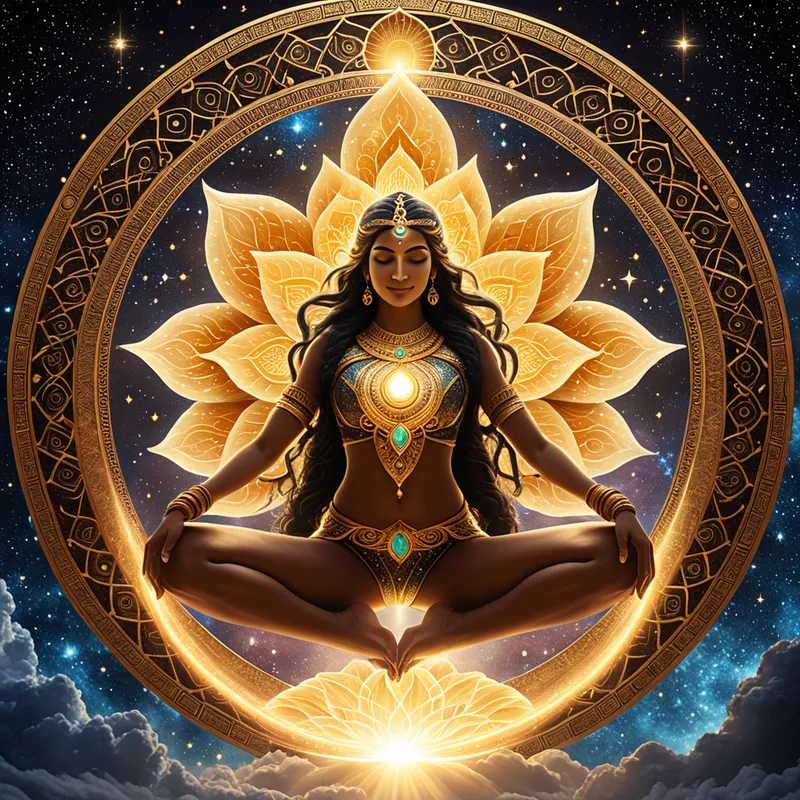
Yoni Myth Meaning & Symbolism
The myth of the divine feminine source, the cosmic womb from which all life emerges and returns, a symbol of ultimate creative power and sacred mystery.
The Tale of Yoni
Listen. Before the worlds were named, before time learned to flow in a river, there was only the One. A boundless, silent ocean of pure potential, a consciousness so vast and still it knew not itself. This was Brahman, the absolute. And within that perfect stillness, a tremor arose—not a sound, but the first longing for sound. A desire to know itself, to become two so it could behold one.
From this divine desire, a warmth kindled in the cosmic dark. This warmth coalesced into a presence of unimaginable power and grace: [Shakti](/myths/shakti “Myth from Hindu culture.”/). She was the first movement, the first vibration that would become the Om. She was energy itself, dynamic, creative, yearning to dance. Yet, without a witness, her dance was formless. She turned her gaze inward, to the very heart of the stillness from which she sprang.
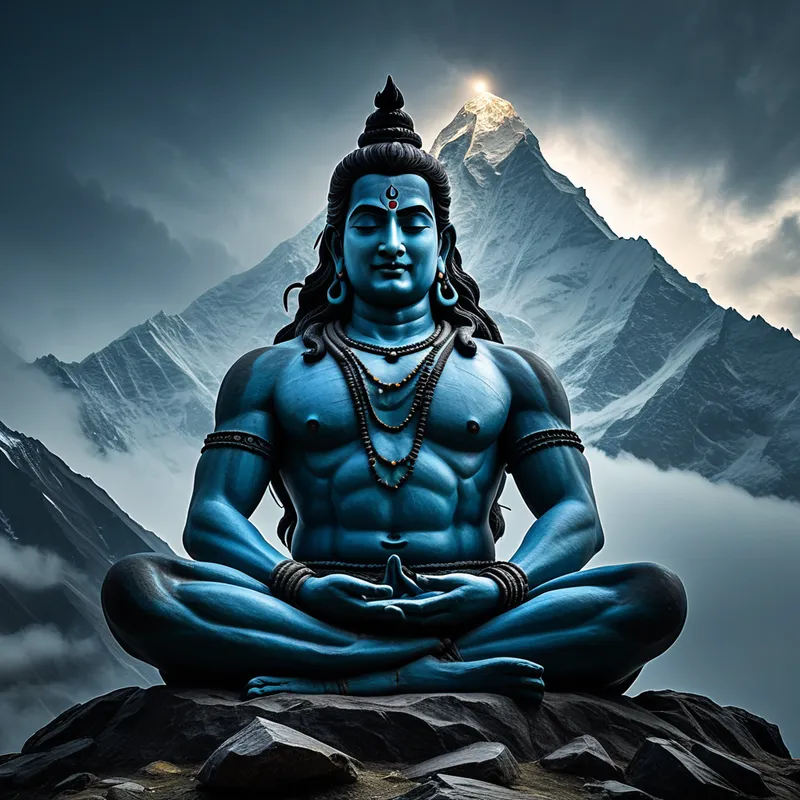
There, in the fathomless void, sat [Shiva](/myths/shiva “Myth from Hindu culture.”/). He was not a man, but the principle of pure, undifferentiated consciousness. His eyes were closed in eternal meditation, his body smeared with the ashes of universes past. He was the unmoving mountain, the silent center around which nothing yet revolved. Shakti, the cosmic energy, swirled around him like a tempest of starlight and possibility. She was life, he was the witness to life. She was the song, he was the silence that hears it.
Their separation was the great cosmic tension. The universe hung in the balance, a held breath. Shakti’s creative fury was boundless, but it scattered into [the void](/myths/the-void “Myth from Buddhist culture.”/) without a vessel, without a form to hold it. Shiva’s consciousness was infinite, but it remained unexpressed, a mirror with no image to reflect. The dance of creation could not begin.
Driven by the imperative of being, Shakti undertook the ultimate tapasya, a meditation of fierce concentration. She gathered all her scattered, brilliant energy, all her longing for manifestation, and focused it into a single, profound point of devotion—directed at the still form of Shiva. Her love was not gentle, but a torrential force, a lightning strike aimed at the heart of the mountain.
And the mountain stirred.
[The ascetic](/myths/the-ascetic “Myth from Christian culture.”/)’s [third eye](/myths/third-eye “Myth from Hindu culture.”/), the eye of inner perception, flickered open. In that timeless moment, the gaze of pure consciousness met [the force](/myths/the-force “Myth from Science Fiction culture.”/) of pure creative power. It was not a collision, but a recognition—a sacred recognition that they were not two, but one being seeing itself. In that ecstatic union, the cosmic tension resolved. Shiva’s transcendent stillness provided the stable, conscious space, the [lingam](/myths/lingam “Myth from Hindu culture.”/). Shakti’s dynamic energy became the active, generative matrix, the yoni.
From their union, from the meeting of the lingam and the yoni, a thunderous pulse of creative vibration exploded forth. The Big Bang of myth. That first pulse became rhythm, rhythm became form, form became the myriad universes, the galaxies, the oceans, the mountains, and every beating heart. The Yoni was not merely a part of Shakti; in that moment, she became the Yoni—the sacred source, the wound in the fabric of the infinite from which the finite world eternally pours forth. All of existence was born from that divine aperture, that holy gateway where consciousness and energy became one.
Cultural Origins & Context
The myth of the Yoni, intrinsically linked to the lingam-yoni, finds its roots deep in the pre-Vedic, indigenous soil of the Indian subcontinent. Its imagery speaks to an ancient, earth-based reverence for the generative powers of nature, particularly the feminine principle as the source of life. This was not a philosophical abstraction but a lived reality witnessed in caves, springs, and the fertile earth itself—natural apertures that were seen as literal and symbolic wombs.
This primal understanding was later woven into the grand tapestry of Shaivism and, most explicitly, into the esoteric paths of Tantra. Unlike orthodox paths that often sought transcendence from [the world](/myths/the-world “Myth from Tarot culture.”/), Tantra sought transcendence through the world. Here, the Yoni was elevated from a natural symbol to a supreme metaphysical principle. It was celebrated in temple iconography, not as obscene, but as the most sacred of murtis (icons). The Shakti Pitha temples, scattered across the land, are believed to mark places where parts of the goddess Sati’s body fell, with many housing self-manifested yoni stones. The myth was passed down through ritual, sculpture, and the oral teachings of gurus to disciples, functioning as a societal acknowledgment of the divine feminine as the active, indispensable force without which the masculine principle of consciousness remains inert and [the world](/myths/the-world “Myth from Tarot culture.”/) uncreated.
Symbolic Architecture
The Yoni is the ultimate [symbol](/symbols/symbol “Symbol: A symbol can represent an idea, concept, or belief, serving as a powerful tool for communication and understanding.”/) of [source](/symbols/source “Symbol: The origin point of something, often representing beginnings, nourishment, or the fundamental cause behind phenomena.”/). It represents the [matrix](/symbols/matrix “Symbol: A dream symbol representing the fundamental structure of reality, consciousness, or the self. It often signifies feelings of being trapped, controlled, or questioning the nature of existence.”/) of all possibility, the [crucible](/symbols/crucible “Symbol: A vessel for intense transformation through heat and pressure, symbolizing spiritual purification, testing, and alchemical change.”/) where the unmanifest becomes manifest. Psychologically, it maps onto the creative void of the unconscious itself—the dark, [fertile ground](/symbols/fertile-ground “Symbol: Fertile ground symbolizes potential, growth, and the promise of new beginnings, reflecting a state where life can thrive.”/) from which all thoughts, dreams, art, and new [life](/symbols/life “Symbol: The symbol of ‘Life’ represents a journey of growth, interconnectedness, and existential meaning, encompassing both the joys and challenges that define human experience.”/) phases emerge.
To encounter the Yoni is to stand at the threshold of your own becoming, where potentiality takes its first breath of form.
The myth beautifully diagrams a fundamental psychic [truth](/symbols/truth “Symbol: Truth represents authenticity, honesty, and the quest for knowledge beyond mere appearances.”/): [consciousness](/symbols/consciousness “Symbol: Consciousness represents the state of awareness and perception, encompassing thoughts, feelings, and experiences.”/) (Shiva) alone is passive and sterile. Raw, undirected [energy](/symbols/energy “Symbol: Energy symbolizes vitality, motivation, and the drive that fuels actions and ambitions.”/) or [emotion](/symbols/emotion “Symbol: Emotion symbolizes our inner feelings and responses to experiences, often guiding our actions and choices.”/) (Shakti) alone is chaotic and dissipative. It is only when consciousness provides a stable, witnessing [space](/symbols/space “Symbol: Dreaming of ‘Space’ often symbolizes the vastness of potential, personal freedom, or feelings of isolation and exploration in one’s life.”/) for that [energy](/symbols/energy “Symbol: Energy symbolizes vitality, motivation, and the drive that fuels actions and ambitions.”/)—when the lingam is received by the yoni—that true creation occurs. The Yoni, therefore, symbolizes the [vessel](/symbols/vessel “Symbol: A container or structure that holds, transports, or protects something essential, representing the self, emotions, or life journey.”/). It is the containing, shaping, nurturing principle that transforms raw potential into coherent [reality](/symbols/reality “Symbol: Reality signifies the state of existence and perception, often reflecting one’s understanding of truth and life experiences.”/). It is the [womb](/symbols/womb “Symbol: A symbol of origin, potential, and profound transformation, representing the beginning of life’s journey and the unconscious source of creation.”/) of the [psyche](/myths/psyche “Myth from Greek culture.”/) that gestates inspiration into [action](/symbols/action “Symbol: Action in dreams represents the drive for agency, motivation, and the ability to take control of situations in waking life.”/), [trauma](/symbols/trauma “Symbol: A deeply distressing or disturbing experience that overwhelms the psyche, often manifesting in dreams as unresolved emotional wounds or psychological injury.”/) into wisdom, and seed into [fruit](/symbols/fruit “Symbol: Fruit symbolizes abundance, nourishment, and the fruits of one’s labor in dreams.”/). It represents the sacred [space](/symbols/space “Symbol: Dreaming of ‘Space’ often symbolizes the vastness of potential, personal freedom, or feelings of isolation and exploration in one’s life.”/)—physical, emotional, and mental—that must be protected and honored for any genuine creation to take place.
The Dreamer’s Resonance
When the archetype of the Yoni stirs in the modern dreamer, it often signals a profound process of inner gestation or a call to acknowledge one’s creative source. One might dream of caves with hidden pools, of entering a mysterious room deep within a house, of discovering a secret garden gate, or of a glowing, geometric aperture in a wall. These are all symbolic yonis.
Somatically, this can correlate with feelings centered in the pelvic bowl—a sense of fullness, pressure, or quickening. Psychologically, the dreamer is likely at a precipice between a latent potential and its birth. There may be a creative project, a new identity, or a deep insight that is fully formed in the unconscious but has not yet found its passage into the conscious world. The dream Yoni can also appear when one’s personal “vessel”—their capacity to hold space for their own emotions, creativity, or relationships—feels damaged, blocked, or violated, calling for healing and reconsecration of one’s inner sanctum.

Alchemical Translation
The alchemical journey modeled by the Yoni myth is the process of giving conscious form to unconscious content. It is the core of Jungian individuation—not just having experiences, but consciously containing and integrating them to give birth to a more whole Self.
[The first stage](/myths/the-first-stage “Myth from Alchemical culture.”/) is recognizing the “Shiva” within: our detached, observing consciousness that can witness our inner chaos without being identified with it. The second is honoring the “Shakti”: the raw, often overwhelming energy of our emotions, drives, and creative impulses. The conflict and longing between them reflect our own inner split between mind and body, spirit and matter.
The alchemical marriage occurs not by eliminating one for the other, but by creating a sacred inner vessel—the psychic Yoni—where they can meet and unite.
For the modern individual, this translates to practical soul-work. It is the practice of creating a disciplined, regular space (meditation, journaling, therapy, artistic practice) that acts as the sacred yoni—the stable, receptive container. Into this container, we invite the chaotic “Shakti” energies of our day: our frustrations, our passions, our fleeting inspirations. We then apply the focused, witnessing “Shiva” consciousness to them. In that container, the two principles engage. The energy is not suppressed or acted out blindly; it is seen, held, and transformed. The result is not an explosion, but a creation: a clear decision born from processed emotion, a work of art born from refined passion, a compassionate response born from understood pain. We become, in our own small way, [the union of Shiva and Shakti](/myths/the-union-of-shiva-and-shakti “Myth from Hindu culture.”/), giving conscious birth to our world from the sacred source within.
Associated Symbols
Explore related symbols from the CaleaDream lexicon: