Yonaguni Monument Myth Meaning & Symbolism
A submerged stone structure off Japan's coast, whispered to be a drowned kingdom, challenging the boundary between human creation and the Earth's own dreaming.
The Tale of Yonaguni Monument
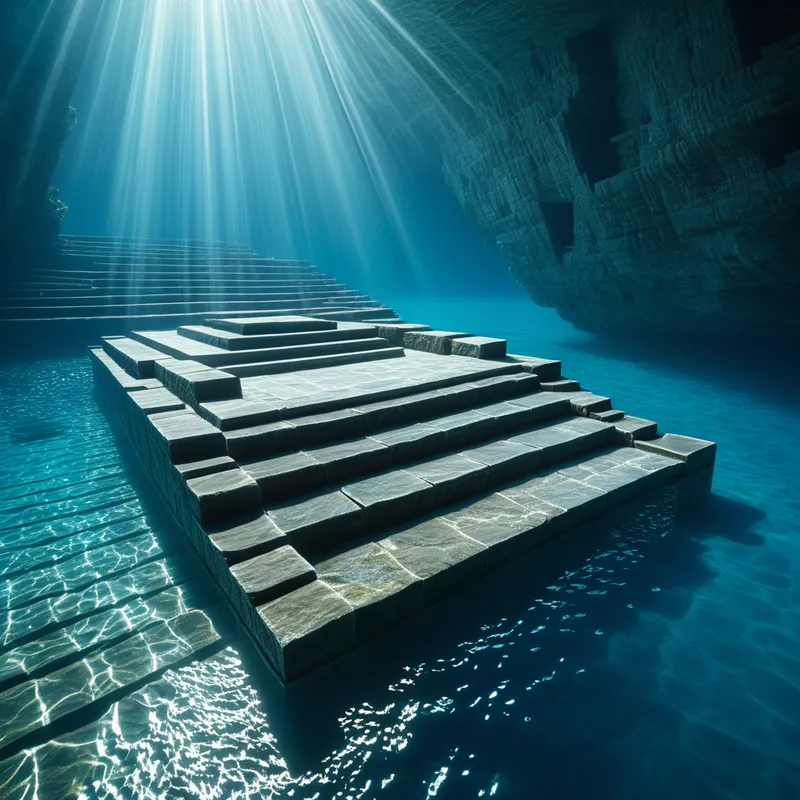
Listen, and let the salt of the story settle on your tongue. In the age when [the world](/myths/the-world “Myth from Tarot culture.”/) was still soft clay in the hands of greater beings, there existed a kingdom not of land, but of [the threshold](/myths/the-threshold “Myth from Folklore culture.”/). It was built where [the sky](/myths/the-sky “Myth from Persian culture.”/)-titan met [the sea](/myths/the-sea “Myth from Greek culture.”/)-mother, on the last island where the sun dipped its fiery head into the ocean’s bowl. This was not a place for mortals of simple earth and fire; it was a place for those who understood the language of stone and tide.
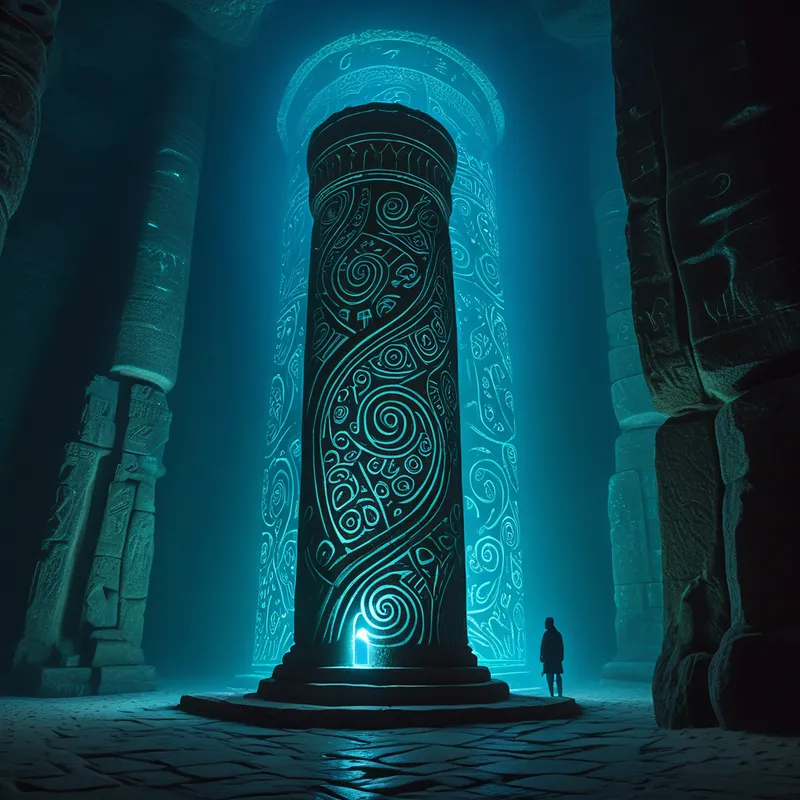
The people of this kingdom were the Kami-Ishi, the Stone-Spirits. They did not build upon [the earth](/myths/the-earth “Myth from Hindu culture.”/); they conversed with it. With tools of resonant crystal and songs that could soften granite, they persuaded the living bedrock to rise in homage—to form vast terraces like the steps of a giant, perfect portals framing the equinox sun, and monolithic pillars that sang when the deep currents passed through them. Their city, Shizumu Kado, was a tuning fork for the world, harmonizing the rhythms of [the moon](/myths/the-moon “Myth from Tarot culture.”/)’s pull with the slow, dreaming heartbeat of the continental plates.
But the sea-mother, Watatsumi, watched. She saw this orderly geometry, this stone poetry imposed upon her chaotic, fertile realm. She felt the songs of the Kami-Ishi as a vibration that stilled her wild children, the waves. A pact had been broken—the unspoken law that the deep shall remain formless, a womb of potential. In her silent wrath, she began to whisper to the great Ryū-No-Nemuri, [the dragon](/myths/the-dragon “Myth from Chinese culture.”/) whose slumber shaped the land.
One night, without storm or warning, the dragon stirred. The earth did not shake; it sighed. A great exhalation, a letting go. The island shelf upon which Shizumu Kado rested simply… descended. It was not a violent drowning, but a profound acceptance. The sea did not crash in; it rose in a gentle, inevitable embrace. The Kami-Ishi did not flee. They stood upon their terraces, their songs changing from ones of structure to ones of release, guiding their creation into the embrace of the deep. As the waters closed over the final pinnacle, the last note of their song transformed into the perpetual hum of the ocean currents, and their forms dissolved into the very stone they had loved.
Now, Shizumu Kado sleeps. It is a memory held in mineral, a dream the ocean itself occasionally glimpses and wonders if it dreamed it into being, or if the dream dreamed the ocean.
Cultural Origins & Context
The “myth” of Yonaguni is unique, for it is a story born not from ancient [papyrus](/myths/papyrus “Myth from Egyptian culture.”/) or oral epic, but from the late 20th century. Its bards are divers, geologists, archaeologists, and filmmakers. It emerged in the 1980s when the structure was discovered off the coast of Yonaguni Island, Japan. There is no traditional indigenous mythos attached to it; instead, the monument generated a myth directly into the global, technological consciousness.
This is a modern, collective myth-making in action. The “society” that tells it is global: internet forums, documentary channels, and academic debates. Its function is not to explain natural phenomena to a pre-scientific people, but to confront a post-modern humanity with a profound riddle. It serves as a societal [Rorschach test](/myths/rorschach-test “Myth from Psychological culture.”/). For some, it validates narratives of lost advanced civilizations (a global Atlantis trope). For others, it is a testament to the astonishing, artistic power of natural geological processes. The myth’s primary societal function is to hold the tension between two fundamental human drives: the need to find intentional design (the Creator) and the awe of sublime, accidental beauty (the unconscious processes of Nature).
Symbolic Architecture
At its core, the Yonaguni myth is about the Threshold. It is a physical and symbolic representation of the liminal [space](/symbols/space “Symbol: Dreaming of ‘Space’ often symbolizes the vastness of potential, personal freedom, or feelings of isolation and exploration in one’s life.”/) between categories we hold as absolute: natural vs. artificial, land vs. sea, [memory](/symbols/memory “Symbol: Memory symbolizes the past, lessons learned, and the narratives we construct about our identities.”/) vs. oblivion, [history](/symbols/history “Symbol: History in dreams often represents the dreamer’s past experiences, lessons learned, or unresolved issues that continue to influence their present.”/) vs. myth.
The [monument](/symbols/monument “Symbol: A structure built to commemorate a person, event, or idea, often representing legacy, memory, and cultural identity.”/)’s defining characteristic is its [ambiguity](/symbols/ambiguity “Symbol: A state of uncertainty or multiple possible meanings, often found in abstract art and atonal music where clear interpretation is intentionally elusive.”/). Are those steps or [sandstone](/symbols/sandstone “Symbol: A sedimentary rock formed from compressed sand, symbolizing gradual transformation, resilience through erosion, and the layering of time and experience.”/) bedding planes? Is that a carved face or a trick of [erosion](/symbols/erosion “Symbol: Erosion in dreams represents gradual decay, loss of structure, or the wearing away of foundations over time through persistent forces.”/) and pareidolia? This ambiguity is the myth’s greatest symbolic power.
The most profound truths are not found in the clear light of the surface, but in the murky, pressure-filled depths where certainty dissolves.
Psychologically, the monument represents the [collective unconscious](/symbols/collective-unconscious “Symbol: The Collective Unconscious refers to the part of the unconscious mind shared among beings of the same species, embodying universal experiences and archetypes.”/) itself—a vast, ancient, and structured substratum of the [human](/symbols/human “Symbol: The symbol of a human represents individuality, complexity of emotions, and social relationships.”/) [psyche](/myths/psyche “Myth from Greek culture.”/) that occasionally sends enigmatic formations (archetypes, intuitions, dreams) up toward the light of [consciousness](/symbols/consciousness “Symbol: Consciousness represents the state of awareness and perception, encompassing thoughts, feelings, and experiences.”/). We peer down and see shapes that seem hauntingly familiar, like a [city](/symbols/city “Symbol: A city often symbolizes community, social connection, and the complexities of modern life, reflecting the dreamer’s relationships and societal integration.”/) from a forgotten dream, yet we cannot definitively claim we built it. It is the [psyche](/myths/psyche “Myth from Greek culture.”/)’s own [architecture](/symbols/architecture “Symbol: Architecture in dreams often signifies structure, stability, and the framing of personal identity or life’s journey.”/), both ours and not-ours.
The act of [submersion](/symbols/submersion “Symbol: Being immersed or overwhelmed by water or another substance, often representing emotional engulfment, purification, or a return to primal states.”/) is not a catastrophe in the symbolic reading; it is an [integration](/symbols/integration “Symbol: The process of unifying disparate parts of the self or experience into a cohesive whole, often representing psychological wholeness or resolution of internal conflict.”/). The conscious, ordering principle of the Kami-Ishi ([the ego](/myths/the-ego “Myth from Jungian culture.”/)’s desire for [structure](/symbols/structure “Symbol: Structure in dreams often symbolizes stability, organization, and the framework of one’s life, reflecting how one perceives their environment and personal life.”/) and [legacy](/symbols/legacy “Symbol: What one leaves behind for future generations, encompassing values, achievements, possessions, and memory.”/)) is gently, inevitably reclaimed by the unconscious, creative, and formless sea (the [anima](/symbols/anima “Symbol: The feminine archetype within the male unconscious, representing soul, creativity, and connection to the inner world.”/) mundi). The myth symbolizes the necessary descent of conscious achievements back into the unconscious to be transformed, rather than remaining rigid and exposed on the arid land of literal meaning.
The Dreamer’s Resonance
When the imagery of Yonaguni surfaces in modern dreams, it signals a process of confronting psychic ambiguity and submerged history. The dreamer is often at a point of questioning the foundations of their identity or beliefs.
To dream of swimming over the monument is to explore the foundational structures of [the self](/myths/the-self “Myth from Jungian culture.”/). The clear [water](/myths/water “Myth from Chinese culture.”/) represents a moment of lucidity, where one can observe the often-hidden architecture of one’s personality—the “shoulds,” the inherited platforms, the stairways to nowhere. To dream of it in murky, dark water suggests these structures are felt somatically as a pressure or an obscure, looming presence, not yet visible to the mind’s eye. The body may feel the weight of deep water, a somatic echo of carrying unseen history.
Dreams where the monument is both clearly artificial and clearly natural, simultaneously, indicate the psyche working to reconcile a deep inner conflict—perhaps between logic and intuition, between a constructed [persona](/myths/persona “Myth from Greek culture.”/) and an authentic, wilder self. The dream is performing the alchemical coniunctio oppositorum (union of opposites) on a symbolic level. The emotional tone is rarely terror; more often, it is awe, profound curiosity, or a melancholic sense of witnessing something both immensely ancient and personally relevant.
Alchemical Translation
The individuation process modeled by the Yonaguni myth is not one of heroic conquest, but of humble recognition and integration. It is the path of the Sage, who seeks not to build higher towers, but to understand what is already there, submerged beneath the surface of daily awareness.
[The first stage](/myths/the-first-stage “Myth from Alchemical culture.”/) is Discovery—the shock of encountering an unknown part of the self. This is the diver’s first sighting. The ego is confronted with evidence of a vast, organized “other” within.
The core alchemical work is the Dissolution of Certainty. This is the prolonged debate: “Did I make this? Or did Nature?” Psychically, this is the struggle to own one’s complexes, talents, and wounds. Are my behaviors my own creation, or the product of ancestral, cultural erosion? The myth insists we hold the question, not jump to a conclusion.
The goal is not to drain the sea to prove the city is man-made, but to learn to breathe in the water where both truths coexist.
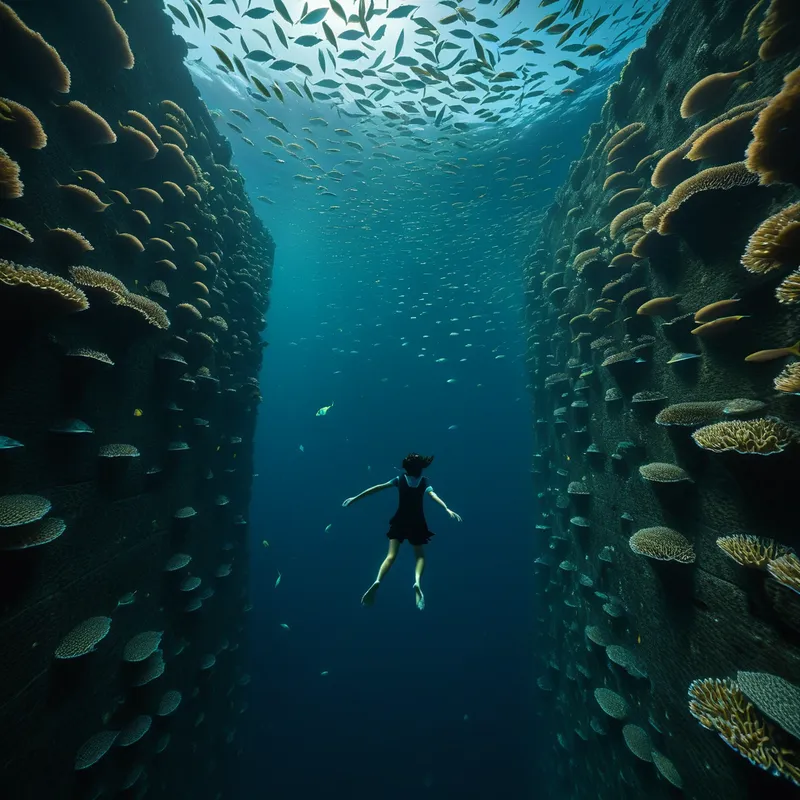
The final stage is Sacred Submersion. This is the Kami-Ishi’s choice to sing their structure into the deep. In psychological terms, it is the conscious decision to let a rigidly held identity, a treasured achievement, or a painful history be re-absorbed into the larger psyche. It is not annihilation, but transformation. The integrated self is like the monument itself: a beautiful, enigmatic whole that belongs as much to the dark, fertile depths of the unconscious as it does to the structured light of consciousness. It becomes a place where the inner currents flow freely, and the self is no longer a fortress on a hill, but a living coral reef in the soul’s ocean, part of a greater, breathing ecosystem.
Associated Symbols
Explore related symbols from the CaleaDream lexicon: