Yohualticitl Myth Meaning & Symbolism
The story of the Aztec goddess who guides the sun's corpse through the underworld, transforming death into the promise of dawn.
The Tale of Yohualticitl
Listen. The sun has died.
It is not a metaphor. It is the brutal, daily truth of the world. Every evening, as the western horizon drinks the last bloody light of Tonatiuh, a great corpse falls from the sky. It plummets, cold and heavy, into the mouth of the earth. The world is plunged into the absolute black of Mictlan. This is the moment of supreme peril. For if the sun is not tended to, if its journey is not guided, the dawn will never come again. The world will remain in the belly of the earth, forever.
But in that deepest dark, she is waiting.
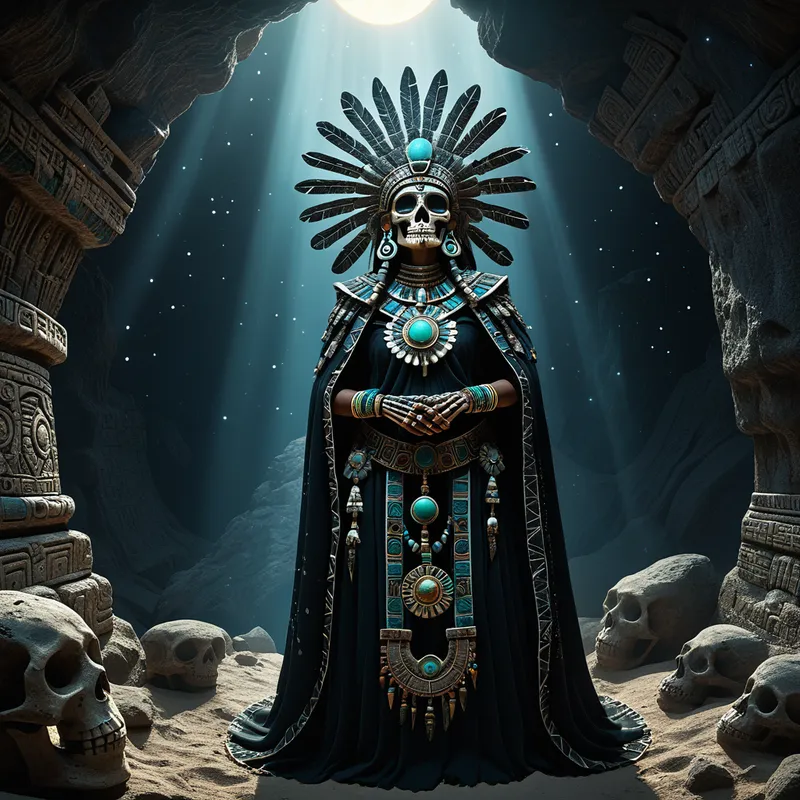
Her name is Yohualticitl. You will not see her in the flamboyant processions of the day gods. She dwells where sight fails, in the nine layers of Mictlan. Her form is that of bone, clean and stark, yet there is no horror in her. She is the midwife of the dead, the tender of the corpse. As the great solar body crashes into her realm, she does not flinch. She receives it.
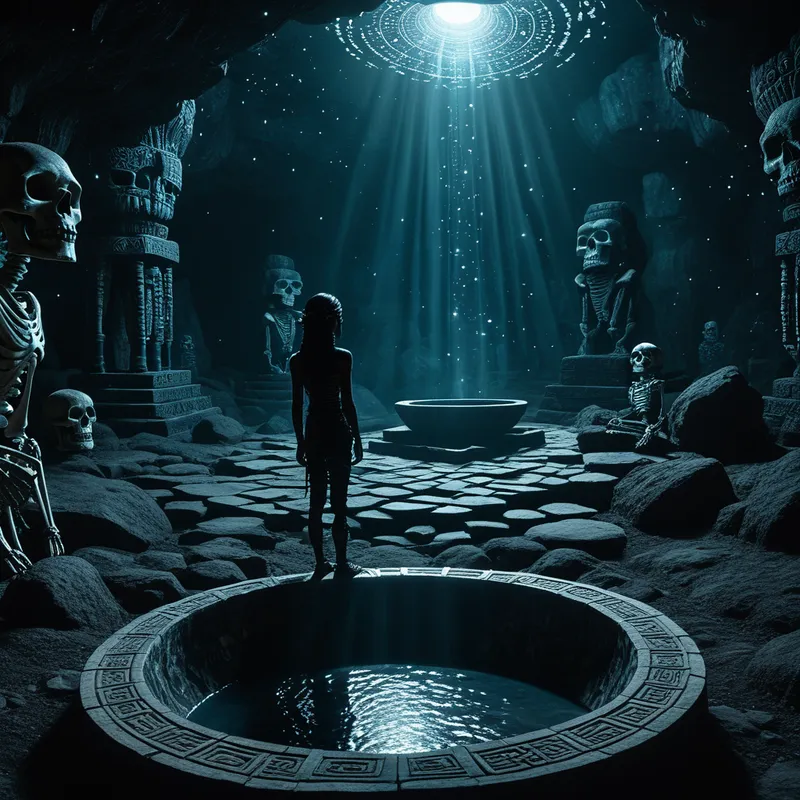
With skeletal hands that are infinitely gentle, she gathers the extinguished sun. She cradles it like a stillborn child, this massive, dark orb that once scorched the heavens. In her silent chambers, lit only by the cold phosphorescence of underworld gems, she begins her work. She washes the soot of the day’s battle from its surface. She anoints it with sacred waters that flow from the roots of the world. She sings to it—not a song of life, but a lullaby of transformation, a humming chant that speaks of dissolution and the patience of stone.
Through the long, terrible night, she carries it. She navigates the treacherous passes of Mictlan, past the clashing mountains, across the river of blood, through the field of obsidian winds. All the while, she tends the corpse. The lords of the underworld, Mictlantecuhtli and his consort, watch her passage. They understand her purpose. She is not stealing from them; she is performing the essential rite. She is midwifing the sun through its death, so that it may be reborn.
In the deepest pit, in the hour just before the world thinks it has been forgotten, her work culminates. The cleansing is complete. The death is fully digested. And within the cold husk, a new spark is kindled—not from outside, but from the very core of the transformation she has facilitated. She lifts the sun, now humming with a nascent, internal light, and begins the arduous ascent.
She pushes it, not upward, but eastward, through the labyrinthine intestines of the earth. And as her bone fingers finally breach the surface at the eastern horizon, she releases it. The sun, newborn, wet with the waters of the underworld, bursts into the sky. Dawn breaks. Yohualticitl does not linger to receive praise. She sinks back into her darkness, her task complete, waiting once more for the corpse to fall.
Cultural Origins & Context
The figure of Yohualticitl emerges from the rich, complex, and often terrifyingly pragmatic cosmology of the Mexica (Aztec) people. This was a worldview built on a foundational, non-negotiable truth: the cosmos was fragile, and the sun’s journey was a violent, cyclical struggle that required constant nourishment and intervention. Myths were not mere stories; they were the metaphysical blueprints for reality itself.
Yohualticitl’s role was likely preserved and transmitted within the vast body of knowledge held by the tlamatinime (the wise ones, the philosophers) and the ritual specialists. Her story would have been part of the deeper esoteric understanding of the priesthood, explaining the mechanics of what happened in the unseen world during the terrifying hours of night. While not a major deity of state cults with grand temples, her function was absolutely critical. She personified the essential, behind-the-scenes work that made the central drama of the sun’s battle possible. In a culture where midwifery was a sacred and highly skilled profession, the metaphor was potent: just as a human midwife guided a child from the dark womb into the light of the world, so did Yohualticitl guide the sun from the womb of the earth.
Symbolic Architecture
Yohualticitl is the archetype of the necessary darkness. She represents the part of the psyche—and the cosmos—that is not opposed to life, but is essential for its renewal. She is the container for dissolution.
The most profound rebirth is not an escape from death, but a full gestation within it.
Her skeletal form symbolizes stripping away the ephemeral—the flesh of the day, its passions, its victories, and its failures—to reveal the essential structure beneath. She is not decay, but the enduring framework that remains when all that is temporary falls away. The sun she tends is not just a celestial body, but the symbolic core of consciousness, identity, and vitality. Each “death” is the end of a cycle, a completion, a necessary burnout.
Her guidance through Mictlan is the symbolic journey of the core self through its own psychic underworld after a period of great expenditure, failure, or ending. She is the personification of the unconscious itself, not as a chaotic monster, but as a skilled, purposeful, if fearsome, caretaker. The washing and anointing are rituals of purification and reconsecration, implying that for a new beginning to be authentic, the old self must be thoroughly processed, not just discarded.

The Dreamer’s Resonance
When the pattern of Yohualticitl stirs in the modern dreamer, it often signals a profound, non-egoic process of psychic recuperation and transformation. One does not dream of her directly, but dreams within her domain.
The dreamer may find themselves in endless, dark labyrinths (office corridors at night, basements, subway tunnels) that feel simultaneously terrifying and strangely safe. They may be tending to a dead or broken object—a blackened lightbulb, a cold engine, a withered plant—with a sense of solemn duty. There is often a somatic component: a feeling of being weighed down, of moving through thick fluid, or of a deep, cellular fatigue that is not quite illness, but a profound rest. The emotional tone is not panic, but a heavy, sacred melancholy, a “dark night of the soul” in the truest sense.
This is the psyche enacting Yohualticitl’s ritual. The ego (the day-sun) has exhausted itself. The dream imagery shows the unconscious (the Night Midwife) taking the exhausted components of identity into its care for necessary dissolution and repair. The feeling of guidance in the darkness, even if the guide is unseen, is key. It is the dreamer’s system assuring itself that this descent has a purpose and a guardian.
Alchemical Translation
The alchemical process mirrored in this myth is the Nigredo. It is the first and most crucial stage, where the base material is reduced to black, chaotic matter. In psychological terms, this is the complete breakdown of the conscious attitude, the plunge into depression, despair, or meaninglessness. The ego experiences this as pure defeat.
Yohualticitl models the correct relationship to this stage. She does not resist the Nigredo; she is its priestess. For the individual, the alchemical translation is this: when you are in your “night,” your task is not to frantically strike sparks or curse the darkness. Your task is to submit to the process of being tended to by the deeper, unconscious self.
The work of the dark night is not to see your way through it, but to be worked upon by it.
This means allowing the dissolution—the grief, the stillness, the apparent barrenness. It means trusting that a part of you, far older and wiser than your daily identity, is holding the process. It is washing the corpse of your old ambitions, your failed projects, your outworn self-image. It is singing the lullaby of patience to your frantic mind. The promise of the myth is that if you can endure this guided dissolution, without aborting the process with false dawns or desperate distractions, a new light will be kindled from within the very material of the darkness itself. The rebirth is not a rescue from the underworld, but a direct product of its alchemy. You do not escape Mictlan; you are transformed by it, and emerge carrying its wisdom as the first light of a truer dawn.
Associated Symbols
Explore related symbols from the CaleaDream lexicon: